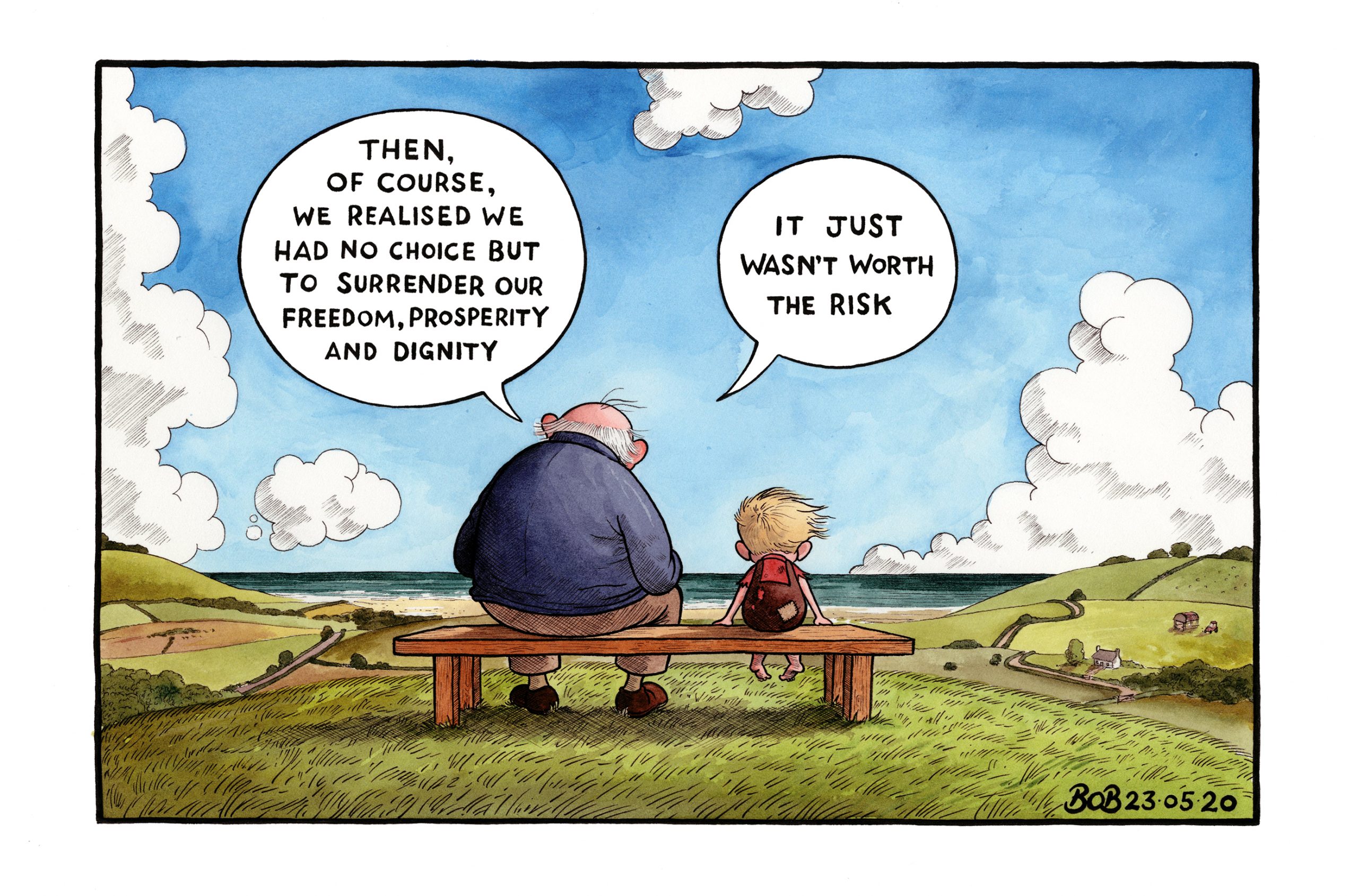
The double-negative morality of Leftism

The actuality of Leftist morality – and that it is inversion of the true, beautiful and virtuous – is revealed by describing the double-negative reality concealed by the pseudo-positive moral ‘principles’ used to justify Leftist evil.

Here is the way it works:

To be a ‘racist’ is = not to be anti-white

To be a sexist = not to be anti-men…

You see the way it works? Leftism is oppositional, being defined as ‘against’ various ‘evils’. Most of the Leftist ‘evils’ (often expressed as ‘-ist’ or ‘-phobic’) can accurately be described in a similar double-negative fashion:

Not to be anti-native inhabitants of a country…

Not to be opposed to biologically real, reproductively-adaptive sexuality…

Not to be anti-Christian… etc.

The double-negative formulation is a necessity for Leftism, since Leftism is indeed ultimately oppositional (opposing God and divine creation; opposing the true, beautiful and virtuous); thus its ‘positive’ content (i.e. what Leftists want) is protean and labile, self-contradicting and incoherent.

After all, there are an ‘infinite’ number of ways of opposing The Good.

To be morally excoriated by the Left, all that is required is to be against opposing the Good, in any particular respect.

Added – Double-negative denialism

For the sake of completeness, and to include two of the biggest recent double-negative global crusades. What do accusations of denialism amount to?

Climate denialism: Hatred of those people who do not regard carbon as the greatest threat to life on earth

Birdemic denialism: Terror of those who are not afraid of close proximity to human beings


Note: This idea was triggered by a post by William Wildblood, where he give a double negative definition of ‘racist’.

Explaining human altruism

Taken from here

Humans often behave altruistically towards strangers with no chance of reciprocation. From an evolutionary perspective, this is puzzling. The evolution of altruistic cooperative behavior—in which an organism’s action reduces its fitness and increases the fitness of another organism (e.g. by sharing food)—only makes sense when it is directed at genetically related organisms (kin selection) or when one can expect the favor to be returned (reciprocal altruism). Therefore, evolutionary theorists such as Sober and Wilson have argued that we should revise Neo-Darwininian evolutionary theory. They argue that human altruism evolved through group selection in which groups of altruists were naturally selected because they had a comparative advantage over other groups. Wilson and Sober’s hypothesis attracted followers but is rejected by most of their peers. The heated debate between advocates and critics of group selection often suffers from a lack of conceptual clarity. In response, I set out to clearly distinguish ‘genetic’ from ‘cultural’ group selection (developed by Boyd, Richerson & Henrich) and argue that the latter does not face the potentially debilitating problems plaguing the former. I defend the claim that human altruistic dispositions evolved through cultural group selection and gene-culture coevolution and offer empirical evidence in support. I also argue that actual altruistic behavior often goes beyond the kind of behavior humans have evolved to display. Conscious and voluntary reasoning processes, I show, have an important role in altruistic behavior. This is often overlooked in the scientific literature on human altruism.

Introduction

Humans often behave altruistically towards strangers with no chance of reciprocation. Many people donate blood and funds for the benefit of people they will never meet and often do so anonymously. In experimental settings, people often cooperate with strangers in one-shot prisoner’s dilemma’s (in which ‘defecting’ always yields a higher individual payoff) and offer something rather than nothing in dictator games to strangers (when they could have kept everything for themselves) (Camerer and Thaler 1995; Camerer 2003; Henrich et al. 2001; Fehr and Rockenbach 2004; Gächter and Herrmann 2009). Many people are also willing to incur costs to punish those who have harmed the group or others. This too is altruistic behavior. (Fehr and Gächter 2002a). While there is variation between cultures, altruistic behavior is a human universal (Gächter and Herrmann 2009; Vakoch 2013).

The question I pose in this paper is the following: why do humans often exhibit altruistic behavior towards non-kin with no chance of reciprocation? From an evolutionary perspective, this is puzzling. The evolution of altruistic cooperative behavior—in which an organism’s action reduces its fitness and increases the fitness of another organism (e.g. by sharing food) only makes sense when it is directed at genetically related organisms or when one can expect the favor to be returned. The first kind of altruism is referred to as ‘kin altruism’ and was elucidated by Fisher (1930), Haldane (1932) and Hamilton (1964) who understood that the altruistic organism was in fact increasing its evolutionary success since it was helping genetically related organisms. The second kind of altruism is known as ‘reciprocal altruism’ and was elucidated by Trivers (1971) who understood that the altruistic organism was in fact behaving in an ‘enlightened’ self-interested way since it could expect the favor to be returned in the future (Ruse 1979, p. 49).

Human altruism directed at non-kin with no chance of reciprocation cannot be satisfactorily explained in terms of ‘kin selection’ or ‘reciprocal altruism’. Behavioral and evolutionary scientists and philosophers of science have consequently looked for alternative explanations of human altruism. These explanations often invoke ‘group selection’. Influential scholars such as David Wilson (19752005) and Elliot Sober and Wilson (1998) have developed group selection accounts of human altruism and many have followed their lead. Group selection theories, however, remain very controversial and are strongly rejected by an important numbers of scientists and philosophers of science (e.g. Dawkins 1994; Dennett 1994; Maynard Smith 1998; Pinker 2012).

Amid the controversy, a promising account of the evolution of human altruism: cultural group selection and gene-culture coevolution, is often brushed aside for no good reason. Cultural group selection, however, does not face the problems associated with traditional group selection (henceforth: genetic group selection). Human altruistic dispositions, I will argue, evolved through a combination of cultural group selection leading to a highly cooperative niche characterized by prosocial norms and punishments and standard (individualistic) natural selection of (altruistic) psychological traits in this altered social environment (that rewards altruism and punishes free-riding and other anti-social behavior). Such an interaction between cultural and genetic evolutionary processes is referred to as ‘gene-culture coevolution’ by Boyd and Richerson (1985) and Richerson and Boyd (2005).

While this hypothesis provides us with a plausible and evidence-based explanation of the evolution of altruistic psychological dispositions, it cannot explain many instances of human altruism and moral behavior in general that evidently go beyond the kind of behavior for which these dispositions evolved. The evolutionary story only provides us with half of the story of why humans often behave altruistically towards non-kin with no chance of reciprocation. We must also consider the important role of conscious and voluntary reasoning processes in moral decision-making. This is often overlooked in the scientific literature on human altruism.

In this paper, I have three objectives. Firstly, I want to clearly distinguish between ‘genetic’ and ‘cultural’ group selection and argue that the latter does not face the potentially debilitating problems plaguing the former. This is important since many group selection accounts combine (and do not clearly distinguish between) genetic and cultural group selection. Secondly, I aim to provide a plausible account of the evolution of human altruistic dispositions in particular and human moral psychology in general and support my hypothesis with evidence. Finally, I aim to complete extant naturalistic explanations of human altruism that focus on its evolutionary underpinning, by showing and describing the important role of reasoning processes in altruistic behavior.

In Sect. 2, I elucidate the notion of altruism by distinguishing between biological and psychological altruism and discuss the proximate explanations of human biological altruism. In Sect. 3, I take on the ultimate explanation of human (biological) altruism: group selection. I distinguish between ‘genetic’ and ‘cultural’ group selection and argue that the latter—in conjunction with gene-culture coevolution—offers a theoretically satisfactory and empirically supported explanation for the evolution of human altruistic dispositions. In Sect. 4, I discuss the evidence for the existence of a highly cooperative cultural niche in which recent human evolution took place. In Sect. 5, I argue that evolutionary dynamics only provide us with a partial answer to the question why some humans behave altruistically towards strangers with no chance of reciprocation. When explaining altruistic human behavior (and norms) we must also take into account conscious and voluntary reasoning processes. In Sect. 6, I conclude.

Proximate explanations

Psychological versus biological altruism

What do I mean by altruism? In its vernacular sense, altruism refers to other-regarding and selfless acts and dispositions. Altruists (are predisposed to) engage in costly behavior aimed to benefit others without an ulterior selfish motive (such as enhancing one’s reputation or expecting the beneficiary to return the favor). In the scientific literature on altruism, however, altruism does not take on this vernacular sense but refers to either psychological or biological altruism. Psychological altruism is solely concerned with motives. It refers to the desire to benefit another. Biological (or evolutionary) altruism, on the other hand, is solely concerned with acts. It refers to acts that increase the fitness (the chances of survival and reproduction) of the recipient and decrease the fitness of the actor. The desire to share a candy bar is a matter of psychological altruism, while the act of sharing food qualifies as biological altruism (see Sober 1988; Sober and Wilson 1998; Ananth 2005).

Biological altruism is a common occurrence in the natural world. At all levels of complexity, organisms act in ways that reduce their own chances of survival and reproduction and increases the chances of survival and reproduction of other organisms. Most often, the beneficiaries of altruistic acts are offspring or genetically related organisms. This is referred to as ‘kin altruism’ and it makes good evolutionary sense. Enhancing the fitness of genetically related organisms enhances one’s own evolutionary success (i.e. the success an organism has in spreading its genetic material) since it helps organisms carrying similar genetic material to spread their genetic material. From a gene-centric perspective on natural selection (famously popularized by Dawkins 1976) kin altruism is readily understood: genes coding for altruistic behavior towards kin are great replicators (and can therefore be expected to spread), since they ‘help’ copies of themselves in other organisms (i.e. in those genetically related organisms).

Fisher (1930) and Haldane (1932) were the first to formalize this process of ‘kin selection’. It explains most instances of altruistic animal behavior, including its most extreme manifestations such as the sacrificing behavior of eusocial insects likes bees and ants for the hives and colonies (of genetically related organisms) they belong to. Later, Hamilton (1964) developed and formalized the concept of ‘inclusive fitness’. According to Hamilton, genes that underlie behavior that benefits a genetically related organism contribute to the inclusive fitness of that organism if the benefit is larger than the cost given the degree of relatedness. So, given that I share 50% of my genes with my brother (on average), my inclusive fitness goes up if my actions boost his fitness by a factor of 10 and reduce my fitness (the cost of my altruistic act) by less than 5.

Biological altruism towards non-kin is less prevalent, but it does occur. Some birds give warning calls when they spot a predator (thereby potentially attracting the attention of the predator), vampire bats share food with conspecifics that didn’t have a successful hunt, and meerkats routinely go on the lookout for danger (and also emit warning cries) while the others are foraging and feeding. In all of these cases, the immediate fitness (chances of survival and reproduction) of the actors decreases and the fitness of the recipient (and often non-related) group members goes up. Despite the fact that it decreases the (inclusive) fitness of the altruistic organism in the short term, such altruistic behavior evolved because it is reciprocal. The altruists are repaid the favor (and free-riders are denied future favors), so the altruist benefits in the long term (its fitness increases). Robert Trivers (1971) elucidated the concept of reciprocal altruism and showed that it is ‘enlightened self-interest’ (Ruse 1979, p. 49).

Humans, however, often engage in altruistic acts directed at strangers (non-kin) and with no chance of reciprocation. Evidence for this unique form of altruism (it has not been observed in any other species) can be found both in the field and in the lab. Many people donate blood and money, they offer their seat to unrelated pregnant ladies and help old people cross the street. All of these altruistic acts come with no expectation of reciprocation. In the lab, behavioral game-theoretic experiments—such as one-shot prisoner’s dilemma, public good games or dictator games played for real money—reveal that a sizable percentage of test subjects will indeed act altruistically towards total strangers. They forego a larger payoff to benefit the other player(s), even when they know that the recipients cannot repay the favor. Many participants will also give up part of their allocated sum in public good games to punish free-riders who do not contribute to the public good. (For an overview of these experiments and the results they yield: see Camerer and Thaler 1995; Camerer 2003; Fehr and Gächter 2002ab; Fehr and Rockenbach 2004; Gächter and Herrmann 2009).

Proximate explanations

What causes this peculiar behavior? Proximate explanations of human biological altruism—explanations in terms of the direct causes—are not hard to come by. Many people are endowed with psychological altruism or other-regarding preferences: they often desire to help another even if that comes at a personal cost. Furthermore, they possess a sense of fairness and a desire or a feeling of obligation to act fairly. Finally, they want to follow social norms that require them to act fairly and engage in altruistic acts or feel obligated to so. Evidence for these psychological preferences and their universality comes from diverse strands of research such as neurology, anthropology and developmental psychology.

Neuroimaging studies reveal that altruistic behavior activates brain regions that are associated with cognitive and emotional empathy and reward processing (Filkowski et al. 2016; Sonne and Gash 2018). Engaging in altruistic behavior stimulates the feel good hormones of the brain: dopamine, oxytocin and serotonin (Bruening 2016). In fact, in a clever experiment in which a large sample of people were randomly assigned to spend money on themselves or to spend it on others, Dunn and colleagues (2008) found that the group that was asked to spend it on others reported (significantly) greater happiness than the group that was asked to keep it for themselves. This evidence suggests that engaging in altruistic acts often follows from a genuine concern for others (emotional empathyFootnote1) and is inherently rewarding. This explains why many people behave altruistically (without expecting anything in return).

There is also good evidence that humans are endowed with an innate sense of fairness and a desire to act accordingly. Tomasello and colleagues found that young children possess a set of (innate) intuitions about distributive fairness. They tend to share spoils equally after having collaborated equally to obtain them—even if they could keep them for themselves (Warneken and Tomasello 2009; Warneken et al. 2011)—they understand and defend the entitlement of others (Schmidt et al. 2013), and give less to free-riders than to collaborators (Melis et al. 2013). According to Binmore (2005), a universal deep structure of fairness underlies human fairness considerations, analogically to Chomsky’s (1955) deep structure underlying natural language acquisition (the so-called ‘universal grammar’). In support of his claim, Binmore (2005) points at strong cross-cultural similarities in human fairness norms. This innate sense of fairness (present in very young children and in all cultures), explains why people would behave altruistically in certain contexts (such as proposing equal divisions in dictator games and cooperating in one-shot prisoner’s dilemma).

Finally, people tend to follow social norms. According to Bicchieri (2005, p. 42), they can be moved to do so for a number of reasons. Their compliance may be born out of fear of incurring reputation damage or of being punished (informally) by their peers for breaking the rules. People may also follow norms because they accord value to these norms or because they want to fulfill the legitimate expectations of others. Whatever the underlying reason, it stands beyond doubt that most humans have the inclination to follow social norms. As Bicchieri (2005, p. 55) rightly points out: if this were not the case, social norms could not exist. Interestingly, cross-cultural research with behavioral game-theoretic experiments gauging altruism and fairness in different societies, shows that the actions of participants in these games tend to mirror the patterns of interaction in their society (Gintis 2006, p. 26). In other words, participants often follow the social norms that govern the social interaction in their societies. The reason for many altruistic acts therefore may be that people follow social norms requiring them to act altruistically.

While these proximate explanations of human altruistic behavior—the underlying psychological features (and the neurological underpinnings)—are well documented and widely accepted, the same cannot be said for the ultimate explanation. Why did humans evolve such altruistic dispositions in the first place?

Group selection

Ultimate explanations of the evolution of altruistic dispositions, leading to behavior that benefits others in the group at the expense of the altruistic individual, often invoke group selection. The reasoning goes as follows: groups of altruists have a higher fitness than (and often outcompeted) groups of non-altruists. Therefore, altruistic individuals making up these successful groups, generously contributed to the genepool. Groups of non-altruists—on the other hand—eventually perished, so their members left no descendants. Darwin himself pointed this out:

When two tribes of primeval man, living in the same country, came into competition, if (other things being equal) the one tribe included a great number of courageous, sympathetic and faithful members, who were always ready to warn each other of danger, to aid and defend each other, this tribe would succeed better and conquer the other. (Darwin 1871, p. 166).

Ancestral human groups had much to gain with altruistic cooperation. Altruistic cooperation makes hunting more successful since it allowed ancestral humans to take down big game. It also reduces the risk of famine through food sharing. It provides a huge advantage when it comes to warfare: imagine a group of individuals willing to risk life and limb for the group facing a group of individuals not willing to do so (Bowles and Gintis 2011, pp. 3–4, Wilson 2005, p. 12). Finally, it allows for cooperative child rearing, in which ‘allo-parents’ share some of the long and arduous work to raise children. This raises the reproductive success of members in the group (Hrdy 2009). Given the large benefits produced by altruistic cooperation, it safe to assume that throughout human evolutionary history groups of altruistic cooperators would have thrived at the expense of groups of non-altruists.

However, any explanation that invokes the (natural) selection of traits that benefit the group at the expense of the individual faces an obvious challenge. The consensus among evolutionary biologists is that natural selection will retain traits in organisms that provide those organisms with an advantage in terms of survival and reproduction over conspecifics that do not possess these traits or possess them to a lesser extent. So how could altruistic traits have been selected? Free-riders would readily drive altruists to extinction within the group. They would profit from the altruism of others without bearing any of the costs of altruism and pass down their egotistical genes in greater numbers than the altruists would. Darwin (1871, p. 88) understood this too: “He who was ready to sacrifice his life, as many a savage has been, rather than betray his comrades, would often leave no offspring to inherit his noble nature.” So, how could such a trait evolve?

One possible explanation is that free-riding within groups is prevented and that natural selection driven by between group dynamics (selecting for group beneficial traits in individuals) offsets natural selection driven by within group dynamics (selecting for individually beneficial traits). This is Sober and Wilson’s (1998) view. They propose a so-called ‘multi-level selection’ account, claiming that not only genes and/or organisms are units of natural selection but also groups. While theoretically possible, this conjecture faces important and potentially debilitating problems (that I will mention below).

There is however another explanation for the evolution of altruistic dispositions in humans, which does not face these problems and is supported by extensive evidence. Between-group competition did not select directly for ‘altruistic genes’ in humans but selected (culturally not biologically) for strong prosocial norms in groups. These cultural features, in turn, have shaped a radically altered social environment in which altruistic traits are naturally selected because they boost the fitness of individuals. Such an explanation invokes cultural group selection (and gene-culture coevolution) rather than genetic group selection.

This distinction between ‘genetic’ and ‘cultural’ group selection is not always clearly made in the literature. Many accounts invoke both kinds of group selection. Sober and Wilson (1998, p. 147), for instance, argue that groups needed rules and regulations to become adaptive units (of natural selection). In other words, cultural group selection yielded rules and regulations, which then brought about a process of genetic group selection. Similarly mixed accounts have been proposed by others (e.g. Boehm 1997; Wilson and Kniffin 1999; Wilson 2005; Fehr and Gächter 2002b; Gintis et al. 2003; Bowles and Gintis 2011). This may have led sceptics (such as Pinker 2012) to dismiss any form of group selection, including cultural group selection, at the outset (while only offering arguments targeted at genetic group selection).

Genetic group selection

Sober and Wilson (1998, see also Wilson 2005) argue that individual natural selection cannot select for altruistic behavior because such behavior decreases the relative fitness of individuals within the group and would be selected against. Therefore, they conclude, it must have been naturally selected at the level of groups. The position they defend is often referred to as ‘multi-level selection’ (Sober and Wilson 1998; Okasha 2005): natural selection does not only act on the level of individuals, but also on the level of groups. Altruistic behavioral dispositions, by this rationale, evolved because natural selective pressure at the level of the group outweighed selective pressure at the level of the individual.

Simply put, advocates of explanations of altruism in terms of genetic group selection claim that altruistic dispositions evolved because altruistic individuals making up altruistic groups had greater reproductive success than less altruistic individuals making up less altruistic groups. Group selection in this explanation is acting directly on the genome. Such a position is not only championed by Sober and Wilson (1998), others followed in their wake (e.g. Okasha 2005; Fletcher and Doebeli 2009; Bravetti and Padilla 2018).

The obvious challenge to genetic group selection accounts of the evolution of human altruism is that individual selection is a prominent driver of evolution. It is hard to imagine that altruistic groups would not be invaded by free-riders outcompeting them and driving them to extinction. In response, genetic group selectionists invoke assortative interaction (Sober and Wilson 1998, p. 135) or correlated interaction (Okasha 2005). They rightly argue that if there are mechanisms in place so that altruists only interact with other altruists, they can avoid being ‘suckered’ and outcompeted by free-riders. Such altruistic clusters would then have a marked evolutionary advantage over less altruistic groups and their genetic endowment would spread in the human genepool. There is good evidence that humans did evolve cognitive faculties devoted to the detection of ‘cheaters’ (Cosmides and Tooby 2005) and to reputation tracking (Mealey et al. 1996; Oda 1997) together with altruistic dispositions. This would have protected altruists against the exploitation of free-riders and explains why reciprocal altruism occurs (not only in human groups but also in groups of other species such as certain bird species, vampire bats and meerkats, as pointed out above).

As critics have pointed out, however, postulating that there was genetic group selection of human traits requires us to make a series of additional assumptions that are problematic. First and foremost, it assumes that there was substantial genetic variation between human groupsand that there was limited migration between groups (which is necessary to sustain genetic variation between groups). Moreover, it assumes that there was a considerable rate of group extinction and that successful groups split up to form more groups (reproducing or replicating as organisms and genes do) (Maynard Smith 1976; Pinker 2012; Richerson et al 2016). Therefore, the majority of evolutionary scientists are highly skeptical of theories advocating genetic group selection of human traits. When the famous biologist Edward Wilson (not to be confused with David Wilson mentioned above) wrote an article in which he defended genetic group selection with colleagues Nowak et al. (2010), 137 scientists responded in a joint paper strongly contesting their views (Abbot et al. 2011).Footnote2 Reviewing the arguments and counter-arguments is beyond the scope of this paper. For our purposes, it suffices to say that—while the jury is still out—the majority of evolutionary scientists reject explanations of human altruism in terms of genetic group selection. What I will argue below is that we do not need to invoke this controversial evolutionary mechanism to explain human altruism.

Sober and Wilson (1998) are right—I believe—in claiming that between-group dynamics are the architect of certain remarkable human altruistic dispositions. We cannot explain the evolution of human altruistic dispositions solely in terms of inclusive individual fitness (given that it is often directed at non-kin) and reciprocity (given that it is often directed at people who cannot reciprocate). This, however, does not entail that we need to go up a level of natural selection (the group level). Contra Sober and Wilson (1998), I will argue that it is standard individual natural selection that selected for altruistic dispositions in humans. How is this possible? Doesn’t altruism reduce individual fitness and shouldn’t it therefore be selected against at the individual level? To answer this question, we must insert culture and cultural evolution into the equation.

Cultural group selection (and gene-culture coevolution)

Evolutionary processes do not only shape the genome of organisms, they also shape features of human cultures (such as beliefs, customs and norms). In previous work (Vlerick 20162020ab), I have developed a model of cultural evolution in which I identify within and between group dynamics as the main drivers of cultural selection. Within group dynamics select for cultural features that are psychologically attractive (or beliefs that are memorable) and are therefore taken up and transmitted by group members. Between group dynamics select for cultural features that provide the group with an advantage over other groups that do not possess these cultural features (or possess them to a lesser extent).

Between group dynamics select—among other things—for prosocial norms and punishments. This enhances the (altruistic) cooperation within the group (Vlerick 2020ab). In particular, competition between groups selects for norms (and punishments) that reduce conflict and enable and protect altruistic cooperation within groups (Aviles 2002; Boyd et al 2003; West et al. 2007; Puurtinen and Mappes 2009). The selective pressure arising from group competition is what Boyd, Richerson, Henrich and others refer to as ‘cultural group selection’ (Boyd and Richerson 19852002; Richerson and Boyd 1999; Henrich 2004; Richerson et al. 2016).

Several important factors underlie the cultural selection or proliferation of group beneficial social norms and punishments. In direct conflict between groups, other things being equal, the most cooperative group is more likely to be victorious and conquer the other group. In competition between groups over scarce resources, cooperative groups are likely to outcompete less cooperative groups (and survive while the other groups perish). More cooperative groups are also more likely to produce more wealth which throughout human history (until very recently) correlated with demographic expansion and can lead to the demographic swamping of less successful groups. Finally, individuals from less wealthy groups often migrate to wealthier groups and the customs and norms of successful groups are often imitated by less successful neighboring groups (Bowles and Gintis 2011, p. 50).

For all of these reasons, social norms underlying extensive (and altruistic) in-group cooperation are likely to proliferate. Ethnographic analogues suggest that Pleistocene hunter-gatherer groups possessed such complex sets of rules regulating the interaction of individuals within the group, that there were substantial differences (with respect to these sets of rules) between different groups and that there was frequent (competitive) interaction between groups (Hill et al. 2014; Richerson et al. 2016). In such a context, between group dynamics must have been a prominent driver of cultural evolution.

Because of this cultural evolutionary process driven by between group competition, societies emerged that were increasingly governed by prosocial norms and punishments. Such a social environment did in turn have a strong effect on the biological evolution of ancestral humans. It (naturally) selected for cooperative, norm-abiding and altruistic individuals. Prosocial norms and punishment in ancestral societies did not only ensure that free-riders did not get away with their cooperation eroding behavior (they are being punished) and that consequently altruism could be sustained within groups (Vlerick 20162020a), over time they also shaped the genome of the individuals inhabiting those societies. Because with such a normative framework in place, the egoists and the sociopaths are reliably punished (which included banishment and murder) for their anti-social behavior and would be less likely than norm abiding altruists to spread their (antisocial) genes.

In short, a culturally evolved highly cooperative niche radically changed the social environment in which human genetic evolution took place. It produced what Henrich (2016, p. 185) refers to as a process of ‘self-domestication’. Humans did not only domesticate animal species (e.g. turning wolves into dogs by selectively breeding with the most docile animals), they inadvertently did something similar to themselves. By consequently punishing egotistical, unruly and overly aggressive individuals and preventing them from spreading their sociopathic genes, humans were selectively ‘bred’ with those individuals that happened to have an inclination to follow social norms and behave altruistically.

This process is an instance of what Richerson and Boyd (19852005) call ‘culture-led gene-culture coevolution’. A culturally evolved social environment steered human genetic evolution. Human culture and biology co-evolved, leading to ever more altruistic humans. The key to explaining the strong altruistic dispositions of many people—inciting to them to behave altruistically towards strangers without expecting anything in return—lies in the uniqueness of this behavior in the animal kingdom. It evolved in response to an equally unique feature of human life: complex culture with prosocial norms and punishments, which in turn had the power to shape the human genome. Any account of the evolution of human altruism and human moral psychology in general that doesn’t take into account the cultural context in which this evolution took place—such as explanations solely in terms of genetic group selection—misses the central cause.

A culturally evolved highly cooperative niche

Human altruistic dispositions, I have argued, were naturally selected in social environments characterized by ever more stringent prosocial norms, extensive monitoring of group members and harsh punishment of those not abiding by these norms (harsh enough to decrease their reproductive success). In this culturally evolved context, norm abiding altruists had an evolutionary advantage over their more selfish and unruly peers. Any attempt to reverse engineer the environmental context in which traits evolved, however, invites the criticism of being ‘just-so-stories’. Therefore, in this section, I will discuss the evidence supporting my hypothesis.

Evidence

‘Sanctions for crimes against the collectivity’ features on Brown’s (1991) famous list of human universals. All current human societies have such (formal and/or informal) sanctions, including the few remaining hunter-gatherer societies. While anthropological evidence for the universality of prosocial punishment is of course no guarantee that ancestral human (hunter-gatherer) societies would have possessed such prosocial punishments, it is nevertheless a good indication that they had. According to Boehm (1997) and Bowles and Gintis (2011, p. 5), such prosocial punishments were facilitated by the possession of projectile weapons which enabled groups of people to collectively punish norm violators (e.g. by banishing or murdering them) at relatively low risk to each individual punisher.

However, as Henrich (2010, pp. 187–188) points out, punishment of norm violators in small-scale societies doesn’t typically take on this harsh form. It often starts with gossip and ridicule and—if the norm violator doesn’t redeem him or herself—punishment is ramped up leading to exclusion from marital prospects and from trading partners. Only as a last resort does it escalate to banishment, physical violence and coordinated group executions. Henrich (2010) finds support for the universality of such prosocial punishments in small-scale societies in studies on a wide range of different ethnic groups (see Boehm 1993; Chudek and Henrich 2011; Bowles et al. 2012; Mathew and Boyd 2011; and Wiessner 2005).

This is not surprising. Developmental research has brought to light that children are prone to punish rule breakers and free-riders at a very young age (Melis et al. 2013). This points at an innate human desire to punish rule breakers. Moreover, in all cultures people are socially reprimanded for violations of rules of conduct that do not actually harm anybody (such as violating a dietary taboo or ignoring a social convention). Demanding that others conform to the social rules and punishing (often in subtle ways) those who do not, seems to be deeply ingrained in human nature. The prevalence of such punishments combined with effective monitoring of social behavior would have reliably disadvantaged individuals less prone to follow social norms and individuals who repeatedly put their own interests before those of others.

Effective monitoring, in turn, is facilitated by reputation tracking and by exchanging social information. There is equally good evidence for the prevalence of these activities in all human societies. According to Trivers (1971) and Panchanathan and Boyd (2004), reputation tracking is another human universal. It is a common occurrence in all human societies and there is no reason to believe that it wasn’t equally prevalent in pre-agricultural societies inhabited by biologically modern human beings. According to Dunbar (1996) language evolved (gradually) in the human lineage for this very purpose. He proposes a so-called ‘gossip theory’ of the evolution of language, in which he argues that language evolved for social bonding and to exchange social information. Language enabled our ancestors to form close ties with a relatively large number of individuals (about 150 individuals according to Dunbar) and enabled them to acquire and transmit information to others. This protected them against the exploitation of free-riders (see also Enquist and Leimar 1993). In support of his hypothesis, Dunbar points out that ‘gossiping’ (exchanging social information) is still language’s most prominent function. A whopping sixty percent of casual human conversations are about other people (Dunbar et al. 1995).

From these strands of evidence emerges a picture of the societal context in which our recent evolutionary history took place: a context characterized by demanding (pro)social norms, incessant monitoring whether or not individuals abide by these norms and hard to escape punishments for those breaking the rules.

Maladaptive in modern contexts?

Tooby and Cosmides (1996, p. 122) and Dawkins (1976, p. 220) have argued that there is a mismatch between our ancestral social context—in which most interactions took place between genetically related individuals or closely acquainted, reciprocating individuals—and our modern social context, characterized by its many interactions between total strangers. Therefore, they argue, human altruistic dispositions were adaptive in our ancestral context (which is why they evolved), but are actually maladaptive in the modern context. They no longer increase the (long-term, inclusive) fitness of the individuals engaging in altruistic behavior but decrease it, since they lead people to behave altruistically towards total strangers with no chance of reciprocation.

By this rationale, people donate blood and funds to strangers and behave altruistically in one-shot prisoner’s dilemma and dictator games, because natural selection has hardwired them to behave altruistically (see proximate explanations of human altruism—Sect. 2). While this was adaptive in ancestral times, it is maladaptive in modern times. In other words, the reason why humans engage in these peculiar (and allegedly maladaptive) forms of altruistic behavior, is because their evolved social nature ‘misfires’ in a modern context. Compare it with our craving for sweet tasting food and drinks. These cravings were adaptive in ancestral times, where they motivated humans to consume ripe fruit containing the necessary carbohydrates and vitamin C, but are maladaptive in modern environments filled with cheap and unhealthy candy and soft drinks.

Under scrutiny, however, the mismatch hypothesis to explain human altruism does not hold up. Firstly, as Hill and colleagues (20112014) have pointed out, hunter-gatherer societies are relatively open social systems. In all likelihood, our ancestors would have interacted with an important number of people outside of their tribe (e.g. to trade). In other words, (paleo) anthropological evidence seems to refute the premise that our ancestors only interacted with kin and people to whom they were closely acquainted.

Moreover, I discern two important problems with Tooby and Cosmides (1996, p. 122) and Dawkins’ (1976, p. 220) mismatch hypothesis to explain human altruism. The first is that it seems to assume that people evolved to be indiscriminate altruists (leading them to behave altruistically towards non-reciprocating strangers today). This is not the case. As pointed out above, humans have evolved a range of cognitive skills and dispositions—such as a ‘cheater detection module’, the ability and desire to track the reputation of others and to exchange social information with others—precisely to be discriminate altruists. When people behave altruistically towards total strangers, they are not ‘fooled’ by a confusing modern context. They typically do so because they empathize with these strangers and decide it is the morally right thing to do.

This brings me to the second problem with the mismatch hypothesis (and most other evolutionary explanations of human altruism). It assumes that altruistic behavior is solely the result of evolved, ‘hardwired’ psychological mechanisms adapted to the ancestral social environment. As I will argue in the next section, underlying actual altruistic behavior are not merely evolved intuition and emotion-based dispositions but also conscious and voluntary reasoning processes. Many scientific accounts of human altruism ignoreFootnote3 the important role of these reasoning processes (or at least, the causal role of these reasoning processes remains underdeveloped in said accounts). They often look no further than the evolutionary rationale underlying altruistic behavior and miss a very important piece of the puzzle.

The role of reasoning

Moral decisions—such as the decision to cooperate in one-shot prisoner’s dilemma, propose fair divisions in dictator games and donate blood—are not merely the outcome of hard-wired emotion and intuition-based processes. They also involve reasoning processes. In a landmark experimental study subjecting participants to brain scans while presenting them with moral dilemmas, Greene and colleagues (2001) found that next to an emotional cognitive subsystem, we employ a reason-based cognitive subsystem in moral evaluation and decision-making. Whereas the emotional system often floods our moral thinking automatically and subconsciously, the reasoning system can in some cases override its output and generally takes over when presented with moral problems for which we have no ready-made, automatic, intuition or emotion-based response (see also Greene 2013 and Vlerick 2017).

Therefore, if we want to explain human altruistic behavior we should not only take into account the evolution of the intuition and emotion-based psychological dispositions (which I have described in Sect. 2 on ‘proximate explanations’). We must also take into account conscious and voluntary reasoning processes involved in moral decision-making. These reasoning processes, I will argue below, have a major impact on moral behavior in general and altruism towards out-group strangers in particular.

The ‘escalator’ effect of reasoning on morality

The moral behavior some people engage in is far-removed from the kind of behavior we would expect given the adaptive rationale of the psychological dispositions underlying this behavior. Our moral psychology, as argued above, evolved as an adaptation to a highly cooperative niche characterized by strong prosocial norms and punishments that orchestrated in-group interaction. In other words, our moral psychology evolved for altruistic cooperation within the groups in which we live. Yet humans routinely engage in altruistic acts directed at obvious out-group members (and even go so far as to behave altruistically towards non-human animals and future, unborn generations). This is puzzling.

Tooby and Cosmides (1996) and Dawkins’ (1976) attempt to explain this by arguing that our moral psychology ‘misfires’ in modern multicultural contexts is—as argued above—problematic. Western people who donate funds to starving Africans know very well that they are doing so for the benefit of ‘out-group’ individuals. They are not fooled by a confusing modern context, but consciously decide to help those in need, regardless of their culture or ethnicity (Vlerick 2017). This kind of moral behavior is not rooted in (intuition or emotion-based) psychological mechanisms which evolved for in-group (altruistic) cooperation. It is the outcome of conscious reasoning processes.

Peter Singer (1995, p. 226) refers to this as the ‘escalator of reason’. Reasoning about morality can lead to behavior and moral norms that are far-removed from the behavior for which our moral psychology evolved. Altruism towards strangers with no chance of reciprocation in the absence of any social expectation or potential reputation gain—such as anonymous charity donations, anonymous (and unadvertised) blood donations, cooperating in anonymous single shot prisoner dilemma’s with strangers and anonymous fair offerings in dictator games—is an instance of such behavior. These moral actions are not merely the output of hardwired psychological dispositions (which explains why many people do not engage in these altruistic acts). They often involve moral reasoning. Interestingly in this regard, a study has brought to light that altruistic behavior correlates with level of education (Westlake et al. 2019). The authors of the study surmise that people who benefited from a higher level of education might be better at internalizing prosocial norms. I would add that people who benefited from a higher level of education might also be better trained in reasoning about moral issues and reflecting on their moral behavior.

Norm abidance or reasoning?

A rival explanation for altruistic behavior that goes beyond the kind of behavior we would expect from an evolutionary perspective is that people just follow social norms that happen to impose or at least encourage this kind of altruistic behavior. So, rather than behaving altruistically after autonomous moral reasoning or reflection, people could simply be abiding by social norms or social expectations. This is a valid point. Norm abidance is indeed a major cause of altruistic behavior (see Sect. 2 on proximate explanations). As pointed out, data gathered from behavioral game-theoretic experiments in different cultural contexts shows that people tend to follow the social norms that govern their societies in these experiments (Gintis 2006).

However, social norm following does not explain all altruistic deeds. There is no social norm that requires people to donate blood in contemporary societies (people are not socially reprimanded for not donating blood), yet some people regularly volunteer to do so. While they might do so for a variety of reasons—including virtue signaling—moral reasoning is likely to be an important factor. Campaigns for blood donation typically try to persuade people to donate by presenting the public with arguments (e.g. ‘you can save lives’). In other words, these campaigns trigger moral reasoning processes in potential donators, hoping they will make a conscious moral decision to donate.

Moreover, even if many people engage in altruistic acts directed at non-kin with no chance of reciprocation because they abide by social norms or expectations, conscious reasoning processes are still part of the explanation of these altruistic acts. Most of these norms saw the light because individuals challenged the status quo through moral reasoning and because (many) others accepted the new moral imperative after evaluating the reasons offered in support of this imperative. It is only once a social norm is ‘established’ that people abide by it without reflection. Even in cases of social norm following, reasoning processes (albeit of others) are therefore still part of the picture. They explain why these norms arose in the first place.

An evolved moral compass powered by reason

So, in answering the question why humans routinely engage in altruistic behavior towards non-kin and with no chance of reciprocation, the evolution of altruistic dispositions only provides us with half of the explanation. In addition to evolved moral intuitions and emotions (such as empathy and norm abidance), we must take into account reasoning processes that underlie moral decisions and behavior. This however does not diminish the importance of the evolution of these altruistic dispositions in explanations of human altruism. Reasoning processes—which are content-free—will not lead to moral behavior by themselves. They must latch onto ‘moral’ and ‘altruistic’ psychological dispositions such as a sense of fairness (Binmore 2005) and empathy.Footnote4

These evolved psychological dispositions provide our moral reasoning processes with a direction. They provide us with what I have called ‘an evolved moral compass’ in previous work (Vlerick 2017). Such a moral compass powered by reason—I have argued—is the driver of moral progress. Without reasoning processes there would be no way to challenge the moral status quo. Singer’s ‘escalator’ would disappear. Without an innate (intuition and emotion-based) moral compass, reasoning would not lead to moral or altruistic behavior. In the absence of these prosocial dispositions, it is safe to assume that we would apply our reasoning processes in our self-interest and the interest of close kin. What explains the uniqueness of human altruism—the fact that it is often directed at non-kin with no chance of reciprocation—is precisely this powerful combination of a highly prosocial nature (adapted to a highly cooperative social context) and our ability to take our prosocial behavior to the next level by reflecting on moral norms, decisions and behavior.

Conclusion

Human altruism is exceptional in the animal kingdom. In no other species has widespread (biological) altruism directed at non-kin, with no chance of reciprocation, been observed. This remarkable behavior has puzzled evolutionists since Darwin and attempts to explain human altruism have created a lot of confusion and debate. It has led many scholars to develop group selection theories, which in turn have been heavily criticized. Explanations of human altruism are still the subject of much (and heated) debate today, but often the debate suffers from a lack of clarity. It is not always clear what exactly ‘group selection’ refers to and different scholars use it in different ways. As Maynard Smith (1998) rightly points out in his review of Sober and Wilson’s (1998) ‘Unto others’—in which they develop their group selection account of human altruism—the discussion has often turned semantic, with quarreling parties mainly disagreeing on the appropriate terminology rather than the underlying processes they describe.

In response, I set out to create some much needed clarity to this incendiary debate by clearly distinguishing genetic from cultural group selection. The latter does not face the difficulties associated with the former and (together with gene-culture coevolution) provides us with an empirically supported hypothesis of the evolution of the strong altruistic dispositions of humans. Evolved psychological dispositions, however, do not suffice to explain many instances of actual human altruistic behavior. The final aim of this paper, therefore, was to complete extant scientific explanations of human altruism that have focused solely on its evolutionary underpinning. If we want to make sense of human altruism, we must take into account conscious and voluntary reasoning processes, creating—as Singer (1995) has called it—an ‘escalator’ effect on moral behavior and norms. Underlying the uniqueness of human altruism are two equally unique human attributes: the social norms and punishments that govern our societies and the reasoning processes we unleash on the evaluation of moral norms and decisions.

Notes

  1. 1.

    See Bateson (2011) for an extensive account of how empathic concern produces altruistic motivation.

  2. 2.

    The response paper by Abbot et al. (2011) is situated in the debate about the evolution of eusociality. Nowak et al. (2010) argued against Hamilton (1964) that the evolution of eusociality (for instance among bees and ants belonging to the same hive or colony— see above) cannot be satisfactorily explained by invoking kin-selection and inclusive fitness. They believe that eusociality evolved primarily through genetic group selection. Abbot and colleagues (2011) respond that Hamilton’s (1964) theory stands and that the evolution of eusociality can and should be explained in terms of inclusive fitness.

  3. 3.

    With the notable exception of Darwin (1871, p. 185–186) who identifies the following causes of the advance of morality: “the approbations of our fellow men-the strengthening of our sympathies by habit—example and imitation—reason—experience, and even self-interest—instruction during youth, and religious feelings” (my italics).

  4. 4.

    Tomasello and colleagues (2005) argue that human empathy (rooted in a theory of mind) leads to ‘self-other equivalence’. In contrast to other primates, humans view their conspecifics as ‘other selves’ which are fundamentally no different than oneself, rather than viewing them as mere elements of the social environment.

References

  1. Abbot, P., et al. (2011). Inclusive fitness theory and eusociality. Nature, 471(7339), E1–E4.

    Article Google Scholar

  2. Ananth, M. (2005). Psychological altruism vs. biological altruism: Narrowing the gap with the Baldwin effect. Acta Biotheoretica, 53, 217–239.

    Article Google Scholar

  3. Aviles, L. (2002). “Solving the freeloaders paradox: Genetic associations and frequency dependent selection in the evolution of cooperation among nonrelatives. PNAS, 99(22), 14268–14273.

    Article Google Scholar

  4. Bateson, C. D. (2011). Altruism in humans. Oxford: Oxford University Press.

    Google Scholar

  5. Bicchieri, C. (2005). The grammar of society: The nature and dynamics of social norms. New York: Cambridge University Press.

    Google Scholar

  6. Binmore, K. (2005). Natural justice. Oxford: Oxford University Press.

    Google Scholar

  7. Boehm, C. (1993). Egalitarian behavior and reverse dominance hierarchy. Current Anthropology, 34(3), 227–254.

    Article Google Scholar

  8. Boehm, C. (1997). Impact of the human egalitarian syndrome on Darwinian selection mechanics. The American Naturalist, 150(Suppl.), 100–121.

    Article Google Scholar

  9. Bowles, S., Boyd, R., Mathew, S., & Richerson, P. J. (2012). The punishment that sustains cooperation is often coordinated and costly. Behavioral and Brain Sciences, 35(1), 20–21.

    Article Google Scholar

  10. Bowles, S., & Gintis, H. (2011). A cooperative species: Human reciprocity and its evolution. Princeton: Princeton University Press.

    Google Scholar

  11. Boyd, R., Gintis, H., Bowles, S., & Richerson, P. (2003). The evolution of altruistic punishment. PNAS, 100(6), 3531–3535.

    Article Google Scholar

  12. Boyd, R., & Richerson, P. (1985). Culture and the evolutionary process. Chicago: University of Chicago Press.

    Google Scholar

  13. Boyd, R., & Richerson, P. (2002). Group beneficial norms can spread rapidly in a structured population. Journal of Theoretical Biology, 215, 287–296.

    Article Google Scholar

  14. Bravetti, A., & Padilla, P. (2018). An optimal strategy to solve the Prisoner’s Dilemma. Nature, Scientific reports, 8, 1948.

    Article Google Scholar

  15. Bruening, L. (2016). Habits of a happy brain: Retrain your brain to boost your serotonin, dopamine, oxytocin and endorphin levels. Avon, MA: Adams Media.

    Google Scholar

  16. Brown, D. (1991). Human universals. New York: McGraw-Hill.

    Google Scholar

  17. Camerer, C. (2003). Behavioral game theory: Experiments in strategic interaction. Princeton: Princeton University Press.

    Google Scholar

  18. Camerer, C., & Thaler, R. (1995). Anomalies: Ultimatums, dictators and manners. Journal of Economic Perspectives, 9(2), 209–219.

    Article Google Scholar

  19. Chomsky, N. (1955). Logical syntax and semantics: Their linguistic relevance. Language, 31(1), 36–45.

    Article Google Scholar

  20. Chudek, M., & Henrich, J. (2011). Culture-gene coevolution, norm-psychology and the emergence of human prosociality. Trends in Cognitive Sciences, 15(5), 218–226.

    Article Google Scholar

  21. Cosmides, L., & Tooby, J. (2005). Neurocognitive adaptations designed for social exchange. In D. M. Buss (Ed.), Handbook of evolutionary psychology (pp. 584–627). Hoboken, NJ: Wiley.

    Google Scholar

  22. Darwin, C. (1871). The descent of man and selection in relation to sex. London: John Murray.

    Google Scholar

  23. Dawkins, R. (1976). The selfish gene. Oxford: Oxford University Press.

    Google Scholar

  24. Dawkins, R. (1994). Burying the vehicle commentary on Wilson & Sober: Group selection. Behavioral and Brain Sciences, 17(4), 616–617.

    Article Google Scholar

  25. Dennett, D. C. (1994). E Pluribus Unum? Commentary on Wilson & Sober: Group selection». Behavioral and Brain Sciences, 17(4), 617–618.

    Article Google Scholar

  26. Dunbar, R. (1996). Grooming, gossip and the evolution of language. London: Faber and Faber.

    Google Scholar

  27. Dunbar, R. I. M., Duncan, N. D. C., & Nettle, D. (1995). Size and structure of freely forming conversational groups. Human Nature, 6, 67–78.

    Article Google Scholar

  28. Dunn, E., Aknin, L., & Norton, M. (2008). Spending money on other promotes happiness. Science, 319, 1687.

    Article Google Scholar

  29. Enquist, M., & Leimar, O. (1993). The evolution of cooperation in mobile organisms. Animal Behaviour, 45(4), 747–757.

    Article Google Scholar

  30. Fehr, E., & Gächter, S. (2002a). Altruistic punishment in humans. Nature, 415, 137–140.

    Article Google Scholar

  31. Fehr, E., & Gächter, S. (2002b). Strong reciprocity, human cooperation, and the enforcement of social norms. Human Nature, 13(1), 1–25.

    Article Google Scholar

  32. Fehr, E., & Rockenbach, B. (2004). Human altruism: economic, neural, and evolutionary perspectives. Current Opinion in Neurobiology, 14, 784–790.

    Article Google Scholar

  33. Filkowski, M. M., Cochran, R. N., & Haas, B. W. (2016). Altruistic behavior: Mapping responses in the brain. Neuroscience and Neuroeconomics, 5, 65–75.

    Article Google Scholar

  34. Fisher, R. A. (1930). The genetical theory of natural selection. Oxford: Clarendon Press.

    Google Scholar

  35. Fletcher, J., & Doebeli, M. (2009). A simple and general explanation for the evolution of altruism. Proceedings of the Royal Society B, 276, 13–19.

    Article Google Scholar

  36. Gächter, S., & Herrmann, B. (2009). Reciprocity, culture and human cooperation: Previous insights and a new cross-cultural experiment. Proceedings of the Royal Society B, 364, 791–806.

    Google Scholar

  37. Gintis, H. (2006). Behavioral game theory and sociology. Retrieved from: https://www.umass.edu/preferen/gintis/behavi~1.pdf

  38. Gintis, H., Bowls, S., Boyd, R., & Fehr, E. (2003). Explaining altruistic behavior in humans. Evolution and Human Behavior, 24, 153–172.

    Article Google Scholar

  39. Greene, J. (2013). Moral tribes: Emotions, reason, and the gap between us and them. New York: Penguin Press.

    Google Scholar

  40. Green, J., Sommersville, R., Nystrom, L., Darley, J., & Cohen, J. (2001). An fMRI investigation of emotional engagement in moral judgment. Science, 293(5537), 2105–2108.

    Article Google Scholar

  41. Haldane, J. B. S. (1932). The causes of evolution. London: Longmans, Green & Co.

    Google Scholar

  42. Hamilton, W. (1964). The Genetical evolution of social behaviour I and II. Journal of Theoretical Biology, 7, p. 1–16, and p. 17–52.

  43. Henrich, J. (2004). Cultural group selection, coevolutionary processes and large-scale cooperation. Journal of Economic Behavior & Organization, 53(1), 3–35.

    Article Google Scholar

  44. Henrich, J. (2010). The secret of our success: How culture is driving human evolution, domesticating our species and making us smarter. Princeton: Princeton University Press.

    Google Scholar

  45. Henrich, J. (2016). The secret of our success: How culture is driving human evolution, domesticating our species, and making us smarter. Princeton University Press.

  46. Henrich, J., Boyd, R., Bowles, S., Gintis, H., Camerer, C., Fehr, E., et al. (2001). In search of Homo economicus: Experiments in 15 small-scale societies. American Economic Review, 91, 73–78.

    Article Google Scholar

  47. Hill, K. R., Walker, R., Božičević, M., Eder, J., Headland, T., Hewlett, B., et al. (2011). Co-residence patterns in Hunter-Gatherer societies show unique human social structure. Science, 331(6022), 1286–1289.

    Article Google Scholar

  48. Hill, K. R., Wood, B. M., Baggio, J., Hurtado, A. M., & Boyd, R. T. (2014). Hunter-gatherer inter-band interaction rates: Implications for cumulative culture. PLoS ONE, 9(7), e102806.

    Article Google Scholar

  49. Hrdy, S. (2009). Mothers and others: The evolutionary origins of mutual understanding. Cambridge: Harvard University Press.

    Google Scholar

  50. Mathew, S., & Boyd, R. (2011). Punishment sustains large-scale cooperation in prestate warfare. Proceedings of the National Academy of Sciences, USA, 108(28), 11375–11380.

    Article Google Scholar

  51. Maynard Smith, J. (1976). Group selection. Quarterly Review of Biology, 51(2), 277–283.

    Article Google Scholar

  52. Maynard Smith, J. (1998). Book review: Sober, E., Wilson, D. (1998). Unto others: The evolution and psychology of unselfish behavior Harvard University Press: 1998. Nature, 393, p. 639–640.

  53. Mealey, L., Daood, C., & Krage, M. (1996). Enhanced memory for faces of cheaters. Ethology and Sociobiology, 17, 119–128.

    Article Google Scholar

  54. Melis, A., Altricher, A., Schneider, A., & Tomasello, M. (2013). Allocation of resources to collaborators and free-riders by 3-years-old. Journal of Experimental Child Psychology, 114, 364–370.

    Article Google Scholar

  55. Nowak, M. A., Tarnita, C. E., & Wilson, E. O. (2010). The evolution of eusociality. Nature, 466(7310), 1057–1062.

    Article Google Scholar

  56. Oda, R. (1997). Biased face recognition in the prisoner’s dilemma games. Evolution and Human Behavior, 18, 309–315.

    Article Google Scholar

  57. Okasha, S. (2005). Altruism, group selection and correlated interaction. British Journal for the Philosophy of Science, 56(4), 703–725.

  58. Panchanathan, K., & Boyd, R. (2004). Indirect reciprocity can stabilize cooperation without the second-order free-rider problem. Nature, 432, 499–502.

    Article Google Scholar

  59. Pinker, S. (2012). The false allure of group selection. Edge June 19, 2012. Retrieved from: https://www.edge.org/conversation/steven_pinker-the-false-allure-of-group-selection

  60. Puurtinen, N., & Mappes, T. (2009). Between-group competition and human cooperation. Proceedings of the Royal Society B, 276, 355–360.

    Article Google Scholar

  61. Richerson, P., & Boyd, R. (1999). Complex societies: The evolutionary origins of a crude superorganism. Human Nature, 10(3), 253–289.

    Article Google Scholar

  62. Richerson, P., & Boyd, R. (2005). Not by genes alone: How culture transformed human evolution. Chicago: University of Chicago Press.

    Google Scholar

  63. Richerson, P., et al. (2016). Cultural group selection plays an essential role in explaining human cooperation: A sketch of the evidence. Behavioral and Brain Sciences, 39, e30.

    Article Google Scholar

  64. Ruse, M. (1979). Sociobiology: Sense or nonsense?. Dordrecht: Reidel.

    Google Scholar

  65. Schmidt, M., Rakoczy, H., & Tomasello, M. (2013). Young children understand and defend the entitlements of others. Journal of Experimental Child Psychology, 116(4), 930–944.

    Article Google Scholar

  66. Singer, P. (1995). How are we to live? Ethics in an age of self-interest. New York: Prometheus Books.

    Google Scholar

  67. Sober, E. (1988). What Is Evolutionary Altruism? In B. Linsky and M. Matthen (eds.), New Essays on Philosophy and Biology, Canadian Journal of Philosophy, supplementary volume 14, p. 75–99.

  68. Sober, E., & Wilson, D. (1998). Unto others: The evolution and psychology of unselfish behavior. Cambridge MA: Harvard University Press.

    Google Scholar

  69. Sonne, J., & Gash, D. (2018). Psychopathy to altruism: Neurobiology of the selfish–selfless spectrum. Frontiers in Psychology, 9, 575.

    Article Google Scholar

  70. Tomasello, M., Carpenter, M., Call, J., Behne, T., & Moll, H. (2005). Understanding and sharing intentions: The origins of cultural cognition. Behavioral and Brain Sciences, 28, 675–735.

    Article Google Scholar

  71. Tooby, J., & Cosmides, L. (1996). Friendship and the banker’s paradox: Other pathways to the evolution of adaptations for altruism. In W. G. Runciman, J. Maynard Smith, & R. I. M. Dunbar (Eds.), Evolution of social behaviour patterns in primates and man (Vol. 88, pp. 119–143). Proceedings of the British Academy.

  72. Trivers, R. (1971). The Evolution of Reciprocal Altruism. Quarterly Review of Biology, 46, 35–57.

    Article Google Scholar

  73. Vakoch, D. A. (Ed.). (2013). International and cultural psychology. Altruism in cross-cultural perspective. Berlin: Springer.

    Google Scholar

  74. Vlerick, M. (2016). Explaining universal social institutions: A game-theoretic approach. Topoi, 35(1), 291–300.

    Article Google Scholar

  75. Vlerick, M. (2017). ‘Better than our nature? Evolution and moral realism, justification, and progress’. In M. In Ruse & R. Richards (Eds.), Handbook of evolutionary ethics (pp. 226–239). Cambridge: Cambridge University Press.

    Google Scholar

  76. Vlerick, M. (2020a). The evolution of social contracts. Journal of Social Ontology, 5(2), 181–203.

    Article Google Scholar

  77. Vlerick, M. (2020b). The cultural evolution of institutional religions. Religion, Brain & Behavior, 10(1), 18–34.

    Article Google Scholar

  78. Warneken, F., Lohse, K., Melis, A., & Tomasello, M. (2011). Young children share the spoils after collaboration. Psychological Science, 22, 267–273.

    Article Google Scholar

  79. Warneken, F., & Tomasello, M. (2009). Varieties of altruism in children and Chimpanzees. Trends in Cognitive Sciences, 13(9), 397–402.

    Article Google Scholar

  80. West, S., Griffin, A., & Gardner, A. (2007). Social semantics: Altruism, cooperation, mutualism, strong reciprocity and group selection. Journal of Evolutionary Biology, 20(2), 415–432.

    Article Google Scholar

  81. Westlake, G., Coall, D., & Grueter, C. (2019). Educational attainment is associated with unconditional helping behaviour. Evolutionary Human Sciences, 1, E15.

    Article Google Scholar

  82. Wiessner, P. (2005). Norm enforcement among the Ju/’hoansi Bushmen—A case of strong reciprocity? Human Nature, 16(2), 115–145.

    Article Google Scholar

  83. Wilson, D. S. (1975). A theory of group selection. Proceedings of the National Academy of Sciences (USA), 72(1), 143–146.

    Article Google Scholar

  84. Wilson, D. S. (2005). Does altruism exist? Culture, genes, and the welfare of others. New Haven: Yale University Press.

    Google Scholar

  85. Wilson, D. S., & Kniffin, K. M. (1999). Multilevel selection and the social transmission of behavior. Human Nature, 10(3), 291–310.

    Article Google Scholar

Download references

Author information

Affiliations

Corresponding author

Correspondence to Michael Vlerick.

Additional information

Publisher’s Note

Springer Nature remains neutral with regard to jurisdictional claims in published maps and institutional affiliations.

Rights and permissions

Open Access This article is licensed under a Creative Commons Attribution 4.0 International License, which permits use, sharing, adaptation, distribution and reproduction in any medium or format, as long as you give appropriate credit to the original author(s) and the source, provide a link to the Creative Commons licence, and indicate if changes were made. The images or other third party material in this article are included in the article’s Creative Commons licence, unless indicated otherwise in a credit line to the material. If material is not included in the article’s Creative Commons licence and your intended use is not permitted by statutory regulation or exceeds the permitted use, you will need to obtain permission directly from the copyright holder. To view a copy of this licence, visit http://creativecommons.org/licenses/by/4.0/.

Reprints and Permissions

About this article

Verify currency and authenticity via CrossMark

Cite this article

Vlerick, M. Explaining human altruism. Synthese (2020). https://doi.org/10.1007/s11229-020-02890-y

Download citation

Share this article

Anyone you share the following link with will be able to read this content:

Provided by the Springer Nature SharedIt content-sharing initiative

Keywords

  • Human altruism
  • Behavioral game-theory
  • Group selection
  • Genetic group selection
  • Cultural group selection
  • Moral reasoning

The double-negative morality of Leftism

https://charltonteaching.blogspot.com/2021/04/the-double-negative-morality-of-leftism.html

The actuality of Leftist morality – and that it is inversion of the true, beautiful and virtuous – is revealed by describing the double-negative reality concealed by the pseudo-positive moral ‘principles’ used to justify Leftist evil.

Here is the way it works:

To be a ‘racist’ is = not to be anti-white

To be a sexist = not to be anti-men…

You see the way it works? Leftism is oppositional, being defined as ‘against’ various ‘evils’. Most of the Leftist ‘evils’ (often expressed as ‘-ist’ or ‘-phobic’) can accurately be described in a similar double-negative fashion:

Not to be anti-native inhabitants of a country…

Not to be opposed to biologically real, reproductively-adaptive sexuality…

Not to be anti-Christian… etc.

The double-negative formulation is a necessity for Leftism, since Leftism is indeed ultimately oppositional (opposing God and divine creation; opposing the true, beautiful and virtuous); thus its ‘positive’ content (i.e. what Leftists want) is protean and labile, self-contradicting and incoherent.

After all, there are an ‘infinite’ number of ways of opposing The Good.

To be morally excoriated by the Left, all that is required is to be against opposing the Good, in any particular respect.

¿Porqué ahora? ¿Por qué 2020 tuvo que esperar hasta 2020?

[Traducido y abreviado de https://charltonteaching.blogspot.com/2021/04/why-now-why-did-2020-have-to-wait-until.html]

¿Por qué el Poder Global esperó hasta 2020 para lanzar su golpe e implementar un gobierno totalitario global? La respuesta está en el tremendo éxito del golpe; y el hecho de que muy pocas personas lo hayan notado. La clave es no darse cuenta.

Algunos analistas hablan de que se trata de un totalitarismo «suave», porque se basa en la propaganda y la manipulación de la opinión pública más que en la violencia y el terror; pero esto es ver el asunto al revés. Lo que tenemos ahora no es un totalitarismo «suave», sino exitoso, y la necesidad de violencia y terror fue una señal del fracaso de los sistemas [totalitarios] anteriores.

Anteriormente en la historia, la visión del mundo de las personas se basaba en la religión (Dios o dioses) y en fuera de esta vida terrenal-mortal; lo que les daba una raíz, un foco y una coherencia de observación y pensamiento que ahora está completamente ausente. Ahora, los hombres están desarraigados, a la deriva e incoherentes, sin ser conscientes de ello.

Además, las personas del pasado vivieron en la «vida real» arraigadas en su propia experiencia y razonamiento de sentido común. Ahora la gente vive ‘virtualmente’ y obtienen su información e interpretaciones del Sistema; porque (careciendo de religión, negando lo espiritual) no saben nada, no experimentan nada que esté fuera del Sistema.

[Nota del traductor: Un ejemplo sería que la gente del pasado veía como algo obvio que los hombres y las mujeres eran diferentes, pues se suponía que nos podíamos fiar de los ojos y la razón, pues estos habían sido creados por Dios. Hoy en día, el Sistema nos enseña a desconfiar de nuestros poderes de observación y nos dice que confiemos en «expertos», los cuales piensan por nosotros, y que nos dicen que los hombres y las mujeres son iguales]

Los hombres ahora viven virtualmente dentro del Sistema, y ​​el Sistema incluye todo el discurso y la actividad públicos: la política, el gobierno, el derecho, la economía, los medios de comunicación, la policía y el ejército, las iglesias, la ciencia, las artes, la educación … controlado burocráticamente y a través del sistema de información de los medios.

En el pasado, un gobierno totalitario del mundo habría sido demasiado difícil, más allá del alcance de cualquier autoridad; sobre todo porque habría sido obvio y habría provocado una resistencia vehemente y generalizada.

Pero ahora se ignora lo obvio; y se acepta lo falso que es respaldado por el Sistema, en contra de la experiencia personal y el conocimiento común.

Y (especialmente en el mundo desarrollado) las masas, la clase ‘experta’, la población en general, han sido tan degradadas y desmotivadas por varias generaciones de adolescentes cínicos que no han madurado, que no tienen coraje (porque el coraje requiere principios y los hombres sin Dios no tienen ninguna fundamento para los principios). [Como no existe Dios ni la otra vida, lo único que existe es el bienestar personal en esta vida, lo que hace que seamos cobardes e ignoremos cualquier principio si va contra nuestro bienestar personal. Al fin y al cabo, si todo es material, no existen principios.]

Entonces, esta vez, en 2020, el gobierno mundial se implementó con éxito y sin resistencia, porque el Sistema no se lo ha dicho explícitamente a la gente, por lo tanto, no lo saben.

E incluso si las personas piensan por sí mismas por un rato y, en consecuencia, comienzan a darse cuenta de lo que ha sucedido, su falta de principios y coraje significa que pronto se darán cuenta de que es más conveniente aceptar el Sistema porque. .. ¿Por qué no? ¿Qué otra cosa hay?

El totalitarismo moderno es, por lo tanto, tan efectivo porque la gente moderna ha subcontratado su pensamiento al Sistema.

Si la gente moderna pensara, realmente pensara; entonces el totalitarismo actual no sería posible; porque la gente observaría por sí misma, evaluaría por sí misma, se daría cuenta.

Serían libres en pensamiento porque se mantendrían firmes respecto al Sistema en su pensamiento.

Y ese pensamiento, ese tipo de pensamiento, simplemente hace una diferencia, objetivamente; porque con él participamos en la creación divina.


Las creencias de lujo

Las ‘creencias de lujo’ son el último símbolo de estatus para los estadounidenses ricos

Por Rob Henderson

[Tomado de https://nypost.com/2019/08/17/luxury-beliefs-are-the-latest-status-symbol-for-rich-americans/]

New York Post. 17 de agosto de 2019

Una ex compañera de clase de Yale me dijo recientemente que “la monogamia está un poco pasada de moda” y no es buena para la sociedad. Así que le pregunté cuál era su historia y si pensaba casarse.

Me dijo que provenía de una familia acomodada y trabajaba en una reconocida empresa de tecnología. Dijo que sí, que, personalmente, ella tenía la intención de tener un matrimonio monógamo, pero rápidamente agregó que el matrimonio no tiene por qué ser para todo el mundo.

Ella fue criada por una familia tradicional y planeaba tener una familia tradicional. Pero sostuvo que las familias tradicionales están pasadas de moda y que la sociedad debería «evolucionar» más allá de ellas.

¿Qué podría explicar esto?

En el pasado, los estadounidenses de clase alta solían mostrar su estatus social con artículos de lujo. Hoy lo hacen con creencias de lujo.

La gente se preocupa mucho por el estatus social. De hecho, las investigaciones indican que el respeto y la admiración de nuestros compañeros son incluso más importantes que el dinero para nuestra sensación de bienestar.

Sentimos la presión de mostrar nuestro estatus en formas nuevas. Es por eso que la ropa de moda siempre cambia. Pero a medida que la ropa de moda y otros productos se vuelven más accesibles y asequibles, cada vez hay menos estatus asociado a esos artículos de lujo.

Las clases altas han encontrado una solución inteligente a este problema: creencias de lujo. Estas son ideas y opiniones que confieren estatus a los ricos a muy bajo costo, mientras que afectan a la clase baja.

Un ejemplo de creencia de lujo es que todas las estructuras familiares son iguales. Esto no es verdad. La evidencia es clara de que las familias con dos padres casados ​​son las más beneficiosas para los niños pequeños. Y, sin embargo, las personas adineradas y educadas que han sido criadas por dos padres casados ​​tienen más probabilidades que otras de creer que la monogamia está pasada de moda, que el matrimonio es una farsa o que todas las familias son iguales.

‘La gente de clase alta se pone una creencia de lujo para separarse de la clase baja’

Estas actitudes relajadas con respecto al matrimonio se filtran hacia la clase trabajadora y los pobres. En la década de los años sesenta, las tasas de matrimonio entre estadounidenses de clase alta y baja eran casi idénticas. Pero durante este tiempo, los estadounidenses adinerados relajando las normas sociales, expresando escepticismo sobre el matrimonio y la monogamia.

Esta creencia de lujo contribuyó a la erosión de la familia. Hoy en día, las tasas de matrimonio de los estadounidenses ricos son casi las mismas que en la década de los años sesenta. Pero la gente de clase trabajadora tiene muchas menos probabilidades de casarse. Además, las tasas de natalidad fuera del matrimonio son más de 10 veces más altas que en 1960, principalmente entre los pobres y la clase trabajadora. Las personas adineradas rara vez tienen hijos fuera del matrimonio, pero son más propensas que otras a expresar la creencia de lujo de que no tiene consecuencia tener hijos fuera del matrimonio.

Otra creencia de lujo es que la religión es irracional o dañina. Es más probable que los miembros de la clase alta sean ateos o no religiosos. Pero tienen los recursos y el acceso para prosperar sin el edificio social unificador de la religión.

Los lugares de culto suelen ser esenciales para el tejido social de las comunidades pobres. Denigrar la importancia de la religión perjudica a los pobres. Si bien las personas adineradas a menudo encuentran sentido [de la vida] en su trabajo, la mayoría de los estadounidenses no pueden darse el lujo de tener una «profesión» o una «carrera». Tienen trabajos. Registran su entrada y su salida. Sin una familia o una comunidad a la que cuidar, un trabajo así puede parecer insignificante.

Luego está la creencia de lujo de que las decisiones individuales no importan mucho en comparación con las fuerzas sociales aleatorias, incluida la suerte. Esta creencia es más común entre muchos de mis compañeros en Yale y Cambridge que entre los niños con los que crecí en hogares de acogida o las mujeres y hombres con los que serví en el ejército. El mensaje clave es que los resultados de su vida están fuera de su control. Esta idea beneficia a la clase alta y perjudica a la gente corriente.

Es común ver a estudiantes de universidades de prestigio trabajar sin descanso y luego restar importancia a la tenacidad. Suelen decir «qué pena» para sugerir que simplemente tuvieron suerte en lugar de aceptar el crédito por sus esfuerzos. Este mensaje es perjudicial. Si las personas desfavorecidas creen que el azar es el factor clave para el éxito, será menos probable que se esfuercen.

‘El mensaje clave es que los resultados de su vida están fuera de su control’

El privilegio de los blancos es la creencia de lujo que me tomó más tiempo comprender, porque crecí rodeado de blancos pobres. A menudo, los miembros de la clase alta afirman que las disparidades raciales se derivan de las ventajas inherentes de los blancos. Sin embargo, los estadounidenses de origen asiático tienen más educación, ingresos más altos y viven más que los blancos. Los blancos ricos son los más entusiastas con la idea del privilegio de los blancos, sin embargo, son los menos propensos a incurrir en costos por promover esa creencia. Más bien, elevan su posición social hablando de su privilegio.

En otras palabras, los blancos de clase alta ganan estatus hablando de su alto estatus. Cuando se promulguen leyes para combatir el privilegio de los blancos, no serán los blancos privilegiados los que resulten perjudicados. Los blancos pobres llevarán la peor parte.

Es posible que los blancos ricos no siempre estén de acuerdo con sus propias creencias de lujo, o al menos tengan dudas. Tal vez no les guste el abrigo de piel ideológico que llevan. Pero si sus compañeros los castigan por no lucirlo por toda la ciudad, nunca volverán a salir de casa sin él.

Porque, al igual que con los anillos de diamantes o la ropa de diseñador de los viejos, la gente de la clase alta se pone una creencia de lujo para separarse de la clase baja. Estas creencias, a su vez, producen consecuencias reales y tangibles para las personas desfavorecidas, ampliando aún más la brecha. Así como la ropa de moda pronto quedará obsoleta, también lo serán las creencias de moda de hoy. En el futuro, espere que la clase alta difame aún más valores, incluidos los que aprecian, en su búsqueda por obtener el estatus de líder.

Rob Henderson ( @robkhenderson) (Links to an external site.) , quien sirvió en la Fuerza Aérea, es un candidato de doctorado en la Universidad de Cambridge.


Después del suicidio

[Original en francés aquí]

[Traducción: «Entonces, por supuesto, nos dimos cuenta de que no teníamos otra opción que renunciar a nuestra libertad, prosperidad y dignidad»

«Simplemente no valía la pena arriesgarse»]

Se registra el suicidio de Occidente. Incluso si la covidemencia se detuviera de inmediato, el daño ya es histórico.

Sin embargo, la covidemencia no se detendrá, es interminable, ya que hemos admitido que la libertad se puede sacrificar por una enfermedad trivial. El más mínimo resfriado será, por tanto, suficiente para justificar cualquier cosa liberticida.

La tiranía de la salud se instala, la vacunación obligatoria de facto y las estúpidas restricciones adicionales están listas. Hemos abandonado nuestra cultura de la libertad y nuestro prometeísmo.

Somos culpables, somos ridículos: el miedo a una enfermedad que mata al anciano frágil, cuando ha superado su esperanza de vida al nacer, es suficiente para hacernos renunciar a la vida. Hace mucho tiempo que estábamos acostumbrados a tener miedo de todo y los jóvenes no son los menos grotescos en esta cobardía generalizada (el niño-rey más la televisión más la fábrica del idiota).

Ni siquiera perecemos en las llamas de una batalla perdida con el emperador en las murallas. Estamos muriendo como viejos desaliñados que solo pueden hablar de sus enfermedades y de sus pastillas. El vocabulario que me viene a la mente es el del carnaval, el guiñol, la Commedia Del’Arte.

¿Y después?

Hoy China y el Islam son las dos fuerzas que progresan.

El Islam no puede con la libertad occidental. Al renunciar a ésta, una de sus contradicciones se resolverá automáticamente. Pasar de la máscara al velo es bastante natural.

Prefiero la dominación china. Pero China no nos molestará. Estará contenta de asegurarse de que los ayatolás que nos dirigen no desafíen su supremacía.

No se engañe a sí mismo: la esclavitud no es cómoda. Habrá llanto y crujir de dientes. Y los muertos que no se levantarán al final de la obra.

Los planes de China para hacerse con el control del orden global

Los líderes del Partido Comunista de China creen que están en medio de una ‘intensa lucha ideológica’ por la supervivencia y que para ganar deben derrotar a Occidente.

TANNER GREER

17 DE MAYO DE 2020

[Tomado de https://www.tabletmag.com/sections/news/articles/china-plans-global-order ]

La República Popular de China ahora controla la población más grande del mundo, su segunda economía más grande y un complejo militar-industrial y un sector de alta tecnología solo superados por los de Estados Unidos. Detrás de esta gran masa de hombres y material se encuentra Xi Jinping, secretario general del Partido Comunista de China. Xi, apoyado por la clase de comunistas chinos que gobiernan junto con él, cree que su papel es guiar a China, y al resto del mundo, hacia una nueva era. La expansión militar de China, la inversión económica masiva en el control de las rutas comerciales globales y la escalada de las operaciones de información apuntan a una lucha por el dominio que la pone en conflicto directo con Occidente.

En sus discursos internos y documentos de planificación, los líderes del partido comunista de China  describen sus percepciones de esta lucha de manera  bastante abierta : como lo ve Pekín, el éxito de China depende de desacreditar los principios del capitalismo liberal para que nociones como la libertad individual y la democracia constitucional lleguen a considerarse como las reliquias de un sistema obsoleto[…]

A pesar de las concesiones hechas a los mecanismos de […] mercado que han ayudado a impulsar el reciente auge económico de China, los comunistas chinos creen que lideran un sistema político-ideológico distinto y en oposición al del mundo capitalista. Las circunstancias obligan a la cooperación temporal con los capitalistas que tienen sus propios intereses, pero estos dos sistemas no pueden reconciliarse permanentemente. […]

De los fracasos de la era maoísta, los comunistas chinos  aprendieron que la modernización económica y tecnológica no puede ocurrir en el vacío . En muchas mentes chinas, el estancamiento tecnológico de la República Popular China bajo Mao se combina con el desafortunado descubrimiento de la dinastía Qing de que los avances científicos en Occidente habían dejado obsoletos a sus militares. La lección en ambos casos es la misma: si China quiere fortalecerse, debe integrarse con el mundo exterior.

Pero existen peligros de «abrirse» al mundo exterior. Ésta es la lección que los comunistas chinos extraen  del  extenso  estudio  del  fracaso soviético . La explicación oficial del partido sobre el colapso de la Unión Soviética […] es que su desaparición no tuvo nada que ver con las debilidades de su economía planificada o las tensiones inherentes a un imperio multinacional disfrazado de república popular [es decir, república comunista]. En el relato del Partido Comunista Chino, la Unión Soviética comenzó a morir el día en que Nikita Khrushchev denunció el culto a la personalidad que rodeaba a Joseph Stalin. Aunque las políticas reformistas de destalinización solo tenían como objetivo fortalecer el sistema comunista eliminando sus errores y excesos, terminaron erosionando los cimientos del sistema de valores que hacía coherente a la Unión Soviética. Una vez que fue posible cuestionar la dirección del partido, los [políticos] soviéticos perdieron la capacidad de apuntalar la «seguridad ideológica» de su régimen. [Es decir, los políticos soviéticos dejaron de poder transmitir a la población la idea de que el sistema soviético era el mejor y que la ideología sobre la que estaba fundado el sistema era la mejor] En estas circunstancias, los comunistas chinos que estudian la disolución de la URSS ahora concluyen: La decisión de Gorbachov de «abrir» el sistema y exponer a los pueblos soviéticos (que habían estado en cuarentena cultural) a las tentaciones del mundo occidental fue una acción suicida.

Xi Jinping apoyó esta explicación del colapso soviético  en un discurso de 2013  a los cuadros del partido .  «¿Por qué se desintegró la Unión Soviética?» preguntó a su audiencia. «¡Una razón importante es que en el ámbito ideológico, la competencia es feroz!» La dirección del partido está decidida a evitar el error soviético.  Una directiva interna del partido filtrada de 2013 describe «la amenaza muy real de las fuerzas occidentales anti-China y su intento de llevar a cabo la occidentalización» dentro de China. La directiva describe al partido como en medio de una “intensa lucha ideológica” por la supervivencia. Según la directiva, las ideas que amenazan a China con un «desorden mayor» incluyen conceptos como «separación de poderes», «poderes judiciales independientes», «derechos humanos universales», «libertad occidental», «sociedad civil», «liberalismo económico, “privatización total ”,“ libertad de prensa ”y“ libre circulación de información en Internet ”. Permitir que el pueblo chino contemple estos conceptos «desmantelaría la base social de [nuestro] partido» y pondría en peligro el objetivo del partido de construir un futuro socialista moderno. […]

Los comunistas chinos creen que la mayor amenaza para la seguridad de su partido, la estabilidad de su país y el regreso de China al lugar que le corresponde en el centro de la civilización humana, es ideológica. No les gustan las máquinas militares que el Comando del Pacífico de los Estados Unidos ha colocado contra ellos, pero lo que los asusta más que las armas y los soldados estadounidenses son las  ideas.—Ideas hostiles que creen que Estados Unidos ha incrustado en el discurso y las instituciones del orden global existente. “Las fuerzas hostiles internacionales [buscan] occidentalizar y dividir a China”, advirtió el exsecretario general del PCCh, Jiang Zemin, hace más de una década […] Xi Jinping ha respaldado este punto de vista, argumentando que “desde el final de la Guerra Fría, los países afectados por los valores occidentales han sido destrozados por la guerra o afligidos por el caos. Si adaptamos nuestras prácticas a los valores occidentales … Las consecuencias serán devastadoras «.

Pero, ¿cómo se hace exactamente para combatir un sistema de valores? Se podría silenciar a quienes la defienden. Esta es la lógica represiva detrás del vasto sistema de censura y vigilancia que ha construido el partido para controlar el tráfico de ideas entre el pueblo chino. A medida que las ansiedades comunistas se han intensificado durante la última década, este sistema se vuelve cada vez más espeluznante: el Internet chino se ha  inundado de desinformación ; destacados  disidentes ,  periodistas ,  abogados ,  historiadores ,  académicos ,  empresarios y  activistas  que se han opuesto al programa de Xi han sido censurados, encarcelados y “desaparecidos”;  universidades y las  corporaciones  han tenido células partidarias insertadas dentro de ellas; miles de  iglesias  y  mezquitas  en China han sido demolidas; y  cerca de un millón de  uigures » infectados por el extremismo » han sido enviados a campos de concentración.  […] [Nota del traductor: vean que esto sigue la idea de Gramsci que los intelectuales y las instituciones dominan la cultura y que la cultura es la que apoya el sistema]

En su impulso por controlar el mundo exterior, el estado chino no ha dudado en  amenazar a las empresas extranjeras con ataques cibernéticos o tomar como rehenes a sus empleados , aislar a  celebridades ,  corporaciones ,  industrias e incluso  países enteros   del mercado chino. Sobornan en el extranjero  a los funcionarios públicos ,  compran medios extranjeros  ,  organizan protestas que fingen ser populares , incitan a  multitudes de Internet  o envian matones para intimidar personalmente a destacados investigadores ,  activistas o  personalidades de los medios de comunicación extranjeros  .  Las comunidades de la diáspora china  han sido especialmente vulnerables a estas tácticas. Un cóctel de  vigilancia ,  chantaje ,  acoso ,  intimidación ,  soborno y  amenazas  a los  miembros de la familia  que viven en  China  ha  silenciado a los críticos  y ha  llevado a las  publicaciones en idioma chino con sede en Occidente  a seguir la línea del partido. una tras otra .  […]

Para el partido, la censura de las ideas hostiles y la intimidación de quienes las expresan es solo una solución provisional. Para asegurar su victoria, los valores liberales no solo necesitan ser silenciados. Deben ser  desacreditados.

Los planes de los comunistas chinos para desacreditar y desmantelar los valores liberales incorporados en la arquitectura global existente son increíblemente ambiciosos. Se imaginan un futuro en la que incluso la idea de que China podría ser más exitosa, rica o poderosa si fuera libre sonaría demasiado ridícula para tomarla en serio. Xi Jinping le ha dado un nombre a este mundo futuro. Él  llama a esta visión «Una comunidad de destino común para la humanidad». Esta futura comunidad de naciones le daría al comunismo chino el reconocimiento moral que ahora se le niega. […] Ningún país se vería obligado a cambiar su régimen al modelo chino en este escenario, pero la mayoría reconocería que el sistema social y político chino ha «demostrado la superioridad del socialismo». Muchos adoptarían con gusto las herramientas que Pekín ha perfeccionado para gestionar los problemas económicos y políticos y dar forma a sus propias sociedades. La democratización, mercados libres,y los derechos humanos universales ya no se consagrarán como la piedra angular de las instituciones internacionales más importantes del mundo ni se considerarán los estándares predeterminados de la buena gobernanza. En cambio, se reducirían a una tradición local peculiar de un puñado de naciones occidentales marginadas. […]

Los miles de millones de inversores chinos que han invertido en infraestructura en los países en desarrollo bajo la “Iniciativa de la Franja y la Ruta” de Xi son una parte clave de este plan. El Partido Comunista Chino espera que cada proyecto de esta iniciativa acerque a la humanidad hacia un nuevo orden global basado en la asociación económica con Pekín. En palabras de Xi, cada proyecto es una oportunidad para «dar la bienvenida a [otros países] a bordo de  nuestro  tren de desarrollo».

La grandilocuencia de China a favor del comercio y contra el proteccionismo está motivada de manera similar. Al aumentar la integración económica de China con el mundo, ha argumentado Xi, «el mundo también profundizó su dependencia de China». Como el mayor socio comercial de la mayor parte del mundo, Xi cree que China finalmente está posicionada para comenzar a «transformar el sistema de gobernanza global» y dar forma a los «nuevos mecanismos y reglas» que determinarán «el arreglo sistémico a largo plazo del orden internacional». . »

Xi no espera que esta disputa sobre el futuro orden mundial se resuelva rápidamente. En 2013 advirtió a los cuadros que «durante bastante tiempo aún, el socialismo en su etapa primaria existirá junto con un sistema capitalista más productivo y desarrollado … [Y habrá] un largo período de cooperación y conflicto entre estos dos sistemas sociales». antes de que China tenga «la posición dominante». […] Para hacer ese futuro una realidad requiere convencer al mundo de que,  en palabras de Yang Jiechi, «Los conceptos, sistemas y modelos de gobernanza occidentales [ya no] captan la nueva situación internacional ni se mantienen al día». Solo cuando el mundo esté convencido de que Yang tiene razón, de que los ideales liberales como el pluralismo, los derechos individuales y el gobierno constitucional son anacronismos de una época pasada incapaces de resolver los problemas del siglo XXI, los comunistas chinos ya no temerán que su intento de restaurar China a la grandeza será descarrilada por los complots ideológicos de sus enemigos.

Desde este contexto, muchas acciones tomadas por el partido-estado chino de repente cobran más sentido. La decisión de la República Popular China de permitir que los relatos de propaganda y diplomáticos chinos  difundan conspiraciones contra el coronavirus estadounidense , por ejemplo, es difícil de entender hasta que uno se da cuenta de que las personas que difunden estas conspiraciones creen que están inmersas en una «lucha ideológica» con los valores de un orden liberal global. Lo que está en juego en esta lucha no podría ser más alto: creen que está en juego el futuro del orden global y la supervivencia de su régimen. Los estadounidenses no deberían sorprenderse cuando actúan así.

China’s Plans to Win Control of the Global Order

The Chinese Communist Party leadership believe they are in the midst of an ‘intense, ideological struggle’ for survival and that to win they must defeat the West

TANNER GREER

MAY 17, 2020

[Taken from https://www.tabletmag.com/sections/news/articles/china-plans-global-order ]

The People’s Republic of China now commands the world’s largest population, its second-largest economy, and a military-industrial complex and high technology sector second only to America’s. Behind this great mass of men and material stands Xi Jinping, General Secretary of the Communist Party of China. Xi, supported by the class of Chinese communists who rule along with him, believe it is their role to guide China—and the rest of the world—into a new age. China’s military expansion, massive economic investment in controlling global trade routes, and escalating information operations all point to a struggle for dominance that puts it in direct conflict with the West.

In their internal speeches and planning documents, China’s communist party leaders describe their perceptions of this struggle quite openly: As Beijing sees it, China’s success depends on discrediting the tenets of liberal capitalism so that notions like individual freedom and constitutional democracy come to be seen as the relics of an obsolete system. […]

Despite the concessions made to market-price mechanisms that have helped drive China’s recent economic boom, Chinese communists believe that they lead an ideological-political system distinct from and in opposition to those of the capitalist world. Circumstance forces temporary cooperation with the self-interested capitalists, but these two systems cannot be permanently reconciled. […]

As proud self-declared Marxists, the Beijing leadership has carefully studied the failures of past attempts to “construct a socialism superior to capitalism.” From the failings of the Maoist era, the Chinese communists learned that economic and technological modernization cannot happen in a vacuum. In many Chinese minds the People’s Republic of China’s technological stagnation under Mao blends together with the Qing dynasty’s unfortunate discovery that scientific advances in the West had left their military obsolete. The lesson in both cases is the same: If China is to grow strong, it must be integrated with the world outside it.

But there are dangers to “opening up” to the outer world. This is the lesson Chinese communists draw from extensive study of the Soviet failure. The party’s official explanation for the collapse of the Soviet Union—which has been communicated to party cadres through speeches, party school education, and even a full-length documentary—is that its demise had nothing to do with the weaknesses of its planned economy or the tensions inherent in a multinational empire masquerading as a people’s republic. In the telling of the Chinese Communist Party, the Soviet Union began to die the day Nikita Khrushchev denounced the cult of personality surrounding Joseph Stalin. Though the reformist policies of destalinization were only intended to strengthen the communist system by eliminating its errant and excessive aspects, it ended up eroding the foundation of the value system that made the USSR cohere. Once it became possible to question the party leadership, the Soviets lost the ability to shore up the “ideological security” of their regime. In these circumstances, Chinese communists studying the USSR’s dissolution now conclude, Gorbachev’s decision to “open” the system and expose formerly culturally quarantined Soviet peoples to the enticements of the Western order was a suicide pact.

Xi Jinping endorsed this explanation for the Soviet collapse in a 2013 address to party cadres. “Why did the Soviet Union disintegrate?” he asked his audience. “An important reason is that in the ideological domain, competition is fierce!” The party leadership is determined to avoid the Soviet mistake. A leaked internal party directive from 2013 describes “the very real threat of Western anti-China forces and their attempt at carrying out westernization” within China. The directive describes the party as being in the midst of an “intense, ideological struggle” for survival. According to the directive, the ideas that threaten China with “major disorder” include concepts such as “separation of powers,” “independent judiciaries,” “universal human rights,” “Western freedom,” “civil society,” “economic liberalism,” “total privatization,” “freedom of the press,” and “free flow of information on the internet.” To allow the Chinese people to contemplate these concepts would “dismantle [our] party’s social foundation” and jeopardize the party’s aim to build a modern, socialist future.

Westerners asked to think about competition with China—a minority until fairly recently, as many envisioned a China liberalized by economic integration—tend to see it through a geopolitical or military lens. But Chinese communists believe that the greatest threat to the security of their party, the stability of their country, and China’s return to its rightful place at the center of human civilization, is ideological. They are not fond of the military machines United States Pacific Command has arrayed against them, but what spooks them more than American weapons and soldiers are ideas—hostile ideas they believe America has embedded in the discourse and institutions of the existing global order. “International hostile forces [seek to] westernize and divide China” warned former CPC General Secretary Jiang Zemin more than a decade ago […] Xi Jinping has endorsed this view, arguing that “since the end of the Cold War countries affected by Western values have been torn apart by war or afflicted with chaos. If we tailor our practices to Western values … The consequences will be devastating.”

But how exactly does one go about combating a values system? One could silence those who champion it. This is the repressive logic behind the vast system of censorship and surveillance the party has built to control the traffic of ideas among the Chinese people. As communist anxieties have intensified over the last decade this system grows more blood curdling: The Chinese internet has been flooded with disinformation; prominent dissidentsjournalistslawyershistoriansacademicsbusinessmen, and activists who have voiced opposition to Xi’s program have been censored, imprisoned, and “disappeared”; universities and corporations have had party cells inserted within them; thousands of churches and mosques across China have been demolished; and somewhere close to a million Uighurs “infected with extremism” have been placed in concentration camps. […]

Though surprising to most Americans, the truth is that this was just an especially prominent example of a practice the party has long used to silence those who speak against it—be they living inside or outside of China. In its drive to control the outside world, the Chinese state has not hesitated to threaten foreign companies with cyber attacks or hold their employees hostage, cut celebritiescorporationsindustries, and even entire countries off from the Chinese market. They bribe foreign government officialsbuy foreign media organizationsastroturf protests, stir up online mobs against or send goons to personally intimidate prominent foreign researchersactivists, or media personalitiesChinese diaspora communities have been especially vulnerable to these tactics. A cocktail of surveillanceblackmailharassmentintimidationbribery, and threats to family members in China have silenced critics and brought one Western-based Chinese-language publication to toe the party line after another. When the party has enough leverage to win the contest of ideas by silencing them at their source, they do so. […]

For the party, censorship of hostile ideas and intimidation of those who voice them is only a stopgap solution. To secure their victory, liberal values do not just need to be silenced. They must be discredited.

The Chinese communists’ plans to discredit and dismantle the liberal values baked into the existing global architecture are incredibly ambitious. They imagine a future reality where even the notion that China could be more successful, wealthy, or powerful if it were free would sound too ridiculous to take seriously. Xi Jinping has given a name to this future world. He calls this vision “a community of common destiny for mankind.” This future community of nations would give Chinese communism the moral recognition it is now denied. The party-state would be lauded, in Xi’s words, as a new “contribution to political civilization” and a new chapter in “the history of the development of human society.” Power blocs and existing military alliances would soon melt away as the various nations of the Earth are drawn into China’s economic orbit. No country would be compelled to shift their regime to the Chinese model in this scenario, but most would recognize that the Chinese social and political system has “demonstrated socialism’s superiority.” Many would gladly adopt the tools Beijing has perfected to manage economic and political problems to shape their own societies. Democratization, free markets, and universal human rights would no longer be enshrined as the bedrock of the world’s most important international institutions or be seen as the default standards of good governance. They would instead be reduced to a parochial tradition peculiar to a smattering of outcast Western nations. […]

The billions Chinese investors have plowed into infrastructure in developing countries under Xi’s “Belt and Road Initiative” are a key part of this plan. Each BRI-branded project, the party hopes, moves humankind another step closer to a new global order organized around economic partnership with Beijing. In Xi’s words, each is a chance to “welcome [other countries] aboard our development train.”

China’s grandstanding in favor of trade and against protectionism is similarly motivated. By increasing China’s economic integration with the world, Xi has argued, “the world also deepened its dependence on China.” As the largest trading partner of most the globe, Xi believes that China is finally positioned to begin to “transform the global governance system” and shape the “new mechanisms and rules” that will determine “the long-term systemic arrangement of the international order.”

Xi does not expect this contest over the future world order to be resolved quickly. In 2013 he warned cadres that “for a fairly long time yet, socialism in its primary stage will exist alongside a more productive and developed capitalist system … [And there will be a] long period of cooperation and of conflict between these two social systems” before China has “the dominant position.” […] To make that future a reality requires convincing the world that, in the words of Yang Jiechi, “Western governance concepts, systems, and models [no longer] grasp the new international situation or keep up with the times.” Only when the world is persuaded that Yang is correct—that liberal ideals like pluralism, individual rights, and constitutional government are anachronisms of a past age incapable of solving 21st-century problems—will Chinese communists no longer fear that their bid to restore China to greatness will be derailed by the ideological plots of their enemies.

From this context many actions taken by the Chinese party-state suddenly make more sense. The PRC’s decision to allow Chinese diplomats and propaganda accounts to spread anti-American coronavirus conspiracies, for example, are hard to understand until you realize that the people spreading these conspiracies believe they are engaged in an “ideological struggle” with the values of a hostile liberal order. The stakes of this struggle could not be higher: They believe that the future of the global order and the survival of their regime is at stake. Americans should not be surprised when they act like it.

China’s Plans to Win Control of the Global Order

The Chinese Communist Party leadership believe they are in the midst of an ‘intense, ideological struggle’ for survival and that to win they must defeat the West

BY

TANNER GREER

MAY 17, 2020

The People’s Republic of China now commands the world’s largest population, its second-largest economy, and a military-industrial complex and high technology sector second only to America’s. Behind this great mass of men and material stands Xi Jinping, General Secretary of the Communist Party of China. Xi, supported by the class of Chinese communists who rule along with him, believe it is their role to guide China—and the rest of the world—into a new age. China’s military expansion, massive economic investment in controlling global trade routes, and escalating information operations all point to a struggle for dominance that puts it in direct conflict with the West.

In their internal speeches and planning documents, China’s communist party leaders describe their perceptions of this struggle quite openly: As Beijing sees it, China’s success depends on discrediting the tenets of liberal capitalism so that notions like individual freedom and constitutional democracy come to be seen as the relics of an obsolete system. To understand how China’s leaders intend to accomplish this and fully appreciate their designs for the future, we must first come to terms with how they understand themselves.

“The very purpose of the [Chinese Communist] Party in leading the people in revolution and development,” Xi Jinping explained to an audience of party cadres in 2012, “is to make the people prosperous, the country strong, and rejuvenate the Chinese nation.” This “rejuvenation” of the Chinese people, which might also be translated as their “revival” or “restoration,” reflects a specific understanding of Chinese history and China’s proper place in world affairs. Chinese of all political persuasions are acutely aware that China was once the standard setter in advanced civilization, the center point around which the economies and cultures of much of the Earth revolved. For many Chinese nationalists, the last two centuries have been a painful aberration from this natural order. The party labels the years that China was exploited by imperialists and divided by warlords “the century of humiliation,” a century that ended only when they took control. The century that followed—which comes to its end 29 years from now, in 2049—is different. This will be the century that makes China great again.

“The rejuvenation of the Chinese people” has been officially endorsed as the “historical mission” of the Communist Party since 1987 but it is an old dream whose origins predate the party’s founding. In the early 20th century Chinese intellectuals searched for a way to “save China,” modernize it, and restore it to the preeminence that the world’s largest civilization deserved. What made the later communists different from other Chinese modernizers was the solution they endorsed. As their sloganeering went: “Only socialism can save China.” The slogan is still in use, though Xi and other 21st-century Communists add a second clause: “Only socialism can save China, and only socialism can develop China.”

Listening to Chinese communists champion their socialist bona fides in one of China’s money-hungry metropoles summons a special sort of cognitive dissonance; distant electric billboards gleam through industrial smog while your conversation partner parrots Marxist cant. But this dissonance cannot be too different from, say, what an outsider might have felt listening to Franklin Delano Roosevelt address a Jefferson-Jackson dinner in 1936. If Jefferson’s writings are your scripture, Roosevelt’s titanic interventions in American life are heresy. Yet Roosevelt thought of himself as the heir to Jefferson and Jackson. He earnestly believed that his program was an adaptation of Jeffersonian ideals and principles to a 20th-century political economy. Roosevelt’s politics were a natural—albeit historically contingent—evolution of America’s liberal tradition, so the politics of the Chinese communists are an outgrowth of their Leninist identity.

One of the most salient continuities between classical Leninism and the current version of communist politics endorsed by Beijing, which the Chinese uncreatively have labeled “socialism with Chinese characteristics,” is the conviction that true modernization must be led by a “vanguard” party that is able to act in the interests of the “overwhelming majority” of people. According to this Leninist line, free markets and free elections lead to the rule of selfish elites, and China’s rejuvenation depends on being protected from both. Despite the concessions made to market-price mechanisms that have helped drive China’s recent economic boom, Chinese communists believe that they lead an ideological-political system distinct from and in opposition to those of the capitalist world. Circumstance forces temporary cooperation with the self-interested capitalists, but these two systems cannot be permanently reconciled. This was the message Xi delivered to party cadres in one of his first speeches as general secretary of the party in 2013, when he declared his faith in the “historical materialist view that capitalism is bound to die out and socialism is bound to win.” However, as “the ultimate victory of socialism over capitalism” may take several lifetimes to achieve, China’s communists should focus their efforts on a more modest goal:

[We must now] broaden our comprehensive national power, improve the lives of our people, build a socialism that is superior to capitalism, and lay the foundation for a future where we will win the initiative and have the dominant position.

As proud self-declared Marxists, the Beijing leadership has carefully studied the failures of past attempts to “construct a socialism superior to capitalism.” From the failings of the Maoist era, the Chinese communists learned that economic and technological modernization cannot happen in a vacuum. In many Chinese minds the People’s Republic of China’s technological stagnation under Mao blends together with the Qing dynasty’s unfortunate discovery that scientific advances in the West had left their military obsolete. The lesson in both cases is the same: If China is to grow strong, it must be integrated with the world outside it.

But there are dangers to “opening up” to the outer world. This is the lesson Chinese communists draw from extensive study of the Soviet failure. The party’s official explanation for the collapse of the Soviet Union—which has been communicated to party cadres through speeches, party school education, and even a full-length documentary—is that its demise had nothing to do with the weaknesses of its planned economy or the tensions inherent in a multinational empire masquerading as a people’s republic. In the telling of the Chinese Communist Party, the Soviet Union began to die the day Nikita Khrushchev denounced the cult of personality surrounding Joseph Stalin. Though the reformist policies of destalinization were only intended to strengthen the communist system by eliminating its errant and excessive aspects, it ended up eroding the foundation of the value system that made the USSR cohere. Once it became possible to question the party leadership, the Soviets lost the ability to shore up the “ideological security” of their regime. In these circumstances, Chinese communists studying the USSR’s dissolution now conclude, Gorbachev’s decision to “open” the system and expose formerly culturally quarantined Soviet peoples to the enticements of the Western order was a suicide pact.

Xi Jinping endorsed this explanation for the Soviet collapse in a 2013 address to party cadres. “Why did the Soviet Union disintegrate?” he asked his audience. “An important reason is that in the ideological domain, competition is fierce!” The party leadership is determined to avoid the Soviet mistake. A leaked internal party directive from 2013 describes “the very real threat of Western anti-China forces and their attempt at carrying out westernization” within China. The directive describes the party as being in the midst of an “intense, ideological struggle” for survival. According to the directive, the ideas that threaten China with “major disorder” include concepts such as “separation of powers,” “independent judiciaries,” “universal human rights,” “Western freedom,” “civil society,” “economic liberalism,” “total privatization,” “freedom of the press,” and “free flow of information on the internet.” To allow the Chinese people to contemplate these concepts would “dismantle [our] party’s social foundation” and jeopardize the party’s aim to build a modern, socialist future.

Westerners asked to think about competition with China—a minority until fairly recently, as many envisioned a China liberalized by economic integration—tend to see it through a geopolitical or military lens. But Chinese communists believe that the greatest threat to the security of their party, the stability of their country, and China’s return to its rightful place at the center of human civilization, is ideological. They are not fond of the military machines United States Pacific Command has arrayed against them, but what spooks them more than American weapons and soldiers are ideas—hostile ideas they believe America has embedded in the discourse and institutions of the existing global order. “International hostile forces [seek to] westernize and divide China” warned former CPC General Secretary Jiang Zemin more than a decade ago, and that means that, as Jiang argued in a second speech, the “old international political and economic order” created by these forces “has to be changed fundamentally” to safeguard China’s rejuvenation. Xi Jinping has endorsed this view, arguing that “since the end of the Cold War countries affected by Western values have been torn apart by war or afflicted with chaos. If we tailor our practices to Western values … The consequences will be devastating.”

But how exactly does one go about combating a values system? One could silence those who champion it. This is the repressive logic behind the vast system of censorship and surveillance the party has built to control the traffic of ideas among the Chinese people. As communist anxieties have intensified over the last decade this system grows more blood curdling: The Chinese internet has been flooded with disinformation; prominent dissidentsjournalistslawyershistoriansacademicsbusinessmen, and activists who have voiced opposition to Xi’s program have been censored, imprisoned, and “disappeared”; universities and corporations have had party cells inserted within them; thousands of churches and mosques across China have been demolished; and somewhere close to a million Uighurs “infected with extremism” have been placed in concentration camps.

Most Americans paid little attention to this—until the party leadership decided to punish the NBA with punitive sanctions in response to an “offensive” tweet by Houston Rockets General Manager Daryl Morey. Though surprising to most Americans, the truth is that this was just an especially prominent example of a practice the party has long used to silence those who speak against it—be they living inside or outside of China. In its drive to control the outside world, the Chinese state has not hesitated to threaten foreign companies with cyber attacks or hold their employees hostage, cut celebritiescorporationsindustries, and even entire countries off from the Chinese market. They bribe foreign government officialsbuy foreign media organizationsastroturf protests, stir up online mobs against or send goons to personally intimidate prominent foreign researchersactivists, or media personalitiesChinese diaspora communities have been especially vulnerable to these tactics. A cocktail of surveillanceblackmailharassmentintimidationbribery, and threats to family members in China have silenced critics and brought one Western-based Chinese-language publication to toe the party line after another. When the party has enough leverage to win the contest of ideas by silencing them at their source, they do so.

Internally, the Chinese government can appear terrifyingly omnipotent. As an actor on the global stage, the current balance of power and the existing norms of the international system still constrain the party’s power to control free speech and association outside their borders. The NBA fracas showed that the United States and other Western powers have the capability to push back against communist encroachments in their society, given sufficient will and motivation to do so. For the party, censorship of hostile ideas and intimidation of those who voice them is only a stopgap solution. To secure their victory, liberal values do not just need to be silenced. They must be discredited.

The Chinese communists’ plans to discredit and dismantle the liberal values baked into the existing global architecture are incredibly ambitious. They imagine a future reality where even the notion that China could be more successful, wealthy, or powerful if it were free would sound too ridiculous to take seriously. Xi Jinping has given a name to this future world. He calls this vision “a community of common destiny for mankind.” This future community of nations would give Chinese communism the moral recognition it is now denied. The party-state would be lauded, in Xi’s words, as a new “contribution to political civilization” and a new chapter in “the history of the development of human society.” Power blocs and existing military alliances would soon melt away as the various nations of the Earth are drawn into China’s economic orbit. No country would be compelled to shift their regime to the Chinese model in this scenario, but most would recognize that the Chinese social and political system has “demonstrated socialism’s superiority.” Many would gladly adopt the tools Beijing has perfected to manage economic and political problems to shape their own societies. Democratization, free markets, and universal human rights would no longer be enshrined as the bedrock of the world’s most important international institutions or be seen as the default standards of good governance. They would instead be reduced to a parochial tradition peculiar to a smattering of outcast Western nations.

The party does not just dream of this future: It has begun building it. In his report to the 19th Party Congress in 2017—think of it as a communist dictatorship version of a State of the Union Address, if that address were the result of six months of drafts, redrafts, and bureaucratic skirmishing—Xi Jinping declared that China had entered a “new era.” No longer would the country “hide its strength and bide its time,” as his predecessor Deng Xiaoping had directed the country to do in the initial stages of China’s opening up. Instead, China would begin to openly and proudly reshape the international system. “The banner of socialism with Chinese characteristics is now flying high and proud for all to see,” said Xi. Already, the party was

Blazing a new trail for other developing countries to achieve modernization. [The Chinese example] offers a new option for other countries and nations who want to speed up their development while preserving their independence; and it offers Chinese wisdom and a Chinese approach to solving the problems facing mankind.

In light of these pronouncements, politburo member and former senior diplomat Yang Jiechi urged China’s diplomats that the time had come to confidently and “energetically control the new direction of the common progress of China and the world.” The billions Chinese investors have plowed into infrastructure in developing countries under Xi’s “Belt and Road Initiative” are a key part of this plan. Each BRI-branded project, the party hopes, moves humankind another step closer to a new global order organized around economic partnership with Beijing. In Xi’s words, each is a chance to “welcome [other countries] aboard our development train.”

China’s grandstanding in favor of trade and against protectionism is similarly motivated. By increasing China’s economic integration with the world, Xi has argued, “the world also deepened its dependence on China.” As the largest trading partner of most the globe, Xi believes that China is finally positioned to begin to “transform the global governance system” and shape the “new mechanisms and rules” that will determine “the long-term systemic arrangement of the international order.”

Xi does not expect this contest over the future world order to be resolved quickly. In 2013 he warned cadres that “for a fairly long time yet, socialism in its primary stage will exist alongside a more productive and developed capitalist system … [And there will be a] long period of cooperation and of conflict between these two social systems” before China has “the dominant position.” The PRC’s plan to build up the economic sinews of a less hostile order will take several decades to come to fruition. To make that future a reality requires convincing the world that, in the words of Yang Jiechi, “Western governance concepts, systems, and models [no longer] grasp the new international situation or keep up with the times.” Only when the world is persuaded that Yang is correct—that liberal ideals like pluralism, individual rights, and constitutional government are anachronisms of a past age incapable of solving 21st-century problems—will Chinese communists no longer fear that their bid to restore China to greatness will be derailed by the ideological plots of their enemies.

From this context many actions taken by the Chinese party-state suddenly make more sense. The PRC’s decision to allow Chinese diplomats and propaganda accounts to spread anti-American coronavirus conspiracies, for example, are hard to understand until you realize that the people spreading these conspiracies believe they are engaged in an “ideological struggle” with the values of a hostile liberal order. The stakes of this struggle could not be higher: They believe that the future of the global order and the survival of their regime is at stake. Americans should not be surprised when they act like it.

The Thirty Tirants: China and American elite as allies

The deal that the American elite chose to make with China has a precedent in the history of Athens and Sparta

BY LEE SMITH

FEBRUARY 03, 2021

[Taken from https://www.tabletmag.com/sections/news/articles/the-thirty-tyrants]

In Chapter 5 of The Prince, Niccolo Machiavelli describes three options for how a conquering power might best treat those it has defeated in war. The first is to ruin them; the second is to rule directly; the third is to create “therein a state of the few which might keep it friendly to you.”

The example Machiavelli gives of the last is the friendly government Sparta established in Athens upon defeating it after 27 years of war in 404 BCE. For the upper caste of an Athenian elite already contemptuous of democracy, the city’s defeat in the Peloponnesian War confirmed that Sparta’s system was preferable. It was a high-spirited military aristocracy ruling over a permanent servant class, the helots, who were periodically slaughtered to condition them to accept their subhuman status. Athenian democracy by contrast gave too much power to the low-born. The pro-Sparta oligarchy used their patrons’ victory to undo the rights of citizens, and settle scores with their domestic rivals, exiling and executing them and confiscating their wealth.

The Athenian government disloyal to Athens’ laws and contemptuous of its traditions was known as the Thirty Tyrants, and understanding its role and function helps explain what is happening in America today.

For my last column I spoke with The New York Times’ Thomas Friedman about an article he wrote more than a decade ago, during the first year of Barack Obama’s presidency. His important piece documents the exact moment when the American elite decided that democracy wasn’t working for them. Blaming the Republican Party for preventing them from running roughshod over the American public, they migrated to the Democratic Party in the hopes of strengthening the relationships that were making them rich.

A trade consultant told Friedman: “The need to compete in a globalized world has forced the meritocracy, the multinational corporate manager, the Eastern financier and the technology entrepreneur to reconsider what the Republican Party has to offer. In principle, they have left the party, leaving behind not a pragmatic coalition but a group of ideological naysayers.”

In the more than 10 years since Friedman’s column was published, the disenchanted elite that the Times columnist identified has further impoverished American workers while enriching themselves. The one-word motto they came to live by was globalism—that is, the freedom to structure commercial relationships and social enterprises without reference to the well-being of the particular society in which they happened to make their livings and raise their children.

Undergirding the globalist enterprise was China’s accession to the World Trade Organization in 2001. For decades, American policymakers and the corporate class said they saw China as a rival, but the elite that Friedman described saw enlightened Chinese autocracy as a friend and even as a model—which was not surprising, given that the Chinese Communist Party became their source of power, wealth, and prestige. Why did they trade with an authoritarian regime and send millions of American manufacturing jobs off to China thereby impoverish working Americans? Because it made them rich. They salved their consciences by telling themselves they had no choice but to deal with China: It was big, productive, and efficient and its rise was inevitable. And besides, the American workers hurt by the deal deserved to be punished—who could defend a class of reactionary and racist ideological naysayers standing in the way of what was best for progress?

Returning those jobs to America, along with ending foreign wars and illegal immigration, was the core policy promise of Donald Trump’s presidency, and the source of his surprise victory in 2016. Trump was hardly the first to make the case that the corporate and political establishment’s trade relationship with China had sold out ordinary Americans. Former Democratic congressman and 1988 presidential candidate Richard Gephardt was the leading voice in an important but finally not very influential group of elected Democratic Party officials and policy experts who warned that trading with a state that employed slave labor would cost American jobs and sacrifice American honor. The only people who took Trump seriously were the more than 60 million American voters who believed him when he said he’d fight the elites to get those jobs back.

What he called “The Swamp” appeared at first just to be a random assortment of industries, institutions, and personalities that seemed to have nothing in common, outside of the fact they were excoriated by the newly elected president. But Trump’s incessant attacks on that elite gave them collective self-awareness as well as a powerful motive for solidarity. Together, they saw that they represented a nexus of public and private sector interests that shared not only the same prejudices and hatreds, cultural tastes and consumer habits but also the same center of gravity—the U.S.-China relationship. And so, the China Class was born.

Connections that might have once seemed tenuous or nonexistent now became lucid under the light of Trump’s scorn, and the reciprocal scorn of the elite that loathed him.

A decade ago, no one would’ve put NBA superstar LeBron James and Apple CEO Tim Cook in the same family album, but here they are now, linked by their fantastic wealth owing to cheap Chinese manufacturing (Nike sneakers, iPhones, etc.) and a growing Chinese consumer market. The NBA’s $1.5 billion contract with digital service provider Tencent made the Chinese firm the league’s biggest partner outside America. In gratitude, these two-way ambassadors shared the wisdom of the Chinese Communist Party with their ignorant countrymen. After an an NBA executive tweeted in defense of Hong Kong dissidents, social justice activist King LeBron told Americans to watch their tongues. “Even though yes, we do have freedom of speech,” said James, “it can be a lot of negative that comes with it.”

Because of Trump’s pressure on the Americans who benefited extravagantly from the U.S.-China relationship, these strange bedfellows acquired what Marxists call class consciousness—and joined together to fight back, further cementing their relationships with their Chinese patrons. United now, these disparate American institutions lost any sense of circumspection or shame about cashing checks from the Chinese Communist Party, no matter what horrors the CCP visited on the prisoners of its slave labor camps and no matter what threat China’s spy services and the People’s Liberation Army might pose to national security. Think tanks and research institutions like the Atlantic Council, the Center for American Progress, the EastWest Institute, the Carter Center, the Carnegie Endowment for International Peace, Johns Hopkins School of Advanced International Studies, and others gorged themselves on Chinese money. The world-famous Brookings Institution had no scruples about publishing a report funded by Chinese telecom company Huawei that praised Huawei technology.

The billions that China gave to major American research universities, like $58 million to Stanford, alarmed U.S. law enforcement, which warned of Chinese counterintelligence efforts to steal sensitive research. But the schools and their name faculty were in fact in the business of selling that research, much of it paid for directly by the U.S. government—which is why Harvard and Yale among other big-name schools appear to have systematically underreported the large amounts that China had gifted them.

Indeed, many of academia’s pay-for-play deals with the CCP were not particularly subtle. In June 2020, a Harvard professor who received a research grant of $15 million in taxpayer money was indicted for lying about his $50,000 per month work on behalf of a CCP institution to “recruit, and cultivate high-level scientific talent in furtherance of China’s scientific development, economic prosperity and national security.”

But if Donald Trump saw decoupling the United States from China as a way to dismantle the oligarchy that hated him and sent American jobs abroad, he couldn’t follow through on the vision. After correctly identifying the sources of corruption in our elite, the reasons for the impoverishment of the middle classes, and the threats foreign and domestic to our peace, he failed to staff and prepare to win the war he asked Americans to elect him to fight.

And because it was true that China was the source of the China Class’ power, the novel coronavirus coming out of Wuhan became the platform for its coup de grace. So Americans became prey to an anti-democratic elite that used the coronavirus to demoralize them; lay waste to small businesses; leave them vulnerable to rioters who are free to steal, burn, and kill; keep their children from school and the dying from the last embrace of their loved ones; and desecrate American history, culture, and society; and defame the country as systemically racist in order to furnish the predicate for why ordinary Americans in fact deserved the hell that the elite’s private and public sector proxies had already prepared for them.

For nearly a year, American officials have purposefully laid waste to our economy and society for the sole purpose of arrogating more power to themselves while the Chinese economy has gained on America’s. China’s lockdowns had nothing to do with the difference in outcomes. Lockdowns are not public health measures to reduce the spread of a virus. They are political instruments, which is why Democratic Party officials who put their constituents under repeated lengthy lockdowns, like New York Gov. Andrew Cuomo and Chicago Mayor Lori Lightfoot, are signaling publicly that it is imperative they be allowed to reopen immediately now that Trump is safely gone.

That Democratic officials intentionally destroyed lives and ended thousands of them by sending the ill to infect the elderly in nursing homes is irrelevant to America’s version of the Thirty Tyrants. The job was to boost coronavirus casualties in order to defeat Trump and they succeeded. As with Athens’ anti-democratic faction, America’s best and brightest long ago lost its way. At the head of the Thirty Tyrants was Critias, one of Socrates’ best students, a poet and dramatist. He may have helped save Socrates from the regime’s wrath, and yet the philosopher appears to have regretted that his method, to question everything, fed Critias’ sweeping disdain for tradition. Once in power, Critias turned his nihilism on Athens and destroyed the city.

Riding the media tsunami of Trump hatred, the China Class cemented its power within state institutions and security bureaucracies that have long been Democratic preserves.

The poisoned embrace between American elites and China began nearly 50 years ago when Henry Kissinger saw that opening relations between the two then-enemies would expose the growing rift between China and the more threatening Soviet Union. At the heart of the fallout between the two communist giants was the Soviet leadership’s rejection of Stalin, which the Chinese would see as the beginning of the end of the Soviet communist system—and thus it was a mistake they wouldn’t make.

Meanwhile, Kissinger’s geopolitical maneuver became the cornerstone of his historical legacy. It also made him a wealthy man selling access to Chinese officials. In turn, Kissinger pioneered the way for other former high-ranking policymakers to engage in their own foreign influence-peddling operations, like William Cohen, defense secretary in the administration of Bill Clinton, who greased the way for China to gain permanent most favored nation trade status in 2000 and become a cornerstone of the World Trade Organization. The Cohen Group has two of its four overseas offices in China, and includes a number of former top officials, including Trump’s former Defense Secretary James Mattis, who recently failed to disclose his work for the Cohen Group when he criticized the Trump administration’s “with us or against us” approach to China in an editorial. “The economic prosperity of U.S. allies and partners hinges on strong trade and investment relationships with Beijing,” wrote Mattis, who was literally being paid by China for taking exactly that position.

Yet it’s unlikely that Kissinger foresaw China as a cash cow for former American officials when he and President Richard M. Nixon traveled to the Chinese capital that Westerners then called Peking in 1972. “The Chinese felt that Mao had to die before they could open up,” says a former Trump administration official. “Mao was still alive when Nixon and Kissinger were there, so it’s unlikely they could’ve envisioned the sorts of reforms that began in 1979 under Deng Xiaoping’s leadership. But even in the 1980s China wasn’t competitive with the United States. It was only in the 1990s with the debates every year about granting China most favored nation status in trade that China became a commercial rival”—and a lucrative partner.

The chief publicist of the post-Cold War order was Francis Fukuyama, who in his 1992 book The End of History argued that with the fall of the Berlin Wall Western liberal democracy represented the final form of government. What Fukuyama got wrong after the fall of the Berlin Wall wasn’t his assessment of the strength of political forms; rather it was the depth of his philosophical model. He believed that with the end of the nearly half-century-long superpower standoff, the historical dialectic pitting conflicting political models against each other had been resolved. In fact, the dialectic just took another turn.

Just after defeating communism in the Soviet Union, America breathed new life into the communist party that survived. And instead of Western democratic principles transforming the CCP, the American establishment acquired a taste for Eastern techno-autocracy. Tech became the anchor of the U.S.-China relationship, with CCP funding driving Silicon Valley startups, thanks largely to the efforts of Dianne Feinstein, who, after Kissinger, became the second-most influential official driving the U.S.-CCP relationship for the next 20 years.

In 1978, as the newly elected mayor of San Francisco, Feinstein befriended Jiang Zemin, then the mayor of Shanghai and eventually president of China. As mayor of America’s tech epicenter, her ties to China helped the growing sector attract Chinese investment and made the state the world’s third-largest economy. Her alliance with Jiang also helped make her investor husband, Richard Blum, a wealthy man. As senator, she pushed for permanent MFN trade status for China by rationalizing China’s human rights violations, while her friend Jiang consolidated his power and became the Communist Party’s general secretary by sending tanks into Tiananmen Square. Feinstein defended him. “China had no local police,” Feinstein said that Jiang had told her. “Hence the tanks,” the senator from California reassuringly explained. “But that’s the past. One learns from the past. You don’t repeat it. I think China has learned a lesson.”

Yet the past actually should have told Feinstein’s audience in Washington a different story. The United States didn’t trade with Moscow or allow Russians to make large campaign donations or enter into business partnerships with their spouses. Cold War American leadership understood that such practices would have opened the door to Moscow and allowed it to directly influence American politics and society in dangerous ways. Manufacturing our goods in their factories or allowing them to buy ours and ship them overseas would’ve made technology and intellectual property vulnerable.

But it wasn’t just about jeopardizing national security; it was also about exposing America to a system contradictory to American values. Throughout the period, America defined itself in opposition to how we conceived of the Soviets. Ronald Reagan was thought crass for referring to the Soviet Union as the “Evil Empire,” but trade and foreign policy from the end of WWII to 1990 reflected that this was a consensus position—Cold War American leadership didn’t want the country coupled to a one-party authoritarian state.

The industrialist Armand Hammer was famous because he was the American doing business with Moscow. His perspective was useful not because of his unique insights into Soviet society, politics, and business culture that he often shared with the American media, but because it was understood that he was presenting the views that the politburo wanted disseminated to an American audience. Today, America has thousands of Armand Hammers, all making the case for the source of their wealth, prestige, and power.

It started with Bill Clinton’s 1994 decision to decouple human rights from trade status. He’d entered the White House promising to focus on human rights, in contrast to the George H.W. Bush administration, and after two years in office made an about face. “We need to place our relationship into a larger and more productive framework,” Clinton said. American human rights groups and labor unions were appalled. Clinton’s decision sent a clear message, said then AFL-CIO President Lane Kirkland, “no matter what America says about democracy and human rights, in the final analysis profits, not people, matter most.” Some Democrats, like then Senate Majority Leader George Mitchell, were opposed, while Republicans like John McCain supported Clinton’s move. The head of Clinton’s National Economic Council, Robert E. Rubin, predicted that China “will become an ever larger and more important trading partner.”

More than two decades later, the number of American industries and companies that lobbied against Trump administration measures attempting to decouple Chinese technology from its American counterparts is a staggering measure of how closely two rival systems that claim to stand for opposing sets of values and practices have been integrated. Companies like Ford, FedEx, and Honeywell, as well as Qualcomm and other semiconductor manufacturers that fought to continue selling chips to Huawei, all exist with one leg in America and the other leg planted firmly in America’s chief geopolitical rival. To protect both halves of their business, they soft-sell the issue by calling China a competitor in order to obscure their role in boosting a dangerous rival.

Nearly every major American industry has a stake in China. From Wall Street—Citigroup, Goldman Sachs, and Morgan Stanley— to hospitality. A Marriott Hotel employee was fired when Chinese officials objected to his liking a tweet about Tibet. They all learned to play by CCP rules.

“It’s so pervasive, it’s better to ask who’s not tied into China,” says former Trump administration official Gen. (Ret.) Robert Spalding.

Unsurprisingly, the once-reliably Republican U.S. Chamber of Commerce was in the forefront of opposition to Trump’s China policies—against not only proposed tariffs but also his call for American companies to start moving critical supply chains elsewhere, even in the wake of a pandemic. The National Defense Industrial Association recently complained of a law forbidding defense contractors from using certain Chinese technologies. “Just about all contractors doing work with the federal government,” said a spokesman for the trade group, “would have to stop.”

Even the Trump administration was split between hawks and accommodationists, caustically referred to by the former as “Panda Huggers.” The majority of Trump officials were in the latter camp, most notably Treasury Secretary Steven Mnuchin, a former Hollywood producer. While the film industry was the first and loudest to complain that China was stealing its intellectual property, it eventually came to partner with, and appease, Beijing. Studios are not able to tap into China’s enormous market without observing CCP redlines. For example, in the upcoming sequel to Top Gun, Paramount offered to blur the Taiwan and Japan patches on Tom Cruise’s “Maverick” jacket for the Chinese release of the film, but CCP censors insisted the patches not be shown in any version anywhere in the world.

In the Trump administration, says former Trump adviser Spalding, “there was a very large push to continue unquestioned cooperation with China. On the other side was a smaller number of those who wanted to push back.”

Apple, Nike, and Coca Cola even lobbied against the Uyghur Forced Labor Prevention Act. On Trump’s penultimate day in office, his Secretary of State Mike Pompeo announced that the United States has “determined that the People’s Republic of China is committing genocide and crimes against humanity in Xinjiang, China, targeting Uyghur Muslims and members of other ethnic and religious minority groups.” That makes a number of major American brands that use forced Uyghur labor—including, according to a 2020 Australian study, Nike, Adidas, Gap, Tommy Hilfiger, Apple, Google, Microsoft, and General Motors—complicit in genocide.

The idea that countries that scorn basic human and democratic rights should not be directly funded by American industry and given privileged access to the fruits of U.S. government-funded research and technology that properly belongs to the American people is hardly a partisan idea—and has, or should have, little to do with Donald Trump. But the historical record will show that the melding of the American and Chinese elites reached its apogee during Trump’s administration, as the president made himself a focal point for the China Class, which had adopted the Democratic Party as its main political vehicle. That’s not to say establishment Republicans are cut out of the pro-China oligarchy—Senate GOP leader Mitch McConnell’s shipbuilder billionaire father-in-law James Chao has benefited greatly from his relationship with the CCP, including college classmate Jiang Zemin. Gifts from the Chao family have catapulted McConnell to only a few slots below Feinstein in the list of wealthiest senators.

Riding the media tsunami of Trump hatred, the China Class cemented its power within state institutions and security bureaucracies that have long been Democratic preserves—and whose salary-class inhabitants were eager not to be labeled as “collaborators” with the president they ostensibly served. Accommodation with even the worst and most threatening aspects of the Chinese communist regime, ongoing since the late 1990s, was put on fast-forward. Talk about how Nike made its sneakers in Chinese slave labor camps was no longer fashionable. News that China was stealing American scientific and military secrets, running large spy rings in Silicon Valley and compromising congressmen like Eric Swalwell, paying large retainers to top Ivy League professors in a well-organized program of intellectual theft, or in any way posed a danger to its own people or to its neighbors, let alone to the American way of life, were muted and dismissed as pro-Trump propaganda.

The Central Intelligence Agency openly protected Chinese efforts to undermine American institutions. CIA management bullied intelligence analysts to alter their assessment of Chinese influence and interference in our political process so it wouldn’t be used to support policies they disagreed with—Trump’s policies. It’s no wonder that protecting America is not CIA management’s most urgent equity—the technology that stores the agency’s information is run by Amazon Web Services, owned by China’s No. 1 American distributor, Jeff Bezos.

For those who actually understood what the Chinese were doing, partisanship was a distinctly secondary concern. Chinese behavior was authentically alarming—as was the seeming inability of core American security institutions to take it seriously. “Through the 1980s, people who advanced the interests of foreign powers whose ideas were inimical to republican form of government were ostracized,” says a former Obama administration intelligence official. “But with the advent of globalism, they made excuses for China, even bending the intelligence to fit their preferences. During the Bush and Obama years, the standard assessment was that the Chinese have no desire to build a blue-water navy. It was inconvenient to their view. China now has a third aircraft carrier in production.”

Loathing Trump provided their political excuse, but the American security and defense establishment had their own interest in turning a blind eye to China. Twenty years of squandering men, money, and prestige on military engagements that began in George W. Bush’s “War on Terror” have proved to be of little strategic value to the United States. However, deploying Americans to provide security in Middle East killing fields has vastly benefited Beijing. Last month Chinese energy giant Zen Hua took advantage of a weak Iraqi economy when it paid $2 billion for a five-year oil supply of 130,000 barrels a day. Should prices go up, the deal permits China to resell the oil.

In Afghanistan, the large copper, metal, and minerals mines whose security American troops still ostensibly ensure are owned by Chinese companies. And because Afghanistan borders Xinjiang, Xi Jinping is worried that “after the United States pulls troops out of Afghanistan, terrorist organizations positioned on the frontiers of Afghanistan and Pakistan may quickly infiltrate into Central Asia.” In other words, American troops are deployed abroad in places like Afghanistan less to protect American interests than to provide security for China’s Belt and Road Initiative.

“There’s a belief that we are not in the same type of conflict with them as we were with the USSR,” says the former Obama official. “But we are.” The problem is that virtually all of the American establishment—which is centered in the Democratic Party—is firmly on the other side.

As late as the summer of 2019, Trump looked like he was headed for a second term in the White House. Not only was the economy soaring and unemployment at record lows, he was rallying on the very field on which he’d chosen to confront his opponents. Trump’s trade war with Beijing showed he was serious about forcing American companies to move their supply chains. In July, top American tech firms like Dell and HP announced they were going to shift a large portion of their production outside of China. Amazon, Microsoft, and Alphabet said they were also planning to move some of their manufacturing elsewhere.

It was at exactly this same moment, in late June and early July of 2019 that the residents of Wuhan began to fill the streets, angry that officials responsible for the health and prosperity of the city’s 11 million people had betrayed them. They were sick, and feared getting sicker. The elderly gasped for breath. Marchers held up banners saying, “we don’t want to be poisoned, we just need a breath of fresh air.” Parents worried for their children’s lives. There was fear that the ill had suffered permanent damage to their immune and nervous systems.

Authorities censored social media accounts, photos and videos of the protests, and undercover policemen watched for troublemakers and detained the most vocal. With businesses forced shut, there was nowhere for protesters to hide. Some were carted off in vans. They’d been warned by the authorities: “Public security organizations will resolutely crack down on illegal criminal acts such as malicious incitement and provocation.”

What sent the residents of Wuhan to the streets at the time wasn’t COVID-19—which wouldn’t begin its spread until the winter. In the early summer of 2019, what threatened public health in Wuhan was the plague of air pollution. This is a hitherto untold part of the story of America’s ghastly last year.

To deal with the mounds of garbage poisoning the atmosphere, authorities planned to build a waste incineration plant—a plan that rightly alarmed the people who lived there. (In 2013, five incineration plants in Wuhan were found to emit dangerous pollutants.) Other cities had similarly taken to the streets to protest against air pollution—Xiamen in 2007, Shanghai in 2015, Chengdu in 2016, Qingyuan in 2017—each time sending waves of panic through CCP leadership, which was fearful of the slightest echo of the 1989 pro-democracy protests in Tiananmen Square and of the prospect of unruly democracy protests in Hong Kong making their way to the mainland and igniting a popular brushfire. What if unrest spread from one city to the next, with the entire country, 1.4 billion people, eventually spinning out of control?

The way to keep unrest from going viral, the CCP had learned, was to quarantine it. The party has shown itself especially adept at neutralizing the country’s minority populations, first the Tibetans, and most recently the Turkic ethnic Muslim minority Uyghurs, through mass quarantines and incarcerations, managed through networks of electronic surveillance that paved the way to prisons and slave labor camps. By 2019, the grim fate of China’s Uyghurs had become a matter of concern—whether heartfelt or simply public relations-oriented—even among many who profited hugely from their forced labor.

The country’s 13.5 million Uyghurs are concentrated in Xinjiang, or East Turkestan, a region in northwestern China roughly the size of Iran, rich in coal, oil, and natural gas. Bordering Pakistan, Xinjiang is a terminus point for critical supply routes of the Belt and Road Initiative, Xi’s $1 trillion project to create a global Chinese sphere of interest. Any potential disruptions of the BRI constitute a threat to vital Chinese interests. Xi saw an April 2014 attack in which Uyghur fighters stabbed more than 150 people at a train station as an opportunity to crack down.

Prepare for a “smashing, obliterating offensive,” Xi told police officers and troops. His deputies issued sweeping orders: “Round up everyone who should be rounded up.” Officials who showed mercy were themselves detained, humiliated and held up as an example for disobeying “the party central leadership’s strategy for Xinjiang.”

According to a November 2019, New York Times report, Chinese authorities were most worried about Uyghur students returning home from school outside the province. The students had “widespread social ties across the entire country” and used social media whose “impact,” officials feared, was “widespread and difficult to eradicate.” The task was to quarantine news of what was really happening inside the detention camps. When the students asked where their loved ones were and what happened to them, officials were advised to tell “students that their relatives had been ‘infected’ by the ‘virus’ of Islamic radicalism and must be quarantined and cured.”

But it wasn’t just those most likely to carry out terrorist attacks—young men—who were subject to China’s lockdown policy. According to the documents, officials were told that “even grandparents and family members who seemed too old to carry out violence could not be spared.”

When a real virus hit in the fall of 2019, Chinese authorities followed the same protocol, quarantining not just prospective troublemakers but everyone in Wuhan in the hope of avoiding an even larger public outcry than the one they’d quelled in the same city just months before.

There is a good reason why lockdowns—quarantining those who are not sick—had never been previously employed as a public health measure. The leading members of a city, state, or nation do not imprison its own unless they mean to signal that they are imposing collective punishment on the population at large. It had never been used before as a public health measure because it is a widely recognized instrument of political repression.

At the end of December 2019, Chinese authorities began locking down social media accounts mentioning the new virus, doctors who warned of it or spoke about it with their colleagues were reprimanded and another, allegedly infected by COVID-19, died. All domestic travel in and out of Wuhan was stopped. If the purpose of the lockdowns was really to prevent spread of the contagion, it’s worth noting that international flights continued. Rather, it appears that the domestic travel ban, like the social media censorship, was to keep news of the government’s blunder from spreading throughout China and leading to massive, perhaps uncontrollable, unrest.

If Wuhan’s streets had filled in June and July to protest the authorities’ deadly incompetence when they concealed plans for an incinerator that would sicken the population of one city, how would the Chinese public respond upon discovering that the source for a respiratory illness destined to plague all of the country wasn’t a freak accident of nature that occurred in a wet market, as officials claimed, but the CCP’s own Wuhan Institute of Virology?

In January, the Trump administration’s former Deputy National Security Adviser Matt Pottinger told British officials that the latest American intelligence shows that the likeliest source of COVID-19 is the Wuhan Institute of Virology. Pottinger, according to The Daily Mail—a British publication was one of the few Western press outlets that reported Pottinger’s statements—claimed the pathogen may have escaped through a leak or an accident.

According to a State Department fact sheet published in January, the United States “has reason to believe that several researchers inside the Wuhan lab became sick in autumn 2019, before the first identified case of the outbreak.” The fact sheet further explains that the Chinese government lab has conducted research on a bat coronavirus most similar to COVID-19 since 2016. Since at least 2017, the WIV has conducted classified research on behalf of the Chinese military. “For many years the United States has publicly raised concerns about China’s past biological weapons work, which Beijing has neither documented nor demonstrably eliminated, despite its clear obligations under the Biological Weapons Convention.”

Evidence the pandemic didn’t start in a Wuhan wet market was published as early as January 2020, days after Beijing implemented the lockdown on Jan. 23. According to the British medical journal The Lancet, 13 of the first 41 cases, including the first one, had no links to the market. In May the head of China’s center for disease control and prevention confirmed that there was nothing to link COVID-19 and the wet market. “The novel coronavirus had existed long before” it was found at the market, said the Chinese official.

After the Lancet report, Republican officials close to the Trump administration disputed Beijing’s official account. “We don’t know where it originated, and we have to get to the bottom of that,” Sen. Tom Cotton said in February. “We also know that just a few miles away from that food market is China’s only biosafety level 4 super laboratory that researches human infectious diseases.” Cotton said the Chinese had been duplicitous and dishonest. “We need to at least ask the question to see what the evidence says,” Cotton said. “And China right now is not giving any evidence on that question at all.”

The corporate American press disparaged Cotton’s search for answers. Jeff Bezos’ Washington Post claimed that Cotton was “fanning the embers of a conspiracy theory that has been repeatedly debunked by experts.” Trump was derided for contradicting American spy services when the president said he had a high degree of confidence that the coronavirus originated in a Wuhan lab. Sen. Ted Cruz said that in dismissing obvious questions about the origins of the pandemic the press was “abandoning all pretenses of journalism to produce CCP propaganda.”

The January publication of a New York Magazine article by Nicholson Baker arguing the same case that Trump and GOP officials had been making since last winter raises useful questions. Why did journalists automatically seek to discredit the Trump administration’s skepticism regarding Beijing’s origin story of the coronavirus? Why wait until after the election to allow the publication of evidence that the CCP’s story was spurious? Sure, the media preferred Biden and wanted Trump gone at any cost—but how would it affect the Democrat’s electoral chances to tell Americans the truth about China and COVID-19?

China had cultivated many friends in the American press, which is why the media relays Chinese government statistics with a straight face—for instance that China, four times the size of the United States, has suffered 1/100th the number of COVID-19 fatalities. But the key fact is this: In legitimizing CCP narratives, the media covers not primarily for China but for the American class that draws its power, wealth, and prestige from China. No, Beijing isn’t the bad guy here—it’s a responsible international stakeholder. In fact, we should follow China’s lead. And by March, with Trump’s initial acquiescence, American officials imposed the same repressive measures on Americans used by dictatorial powers throughout history to silence their own people.

Eventually, the pro-China oligarchy would come to see the full range of benefits the lockdowns afforded. Lockdowns made leading oligarchs richer—$85 billion richer in the case of Bezos alone—while impoverishing Trump’s small-business base. In imposing unconstitutional regulations by fiat, city and state authorities normalized autocracy. And not least, lockdowns gave the American establishment a plausible reason to give its chosen candidate the nomination after barely one-third of the delegates had chosen, and then keep him stashed away in his basement for the duration of the Presidential campaign. And yet in a sense, Joe Biden really did represent a return to normalcy in the decadeslong course of U.S.-China relations.

The new American oligarchy believes that democracy’s failures are proof of their own exclusive right to power.

After Biden’s election, China’s foreign minister called for a reset of U.S.-China relations but Chinese activists says Biden policy toward China is already set. “I’m very skeptical of a Biden administration because I am worried he will allow China to go back to normal, which is a 21st-century genocide of the Uyghurs,” one human rights activist told The New York Times after the election. With Biden as president, said another “it’s like having Xi Jinping sitting in the White House.”

In November a video circulated on social media purporting to document a public speech given by the head of a Chinese think tank close to the Beijing government. “Trump waged a trade war against us,” he told a Chinese audience. “Why couldn’t we handle him? Why is that between 1992 and 2016, we always resolved issues with the U.S.? Because we had people up there. In America’s core circle of power, we have some old friends.” The appreciative crowd laughed along with him. “During the last three to four decades,” he continued, “we took advantage of America’s core circle. As I said, Wall Street has a very profound influence … We used to rely heavily on them. Problem is they have been declining since 2008. Most importantly after 2016 Wall Street couldn’t control Trump … In the U.S.-China trade war they tried to help. My friends in the U.S. told me that they tried to help, but they couldn’t. Now with Biden winning the election, the traditional elites, political elites, the establishment, they have a very close relationship with Wall Street.”

Is it true? The small fortune that Treasury Secretary Janet Yellen has earned for simply speaking in front of Wall Street audiences is matter of public record. But she had hard words for Beijing at her confirmation hearing last month, even criticizing the CCP for “horrendous human rights abuses” against the Uyghurs. But the resumes of Biden’s picks for top national security posts tell a different story. Incoming Director of National Intelligence Avril Haines and Secretary of State Antony Blinken worked at a Beltway firm called WestExec, which scrubbed its work on behalf of the CCP from its website shortly before the election.

Longtime Biden security aide Colin Kahl, tapped for the No. 3 spot at the Pentagon, worked at an institute at Stanford University that is twinned with Peking University, a school run by a former CCP spy chief and long seen as a security risk by Western intelligence services.

As head of the Center for American Progress think tank, Biden’s pick for director of the Office of Management and Budget, Neera Tanden, teamed up with a U.S.-China exchange organization created as a front “to co-opt and neutralize sources of potential opposition to the policies and authority” of the CCP and “influence overseas Chinese communities, foreign governments, and other actors to take actions or adopt positions supportive of Beijing.”

Biden’s special assistant for presidential personnel, Thomas Zimmerman, was a fellow at the Shanghai Academy of Social Sciences, flagged by Western intelligence agencies for its ties to China’s Ministry of State Security.

U.N. Ambassador Linda Thomas-Greenfield gave a 2019 speech at a Chinese-government-funded Confucius Institute in Savannah, Georgia, where she praised China’s role in promoting good governance, gender equity, and the rule of law in Africa. “I see no reason why China cannot share in those values,” she said. “In fact, China is in a unique position to spread these ideals given its strong footprint on the continent.”

The family of the incoming commander-in-chief was reportedly given an interest-free loan of $5 million by businessmen with ties to the Chinese military, while Biden’s son Hunter called his Chinese business partner the “spy chief of China.” The reason that the press and social media censored preelection reports of Hunter Biden’s alleged ties to the CCP was not to protect him—$5 million is less than what Bezos has made every hour during the course of the pandemic. No, for the pro-China oligarchy, the point of getting Joe Biden elected was to protect themselves.

Reports claiming that the Biden administration will continue the Trump administration’s aggressive efforts to roll back China’s technology industry are misdirection. The new administration is loaded with lobbyists for the American tech industry, who are determined to get the U.S.-China relationship back on track. Biden’s Chief of Staff Ron Klain was formerly on the executive council of TechNet, the trade group that lobbies on behalf of Silicon Valley in Washington. Biden’s White House counsel is Steve Ricchetti whose brother Jeff was hired to lobby for Amazon shortly after the election.

Yellen says that “China is clearly our most important strategic competitor.” But the pro-China oligarchy is not competing with the country from which it draws its wealth, power, and prestige. Chinese autocracy is their model. Consider the deployment of more than 20,000 U.S. armed forces members throughout Washington, D.C., to provide security for an inauguration of a president who is rarely seen in public in the wake of a sporadically violent protest march that was cast as an insurrection and a coup; the removal of opposition voices from social media, along with the removal of competing social media platforms themselves; the nascent effort to keep the Trump-supporting half of America from access to health care, credit, legal representation, education, and employment, with the ultimate goal of redefining protest against the policies of the current administration as “domestic terrorism.”

What seems clear is that Biden’s inauguration marks the hegemony of an American oligarchy that sees its relationship with China as a shield and sword against their own countrymen. Like Athens’ Thirty Tyrants, they are not simply contemptuous of a political system that recognizes the natural rights of all its citizens that are endowed by our creator; they despise in particular the notion that those they rule have the same rights they do. Witness their newfound respect for the idea that speech should only be free for the enlightened few who know how to use it properly. Like Critias and the pro-Sparta faction, the new American oligarchy believes that democracy’s failures are proof of their own exclusive right to power—and they are happy to rule in partnership with a foreign power that will help them destroy their own countrymen.

What does history teach us about this moment? The bad news is that the Thirty Tyrants exiled notable Athenian democrats and confiscated their property while murdering an estimated 5% of the Athenian population. The good news is that their rule lasted less than a year.