About Leftism being a religion

«Against this, the secular Right have nothing positive to offer. »

Agreed.

At the end of the day, «religion» is only a word. It is true that Leftism is not a true religion in the sense that it is only an excuse and rationalization for evil (selfishness).

It is a religion in the sense that it has blasphemy laws and we live in a theocracy of the Leftist religion. There is no separation between Leftist religion and State, but the main goal of the State is to enforce and evangelize the Leftist religion. The laws are based on Leftism, the same way the laws are based on [the other monotheist religion] in an [other monotheism] theocracy.

Saying that Leftism is a religion is the first step to awaken people that have been lied every day since the time they were born. Because, otherwise, Leftism (freedom, equality, non-discrimination, democracy) is presented as a neutral: as the obvious truth and decency. All the other worldviews are labelled as «religions» and hence, partial, private and debatable. But Leftism is not debatable: it is only the basic truth and decency that can be seen by anyone whose brain has not been washed with religions.

It is a useful weapon with my students, who have been brainwashed with school teachers that are fanatic zealots of political correctness. After telling them that Leftism is a religion, I add «and the goal of life is to find out which religion is true and follow it». Of course, I spend the rest of the course attacking Leftism in one thousand ways.

I cannot go further because I would be accused of violating the neutrality of the University. The professor of Philosophy teaches Leftism every day, because it is seen as neutral. I cannot teach Christianity because it is seen as partial. Do you notice a pattern? Saying Leftism is not a religion makes it entitled to special treatment.

I understand that you write for people like me, who are outside the official discourse. If you say that Leftism is not even a religion but a pseudo-religion, like you do, this means a step forward in the discovery of truth for people like us. Of course, you are right, but saying that Leftism is a religion can be a useful weapon in the first stages of deprogramming.

Millennials, los niños que se están muriendo

https://lexic.co/barfblog/millennials-dying-children

Soy uno de los millennials más viejos. Nos está pasando algo aterrador. Nos estamos muriendo mientras aún somos niños. Los hombres nos estamos quedando calvos y la carne de las mujeres empieza a colgar. Tenemos el cabello canoso. Nuestros ojos se arrugan cuando sonreímos. Tenemos depósitos de grasa antiestéticos que no van a ninguna parte. Nuestras articulaciones revientan por las mañanas. Nos lesionamos si nos damos la vuelta demasiado rápido. Nuestra visión se está desvaneciendo. Nuestros reflejos se están ralentizando. Muchos de nosotros conocemos a alguien de nuestra edad que ha muerto de cáncer, de un ataque cardíaco o de alguna otra enfermedad de la vejez que ocasionalmente afecta a las personas maduras.

Y todavía somos niños.

Los más viejos de nuestra generación nos acercamos rápidamente a los 40. Somos la generación menos casada y menos fecunda de la historia. De hecho, ¡solo el 30% de las personas menores de 40 años están casadas! Los eruditos  culpan a las condiciones económicas, en gran parte porque los eruditos pasan años aprendiendo a no ver lo que está justo en frente de sus caras. Comenzamos a alcanzar la mayoría de edad en 2003, y las condiciones económicas no eran tan malas como las de los años 30, 40 o 70, cuando la gente tenía pocos problemas para casarse y procrear. Sin embargo, aquí estamos, demasiado viejos para  disfrutar de la infancia, sintiendo que la muerte se arrastra hacia nosotros. Los videojuegos se han vuelto aburridos. Los maratones de televisión son asfixiantes. El caramelo sabe a ceniza en nuestra boca. Nos estamos suicidando y consumiendo antidepresivos a tasas récord. Intentamos acumular aún más y no nos hace felices. No sabemos por qué y no sabemos cómo llegamos aquí.

Bueno, os lo diré.

Durante toda mi vida, el único mensaje que recibí de la escuela, la iglesia, la universidad y los medios de comunicación fue que cada decisión que tomé, desde qué carrera seguir, hasta dónde vivía, y si decidía casarme, tenía como objetivo conseguir el máximo placer en la vida. Es cierto que, como fui criado en una iglesia conservadora, se me advirtió contra la fornicación y el abuso de drogas, pero esto se justificó porque se dijo que interfería con la buena vida. En la década de 1990, no había diferencia entre cristianos y no cristianos en ese esquema general. Tanto los cristianos como los no cristianos estaban igualmente horrorizados ante la idea de que una joven brillante dejara de «maximizando su potencial», lo que significaba dedicar 40 horas a la semana a estar en un cubículo. Ambos advirtieron a las mujeres que no se casaran demasiado jóvenes, porque el matrimonio podría interrumpir una carrera prometedora. Los evangélicos, por su parte, se entregaron a la piadosa ficción de que los jóvenes solteros de 25 años de la iglesia eran todos vírgenes. Pero aún así, todos estuvieron de acuerdo en que debes tratar al mundo como si fuera tu patio de recreo.

Nuestros mayores boomers nunca aludieron a que nuestra toma de decisiones debía de tener en cuenta cualquier tipo de contexto o responsabilidad social . ¿Cuál es el propósito social del matrimonio? Los boomers conservadores no pudieron decirlo. Apelaron a la «tradición» sin entender por qué existía, a un literalismo bíblico que era tan insensato como pintoresco, en un mundo donde su propio concepto autoindulgente del matrimonio había llevado a tasas de divorcio récord en los años setenta y ochenta, y había llevado a mi generación a crecer alternando entre padres con cada fin de semana. Los boomers ya habían sentado las bases del matrimonio como un ejercicio de autocomplacencia; el matrimonio homosexual vino como consecuencia. Si el matrimonio tiene un propósito social (canalizar y dirigir la sexualidad humana de manera que promueva la cohesión social y provea recursos para la nueva generación), entonces el matrimonio homosexual es una tontería. Es un absurdo. ¿Pero si es solo para «ser feliz con la persona que amas»? Entonces, ¿por qué no?

De manera similar, no nos dijeron que el propósito de un trabajo es mantener a tu familia. Si ese es el objetivo de trabajar, entonces se evapora cualquier tipo de imperativo moral para incorporar a las mujeres al trabajo. ¿Por qué querrían estar allí? Encuéntrame una mujer que sueñe con proporcionar un auto nuevo para su esposo, o que sienta satisfacción al saber que su dinero será bien gastado por su esposo para los hijos, o que sienta que vale la pena pasar en la oficina para poder llevarse al esposo y a los niños ir a la playa durante un fin de semana. Nos dijeron que el trabajo sería «satisfactorio», que sería otra fuente inagotable de diversión para nosotros. Resulta que el trabajo apesta. Nadie puede explicar realmente por qué el abuelo estaba dispuesto a conducir de pueblo en pueblo vendiendo aspiradoras, porque dar el mismo discursito por milésima vez no es satisfactorio en absoluto (ninguno de nosotros pensó en preguntarle a la abuela si envidiaba los largos días del abuelo en el carretera cuando estaba en casa con los niños). Los millennials están aburridos y enojados en el lugar de trabajo. Nos dijeron que la plenitud estaría allí. En cambio, es … trabajo. Y como no tenemos familias, no tiene ningún propósito.

—–

Es triste ver a mi generación colapsar en el nihilismo y el miedo mientras nuestros cuerpos comienzan el proceso de morir. Los hombres se convierten en bichos, viven para consumir, llenando estante tras estante con juguetes en los que sus cerebros adultos no pueden divertirse, porque no saben nada más que hacer. Las mujeres están en pánico, tratando desesperadamente de aferrarse a su juventud que se evapora, tratando de demostrarse a sí mismas que una mujer puede ser tan sexy y seductora a los 35 como a los 23. Hay mucha rabia contra los Boomers, pero es sin rumbo y desinformado. En su mayoría, la gente está enojada porque «derrumbaron la economía» o «destruyeron el clima», como si la inflación de dos dígitos y el smog sofocante de 1978 fueran mucho mejores.

No, lo que nos hicieron los Boomers fue lo que les hicieron sus padres. Nos arruinaron al tratar de darnos la vida que nunca tuvieron. Nuestros abuelos crecieron en la Depresión y complacían en exceso a sus hijos con juguetes y atención hasta el punto en que los boomers no lograron desarrollar ningún sentido real de autoconciencia. ¿Y qué, puede preguntar, les faltaba a los Boomers? Los Boomers vieron truncados sus idílicos años de adolescencia. WW2 & Silents todavía dominaba el mundo e hizo que nuestros padres se pusieran corbata, fueran a trabajar y sirvieran a The Man antes de que estuvieran listos para dejar de jugar. El hombre promedio de los Boomer recuerda el verano del 69 con nostalgia, deseando que hubiera durado para siempre, un poco resentido de que solo unos años después, conducía un Toyota de mierda, su esposa lo regañaba y escuchaba los gritos de un bebé. . La mujer Boomer piensa que si no fuera por ese matrimonio y esos bebés que tuvo cuando tenía 26 años, habría sido editora de una revista de moda. Ella nunca habría tenido esa barriga de bebé. Ella habría sido joven y sexy para siempre.

Los boomers tienen una mentalidad perpetua de adolescencia que sus padres nunca entendieron, y nos criaron para ser los eternos adolescentes que nunca llegaron a ser. Cuando tienes 17 años, la idea de comprar cosas geniales, tener sexo sin consecuencias y consumir contenido multimedia por el resto de tu vida suena fantástica. No entiendes que cuando tengas 40, ya no querrás eso. Hay toneladas de chicos de mi edad y más jóvenes, que usan camisetas de Star Wars, coleccionan Marvel Funko Pops y se han hecho vasectomías, y no tienen idea de por qué son tan miserables. Hay mujeres de mi edad que acaban de romper con otro novio residente de tres años y no tienen hijos. Así que aquí estamos y nos estamos desmoronando. Nuestros padres nos inculcaron un egoísmo totalizador que nunca pudieron consentir, asegurándonos que el matrimonio y la familia «simplemente llegarían» cuando «llegara el momento adecuado». En lo que a ellos respecta, eso es lo que sucede. Excepto que «simplemente les pasó» por todo el capital social de las generaciones anteriores que todavía les quedaba, que arrasaron. Ahora mi generación es absolutamente miserable, porque estamos llegando a esa edad en la que su cerebro cambia de modo de «consumir y copular» a «preparar a su descendencia para la edad adulta», y no entendemos que eso es lo que realmente está sucediendo. A las mujeres de mi generación se les ha dicho toda su vida que la soledad es un trastorno psicológico, que los niños son parásitos y que agotarse durante 40 horas a la semana en el trabajo es el sentido de la vida. Resulta que seguir viviendo como si fueras un adolescente de hecho no lega la eterna juventud. «La edad es solo un número» es el más insidioso de todos los proverbios Boomer.

Para mi generación, realmente no hay un camino de regreso. Todas las instituciones sociales de este país han sido detonadas en la búsqueda del dinero y de uno mismo, o mediante la histérica condena de todo tipo de relación social orgánica como «sexista» o «racista». En las ciudades nadie conoce a nadie. Las asociaciones profesionales y los clubes sociales son prácticamente inexistentes. Nadie conoce ni se preocupa por nadie, y nadie sabe cómo empezar. Es tan enfermizo y retorcido que mi generación usa la palabra «comunidad» para referirse a personas que compran los mismos productos de consumo, como si ir a ver una película significa que eres parte de la «comunidad de Star Wars». Incluso las iglesias se han consolidado en parques temáticos masivos donde masas anónimas de personas van a divertirse; congregaciones de siglos de antigüedad se han cerrado a medida que la gente se mudó al megaplex. Los expertos «conservadores» con muerte cerebral sólo pueden preocuparse por nuestra disminución de la tasa de natalidad en términos de derechos de financiación o PIB; Casi nadie se atreverá a decir que una sociedad con baja fecundidad está fundamentalmente enferma y desordenada.

Los millennials deben aceptar que los valores que nos inculcaron fueron una mierda. No veo que eso suceda, ya que en su mayoría estamos molestos porque no podemos vivir las idílicas vidas de autocomplacencia que nos prometieron los Boomers. Incluso sugerir que el divorcio debería ser más difícil, el matrimonio debería ser más joven y las mujeres fueron creadas para ser madres, no drones de oficina, hace que el Millennial promedio se disuelva en una indignación histérica. Somos la generación que piensa que tener un país es racista y lo más importante de la exploración espacial es asegurarse de que los musulmanes vestidos con hiyab sean parte de ella. Así que probablemente no vamos a salir de eso. Seremos enterrados en ataúdes de Batman, rodeados de nuestros juegos de Xbox. Quizás quien nos entierre finalmente descarte la moralidad de los Boomers.

Sobre la posverdad

Empiezo mi comentario con una frase del libro “Dios no mola” de Ulrich Lehrner el cual recomiendo. “Los hijos de Dios sabrán la verdad y la verdad les hará raros. No debemos sorprendernos que nuestros vecinos consideren nuestra fe ofensiva o intolerable.”

Como indica el vídeo de Don Alfonso López vivimos en una época donde la verdad absoluta ha caducado, es algo pasado. Cada persona tiene su verdad siempre que esa verdad coincida con los valores políticamente correctos o sean anticristianos. La ideología laica afirma ser tolerante con las verdades de todo el mundo pero en realidad es una especie de culto evangelizador donde los valores cristianos son intolerables.

Por ejemplo, no se puede dudar que una persona nacida hombre se considere una mujer ya que así lo siente aunque la biología lo contradiga. Su verdad es que es una mujer y tu no puedes negarlo.

En cambio, un pastor protestante no puede predicar públicamente que “Dios sólo creo dos sexos, hombre y mujer”  o que el matrimonio sólo se puede dar entre un hombre y una mujer, como ha  sucedido el pasado mes de abril https://www.infocatolica.com/?t=noticia&cod=40471 . Esa verdad no es tolerable. Es incluso denunciable por delito de odio.

Tampoco otro pastor protestante en Toronto puede “incitar a las personas a ir a la iglesia” y tiene como castigo la cárcel de la que está intentando salir haciendo crowfunding. Podéis ver el vídeo de la detención de esta persona peligrosa en este tweet https://twitter.com/ezralevant/status/1391171521692028929

Estoy de acuerdo con Vicente en que el objetivo es la destrucción de la sociedad y la cultura occidental cristiana y todo es permisible siempre que ayude a este fin. El fomento al multiculturalismo es un medio muy importante para conseguirlo. Cuando comprendes esto, te das cuenta porqué se fomenta la llegada de ciertas culturas con costumbres que denigran a la mujer o  matan a los homosexuales aunque el feminismo y el fomento de las personas LGTBI sean dos de los dogmas de fe de la ideología laica. Se fomenta porqué lo importante de estas culturas es que son anticristianas que es el verdadero enemigo a abatir.

Está claro que nuestros políticos están muy comprometidos en el objetivo de la destrucción de la sociedad occidental cristiana. Para ello, se pueden encontrar multitud de iniciativas que benefician a personas foráneas respecto a las autóctonas e iniciativas que desincentivan la familia como las subvenciones a familias monoparentales o la eliminación del libro de familia en favor al código personal de ciudadanía (https://www.infocatolica.com/blog/delapsis.php/1007240548-desaparece-el-llibro-de-famil)

Coincido también con Don Alfonso López en que vivimos en una sociedad donde se priman los sentimientos particulares aunque sean banales y se desprecian los grandes ideales como la verdad, la justicia, el amor o la belleza. Nosotros tenemos parte de culpa ya que muchas veces tememos negar la verdad de otra persona para no dañar sus sentimientos y también porqué eso nos puede comportar una condena social (ser tachado de intolerante o incluso hay casos que han perdido su trabajo como en este caso de Canada https://www.youtube.com/watch?v=n0bxMYlHM00 ).

Pero, en realidad, eso no le hace ningún bien a la persona porqué como indica también Don Alfonso, la persona que se aparta de la verdad, la justicia, el amor y la belleza enferma del espíritu y no puede tener una vida sana y equilibrada. Esto queda demostrado por el consumo creciente de antidepresivos y el aumento de suicidios.

Me ha gustado mucho su definición sobre que la verdad es el estado de plenitud al que se llega cuando tomamos como principios de vida los grandes valores como la verdad, la justicia, etc. Y eso se llega por un camino de renuncias: del egoísmo a la generosidad, del odio al amor, del individualismo a la comunidad. Eso requiere mucho esfuerzo cosa que la mayoría de las personas no está dispuesto a hacer.

Acabo con otra cita más del libro “Dios no mola” que se refiere a este tema:

«A no ser que estemos convencidos de que Dios existe y no huyamos de declarar esa verdad, nuestra fe estará perdida. Cuando las cosas se ponen feas, solo las personas con convicciones resisten.

Si no hay Dios, no hay principios absolutos porqué no hay bondad ni verdad objetiva.»

About the problem of evil

The fact that can be said about any argument does not make it false. But, it cannot be said about any argument.

The argument has to have a specific structure, more specifically, «There is no reason why X could happen because Y. Then X is impossible», where Y is not strong enough. This is a hell of a claim. («There is no reason why God could allow evil because God is good and all-powerful. Hence, God does not exist»).

(Other example of this kind of argument is «There is no reason why extraterrestrials are good and powerful enough because they allow us to suffer in this planet instead of giving us superior technology to live better lives. Hence, extraterrestrials are not good enough or not powerful enough or they don’t exist»)

If Y is strong enough, you don’t care about unknown objections. For example, if God could do everything, including the contradictory things (a squared circle, a free will agent that can only do good), the argument would be completely tight. It would be as tight as «There is no reason why a bachelor married exists because a bachelor is the man who is not married. Then a married bachelor is impossible».

The fact that God cannot do contradictory things opens a leak in this argument. And the leak is impossible to solve. In general, if Y is not strong enough, these kinds of arguments are really difficult or impossible to prove.

See for example, a dog thinking when it is vaccinated: «There is no reason why my master is good because he makes me suffer and a good master would not make me suffer. Then, my master is not good or does not exist».

Imagine the extra-terrestrials doing things that are not understandable by us. This does not mean that they don’t have any reason. Maybe the extraterrestrials does not give us technology because the drawbacks would be much bigger than the advantages and they know why. This does not mean that extraterrestrials are not good enough or powerful enough or they don’t exist.

In the case of God, you should prove that a specific instance of evil E (not all instances of evil are needed for the argument, only one instance will do) is not necessary to produce a great good G. That is, that producing G with not producing E is contradictory. This is completely impossible to prove because:

1. You cannot prove that you know all possible Gs. G could be any greater good that a human could not understand but God could. (See the dog being vaccinated).

2. You cannot prove that you know all the contradictions that exist. If the supernatural realm exists, there may be contradictions that we can’t imagine. For example, the contradictions that see the good extraterrestrials of the example (for example, «if we give them technology, they will self-destruct themselves»).

This is why the logical problem of evil is bankrupt. In addition, even if the argument from evil worked (which doesn’t), only would prove that God is not good or God is not all-powerful. It would not be proof for atheism. An alternative like Open Theism would be as possible as atheism.

It is mostly an emotional argument. The emotion is its entire strength. «How can God allow that children are raped? The horror! The horror!». But emotion is not a logical argument.


But there is no inconsistency Jeffrey. Nobody said that the failure of problem of evil is a reason to believe in God, although if the problem of evil succeeded (which doesn’t), it would be a reason to not believe in God. The failure of problem of evil simply proves that this argument is inconclusive for the existence of God.

This does not mean that other arguments against the existence of God could succeed (it is the task of people creating these arguments to explain them and the task of everybody else is analyzing them). So far they don’t succeed.
This does not mean that apologetics cannot supply arguments in favor of the existence of God. In the mirror image of the argument from evil, proving these arguments is a reason to believe in God but disproving them is not a reason to not believe in God.
And needless to say, I don’t think anybody in history has been theist or atheist because of logic arguments. The logic is not 100% conclusive and you can always dismiss the logic. Human beings do not work like that. They are not 100% logic beings.
Believing or not in God is a matter of experience (religious experiences or the lack of them), intuitions (or the lack of them), habits and self-interest. Then you can bolster your belief or unbelief by knowing some arguments, but arguments are not the important thing.

Muslim anti-corporatism

[Taken from https://bonald.wordpress.com/2011/04/16/muslim-individualism-christian-corporatism/]

The key to the seemingly anarchic or ‘irrational’ growth of the Muslim city may lie in a singular fact of the Shari’a law:  the absence of the Roman-law concept of ‘legal personality’.  In Europe, the public right is an abstraction which can be upheld by defending it in law as a ‘legal person’.  Litigation between the public and private interest can therefore–for civil purposes–take the form of an adjudication between two parties.  In criminal law one party is always the state, which brings a case against a suspected criminal as though it too were a legal party on par with the accused.  This principle applies not only to the state but to companies and corporations, groups of individuals endowed for the purposes of the law with legal personalities.

The absence of juridicial personality in the Muslim law may not have been an oversight:  it is certainly consistent with the uncompromising individualism of the Shari’a.  Many aspects of Roman-Byzantine law and administration were taken over by the Arabs…but in the public sphere the Shari’a seems to have taken no steps to define the interests of the community vis-a-vis those of the individual….

This absence of a juridicial definition of the public sphere had far-reaching consequences.  Islamic law did not recognize cities as such, nor did it admit corporate bodies.  Whereas in late medieval Europe the cities came to be administered by powerful corporations representing the merchant classes, the Muslim city remained in certain respects a collection of villages in which the group interests of families predominated over class interests….In a discussion that covers much of the same ground Pervez Hoodbhoy evaluates the role of Islamic law in inhibiting or preventing the emergence of autonomous cities and corporations and of a self-confident bourgeoisie able to withstand the arbitrary power of dynastic government, a prerequisite for the scientific and technological revolution which gave birth to the modern world….

To add a few links to this argument I suggest that in the West the Church, the ‘mystical body’ of Christ which alone guaranteed salvation, became the archetype in law of a whole raft of secular corporations that suceeded it during the early modern period.  The mystic qualities of fictional personhood originating in the Body of Christ were eventually devolved to joint stock companies and public corporations with tradable shares.  Western capitalism and the bourgeois revolution that accompanied it has a distinctly Christian underpinning (one that is paradoxically ‘Catholic’ rather than ‘Protestant’ in origin, as Weber famously claimed, because its legal foundations are rooted in the idea of the Church as a distinctive body separated from society and infused with divine authority)….The corporate group becomes the vehicle for the accumulation of capital.  The burghers continually reinvest their money in the company which, crucially, not only transcends the sum of its individual members, but exists for eternity, just like the Church.  Whereas Islamic law requires that a merchant’s estate be redistributed amongst his kin upon his death…the capital invested in the western corporation may continue to grow…Hoodbhoy comes close to recognizing the significance of this process in registering a concluding irony:  ‘Paradoxically, a superior moral position–the right of the individual to interpret doctrine without the aid of priests–appears to have led to a systemic organizational weakness which proved fatal to Islamic political and economic–not to speak of scientific and technological–power in the long run.

–Malise Ruthven, from Islam in the World, pp. 167-170

Aristotle And Plato On Why Diversity Is Tyranny – Citas

[Taken from http://www.amerika.org/politics/aristotle-and-plato-on-why-diversity-is-tyranny/]

Some have noticed recently that the ancients realized that diversity was a means to an end, namely of the power of tyrants. Guillaume Durocher quotes Aristotle on the topic of multiculturalism:

Aristotle’s ideal of citizenship, entailing civic duties and group solidarity, necessarily requires a strong common identity and a sharp differentiation between citizens and foreigners. Conversely, foreign mercenaries had no solidarity with the people, and were thus frequently used by tyrants to enforce their unjust rule:

The guard of a legitimate king is composed of citizens: that of a tyrant is composed of foreigners.

It is a habit of tyrants never to like anyone who has a spirit of dignity and independence. The tyrant claims a monopoly of such qualities for himself; he feels that anybody who asserts a rival dignity, or acts with independence, is threatening his own superiority and the despotic power of his tyranny; he hates him accordingly as a subverter of his own authority. It is also a habit of tyrants to prefer the company of aliens to that of citizens at table and in society; citizens, they feel, are enemies, but aliens will offer no opposition.

This passage brings to mind the Bolshevik tyranny in the early decades of the Soviet Union, when the government, and especially the secret police, was dominated by people from non-Russian ethnic groups.

You can also find Aristotle referring to the failure of diversity as a cause of civilization disintegration:

Another cause of revolution is difference of races which do not at once acquire a common spirit; for a state is not the growth of a day, any more than it grows out of a multitude brought together by accident. Hence the reception of strangers in colonies, either at the time of their foundation or afterwards, has generally produced revolution; for example, the Achaeans who joined the Troezenians in the foundation of Sybaris, becoming later the more numerous, expelled them; hence the curse fell upon Sybaris. At Thurii the Sybarites quarrelled with their fellow-colonists; thinking that the land belonged to them, they wanted too much of it and were driven out. At Byzantium the new colonists were detected in a conspiracy, and were expelled by force of arms; the people of Antissa, who had received the Chian exiles, fought with them, and drove them out; and the Zancleans, after having received the Samians, were driven by them out of their own city. The citizens of Apollonia on the Euxine, after the introduction of a fresh body of colonists, had a revolution; the Syracusans, after the expulsion of their tyrants, having admitted strangers and mercenaries to the rights of citizenship, quarrelled and came to blows; the people of Amphipolis, having received Chalcidian colonists, were nearly all expelled by them.

Interestingly enough, Plato observes the exact same thing, namely that tyrants import foreigners as replacements for non-compliant citizens:

Certainly.
And who are the devoted band, and where will he procure them?
They will flock to him, he said, of their own accord, if lie pays them.

By the dog! I said, here are more drones, of every sort and from every land.

Yes, he said, there are.
But will he not desire to get them on the spot?
How do you mean?
He will rob the citizens of their slaves; he will then set them free and enrol them in his bodyguard.

To be sure, he said; and he will be able to trust them best of all.
What a blessed creature, I said, must this tyrant be; he has put to death the others and has these for his trusted friends.

Yes, he said; they are quite of his sort.
Yes, I said, and these are the new citizens whom he has called into existence, who admire him and are his companions, while the good hate and avoid him.

It would be foolish to imagine that anything about human behavior has changed for the last 2400 years. The same tactics still work: if you want to rule forever, subjugate people by destroying their culture and importing scabs to supplant them. The EU and US have pursued the same policy since 1965.

Power tools

Can you believe it’s been 6 years since my last Tools list? Tools have changed, a lot are online, but honestly, it’s just a LOT OF WORK to do the tools list. But here’s one for 2020-2021. These are the tools in my Utils folder. I made a d:\dropbox\utils folder and I added it to my PATH. That way it’s on all my computers and in my path on all my computers and I can get to any of them instantly.

This is the Updated for 2020-21 Version of my 200320052006200720092011, and 2014 List, and currently subsumes all my other lists. I’ve been doing this for over 17 years. Wow. I need to do better, I guess.

Everyone collects utilities, and most folks have a list of a few that they feel are indispensable.  Here’s mine.  Each has a distinct purpose, and I probably touch each at least a few times a week.  For me, «util» means utilitarian and it means don’t clutter my tray.  If it saves me time, and seamlessly integrates with my life, it’s the bomb. Many/most are free some aren’t. Those that aren’t free are very likely worth your 30-day trial, and very likely worth your money.

These are all well loved and oft-used utilities.  I wouldn’t recommend them if I didn’t use them constantly. Things on this list are here because I dig them. No one paid money to be on this list and no money is accepted to be on this list.

Personal Plug: If this list is the first time you and I have met, you should subscribe to my blog, and check out my podcasts, and sign up for my newsletter of Wonderful Things.

Please Link to http://hanselman.com/tools when referencing the latest Hanselman Ultimate Tools List. Feel free to get involved here in the comments, post corrections, or suggestions for future submissions. I very likely made mistakes, and probably forgot a few utilities that I use often.

THE LIFE AND WORK-CHANGING UTILITIES

«If everything was perfect, you would never learn and you would never grow.» – Beyoncé

  • Windows Subsystem for Linux – It really can’t be overstated how WSL/WSL2 has put the cherry on top of Windows 10. It runs on any build 18362 or higher as it was recently backported and it’s integration with Windows is fantastic. It’s also WAY faster than running a VM. Go learn more on my YouTube
  • Windows Terminal – Finally Windows has a modern terminal. You can run shells like Command Prompt, PowerShell, and Windows Subsystem for Linux (WSL). Its main features include multiple tabs, panes, Unicode and UTF-8 character support, a GPU accelerated text rendering engine, and the ability to create your own themes and customize text, colors, backgrounds, and shortcuts. It also includes a pseudo-console so 3rd party Terminals like hyper, conemu, terminus and more work better!
  • Windows PowerToys – They are back and they should be built into Windows. Install them here and get a color picker, fancy zones, file explorer addons, image resizers, keyboard manager and remapper, an Apple Spotlight-like running in the form of PowerToyrs Run, the Shortcut Guide and more!
    • Also check out Ueli as a great launcher/spotlight for Windows!
  • VS Code – Visual Studio Code is hella fast and is my goto text and code editor. I still use notepad sometimes and I’m in full Visual Studio a lot, but VS Code is like the Tesla of code editors. Check out my Favorite VS Code Extensions below.
  • PowerShell/OhMyPosh/PoshGit/Cascadia Code – I’ve had a blast this year taking my console prompt to the next level. Try these out but also look at Starship. Whatever you do, play! Don’t accept the defaults!
  • ZoomIt – A true classic but also the answer to the #1 question I’m asked. How do you draw on the screen when you’re sharing your screen? ZoomIt has been THAT TOOL in my toolbox. Really take some time and learn how to do boxes, arrows, colors and more and you’ll be a more effective screen-sharer. In fact, just go get the whole SysInternals suite and put it all in your PATH.
  • Winget – It’s apt-get for Windows. Similar to choco which I’ve used in the past, WinGet is going to be included in Windows 10 and has a ton of nice features. I use it to setup a machine in an hour from the command line, versus a day before doing it manually. Just add your MSA (Microsoft login) to the Package Manager Insiders Program and get it from the Store. It’s bundled with the Windows App Installer. Then just «winget search <tool>» and winget install whatever!
  • QuickLook – Free in the Windows Store, just highlight a file in Explorer and press Space to get a preview!

AMAZING .NET AND DEVELOPER UTILITIES

«Power means happiness; power means hard work and sacrifice.» – Beyoncé

  • CodeTrack – CodeTrack is a free .NET Performance Profiler and Execution Analyzer. It works on basically every version of .NET and will give you massive insight into how your code is running! The flamegraph view is fantastic. It’s free but you should donate as it’s a one-person amazing app!
  • LINQPad – Interactively query your databases with LINQ with this tool from Joseph Albahari. A fantastic learning tool for those who are just getting into LINQ or for those who want a code snippet IDE to execute any C# or VB expression. Free and wonderful.
  • WinMerge – WinMerge just gets better and better. It’s free, it’s open source and it’ll compare files and folders and help you merge your conflicted source code files like a champ. Also see Perforce Visual Merge which free and also can diff images, which is pretty amazing.
  • WinDbg – Low-level and classic but also new and fresh! WinDbg (Wind-bag?) is now in the Windows Store with ALL NEW VISUALS and more!
  • Insomnia and Nightingale are great alternatives to Postman for doing REST APIs!
  • NuGet Package Explorer – This app allows browsing NuGet packages from an online feed and viewing contents of the packages
  • WireShark – What’s happening on the wire! WireShark knows!
  • GitHub Desktop – Gits, ahem, out of the way! Watch my Git 101 on YouTube!
  • RepoZ – This is a powerful repository hub for Git that enhances Windows Explorer with git superpowers! See your git details in your Windows Explorer title bar!
    • Also from Andreas, if you’re a .NET person you’ll want to look at Fusion+, a modern alternative to the Microsoft Assembly Binding Log Viewer!

USEFUL WINDOWS UTILITIES THAT SHOULD BE BUILT IN

«I love my job, but it’s more than that: I need it» – Beyoncé

  • Ear Trumpet – Fantastic advanced volume control for Windows! If you have ever wished that volume on Windows could turn their UI up to 11, Ear Trumpet is that app.
  • Teracopy – While I use the excellent built in copy features of Windows 10 the most, when I want to move a LOT of files as FAST as possible, nothing beats TeraCopy, an app that does just that – move stuff fast. The queue control is excellent.
  • AutoHotKey – This little gem is bananas. It’s a tiny, amazingly fast free open-source utility for Windows. It lets you automate everything from keystrokes to mice. Programming for non-programmers. It’s a complete automation system for Windows without the frustration of VBScript. This is the Windows equivalent of AppleScript for Windows. (That’s a very good thing.
  • 7-Zip – It’s over and 7zip won. Time to get on board. The 7z format is fast becoming the compression format that choosey hardcore users choose. You’ll typically get between 2% and 10% better compression than ZIP. This app integrates into Windows Explorer nicely and opens basically EVERYTHING you could ever want to open from TARs to ISOs, from RARs to CABs.
  • Paint.NET – The Paint Program that Microsoft forgot, written in .NET. It’s 80% of Photoshop and it’s free. Pay to support the author by getting the Windows Store version AND it will auto-update! It’s only $7, which is an unreal value.
  • NimbleText – Regular Expressions are hard and I’m not very smart. NimbleText lets me do crazy stuff with large amounts of text without it hurting so much.
  • Markdown Monster – While I love VSCode, Markdown Monster does one thing incredibly well. Markdown.
  • Fiddler – The easy, clean, and powerful debugging proxy for checking out HTTP between here and there. It even supports sniffing SSL traffic.
  • NirSoft Utilities Collection – Nearly everything NirSoft does is worth looking at. My favorites are MyUninstaller, a replacement for Remove Programs, and WhoIsThisDomain.
  • Ditto Clipboard Manager – WindowsKey+V is amazing and close but Ditto keeps pushing clipboard management forward on Windows.
  • TaskbarX – It literally centers your Taskbar buttons. I love it. Open Source but also $1 in the Windows Store.
  • ShellEx View – Your Explorer’s right click menu is cluttered, this can help you unclutter it!
  • OneCommander and Midnight Commander and Altap Salamander – As a long time Norton Commander user (google that!) there’s a lot of great «reimaginings» of the Windows File Explorer. OneCommander and Altap Salamander does that, and Midnight Commander does it for the command line/CLI.
  • WinDirStat – A classic but still essential. What’s taking up all that space? Spoiler – It’s Call of Duty.
  • FileSeek and Everything – Search it all, instantly!
  • I like Win+Share+S for Screenshots but also check out ShareXGreenshot, and Lightshot
  • Alt-Tab Terminator – Takes your Alt-Tab to the next level with massive previews and search
  • PureText – PureText pastes plain text, purely, plainly. Free and glorious. Thanks Steve Miller
  • I still FTP and SCP and SFTP and I use WinSCP to do it! It’s free or just $10 to get it from the Windows Store and support the author!
  • VLC Player – The best and still the best. Plays everything, everywhere.
  • PSReadline – Makes PowerShell more Bashy in the best way.
  • Yori and all Malcolm Smith’s Utilities – Yori is a reimagning of cmd.exe!

VISUAL STUDIO CODE EXTENSIONS

«I use the negativity to fuel the transformation into a better me.» – Beyoncé

There’s a million great Visual Studio Extensions. The ones I like won’t be the that ones you like. But, go explore.

  • GitLens – Glorious. Just makes Git and VS a joy and adds a thousand tiny lovely features that will make you smile. You’ll wonder why this isn’t built in.
  • Version Lens – Do you have the latest package versions? Now you know
  • CodeSnap – Screenshots specifically tailored to make your code look nice.
  • .NET Core Test Explorer – Makes unit testing with .NET on VS Code so much nicer
  • Arduino for VS Code – The Arduino extension makes it easy to develop, build, deploy and debug your Arduino sketches in Visual Studio Code! So nice.
  • Coverage Gutters – This amazing extension highlights what code is covered with Unit Test and what’s not. Ryan is looking for help, so go see if this is a great OSS project YOU can get started with!
  • Docker for VS Code – Container explorer and manager and deployer, directly from VS
  • GitHistory – Another nice add-on for Git that shows your Git Log
  • HexDump – I need this more than I would like to admit
  • LiveShare – Stop screen-sharing and start code and context sharing!
  • PowerShell for VS – A great replacement for the PowerShell ISE
  • Remote Containers – This is an AMAZING EXTENSION you have to try if you have Docker but it has a horrible non-descriptive name. But must be seen to be believed. Perhaps it’s «Visual Studio Development Containers,» I’m not sure. Open a folder and attach to a development container. No installs, just you debugging Rust, Go, C#, whatever whilst installing NOTHING. Amazing.
  • Remote SSH – Another in the VS Remote Family of Extensions, this one lets you use any remote SSH Server as your development environment.
  • Remote WSL – Edit and debug and build code from Windows…using Linux!
  • And finally, Yoncé, my current VS Code theme. Beyoncé inspired.

THINGS I ENJOY

“We all have our purpose, we all have our strengths.” – Beyoncé

  • RescueTime – Are you productive? Are you spending time on what you need to be spending time on? RescueTime keeps track of what you are doing and tells you just that with fantastic reports. Very good stuff if you’re trying to GTD and TCB. ;
  • Carnac – This wonderful little open source utility shows the hotkey’s you’re pressing as you press them, showing up as little overlays in the corner. I use it during coding presentations.
  • DOSBox – When you’re off floating in 64-bit super-Windows-10-Pro land, sometimes you forget that there ARE some old programs you can’t run anymore now that DOS isn’t really there. Enter DOSBox, an x86 DOS Emulator! Whew, now I can play Bard’s Tale from 1988 on Windows 10 in 2021! Check out Gog.com for lots of DOSBox powered classics

Oh yes, and finally Windows Sandbox – You already have this and didn’t even know it! You can fire up in SECONDS a copy of your Windows 10 machine in a safe sandbox and when you close it, it’s gone. Poof. Great for testing weird tools and utilities that some rando on a blog asks you to download.


Sponsor: IDC Innovators Report: Multicloud Networking–Read the latest from IDC and discover one of the premier platforms addressing the rise of multicloud architectures and cloud-native apps. Download now.

ABOUT SCOTT

Scott Hanselman is a former professor, former Chief Architect in finance, now speaker, consultant, father, diabetic, and Microsoft employee. He is a failed stand-up comic, a cornrower, and a book author.

facebook twitter subscribe
About   Newsletter

December 25, 2020 2:23
> Can you believe it’s been 6 years since my last Tools list?

Yes. Been waiting every year for the update 🙂

Thanks!

December 25, 2020 2:36
Far Manager is an old replacement for Norton Commander for windows.
December 25, 2020 5:17
Thanks for the list Scott. There are several here I would like to check out.

The biggest surprise for me was that you did not mention Total Commander as a replacement for Norton Commander. It is by far the best file commander «like» software ever made. I’ve used it every day since I bought a license in 1996. Highly recommended!

It has a ton of features built in and is highly customizable.

Check it out at http://www.ghisler.com

December 25, 2020 7:22
Awesome list. A lot of great new Microsoft things in the last 6 years.
December 25, 2020 7:32
Any love for LogViewPlus? 🙂
December 25, 2020 8:06
WizTree is a much much faster WinDirStat replacement. It reads the MFT table instead of parsing the disk file by file.
December 25, 2020 8:47
Q-Dir has saved me so much time over the years, whenever I have to sift to lot of binaries, this is the best!

http://www.softwareok.com/?seite=Freeware/Q-Dir

December 25, 2020 9:29
A great Xmas gift!!
Not only the list is super-useful (as EVERY post of Scott is), but the comments too…
Thanks to Derek for WizTree suggestions. Orders of magnitude quicker!

December 25, 2020 9:30
WinGet is based on the work of Keivan Beigi who created AppGet. It’s worth a few minutes to research the history of how WinGet was born out of AppGet and how proper attribution could prevent disappointments.
December 25, 2020 9:32
@Derek wow WizTree is really fast! Thanks for mentioning it. It also has a portable version. Are there any downsides to using the MFT? The speed difference is huge.
December 25, 2020 11:33
Dngrep is open source file search that also integrates with everything. Tons of features
December 25, 2020 12:17
Great list!

I would add NCrunch to this list, the fast live unit testing and code coverage tool (not free though).
https://ncrunch.net

December 25, 2020 12:44
I was just searching for this yesterday and saw it had not been updated in so long. But then here it is in the RSS feed! Merry Christmas! I am also interested in your work from home equipment setup. Thanks!
December 25, 2020 12:57
This list really captures the majority of tools that are useful for developers using Windows. I also use many of the tools on the list, some suggestions:
Inkscape; free tool for working with vector graphics. Sometimes you need to tweak some vector image or export it as a bitmap.
SourceTree; nice Git GUI, still using it although Git support is constantly improving in Visual Studio.
HttpMaster; feature-rich HTTP tester, written in .NET.
December 25, 2020 14:15
Thanks for such a great article!
Small addition.
Far Manager is an awesome replacement of any file manager similar to the NC and MC. Also it can replace any archiver (even 7-zip) and can extract even from Msi packages. And it can be used as a windows terminal tab.
December 25, 2020 14:17
This is so timely. I recently bought a Thinkpad T14 AMD laptop and started to setup my workflow on Windows 10. Thanks, Scott!
December 25, 2020 15:44
@Warner Indeed, it’s worth remembering this story every time MS praises themselves 😀
December 25, 2020 16:27
I highly recommend Everything too (https://www.voidtools.com/support/everything/)
It’s a lightning fast search engine for files on your PC. Where Windows Explorer takes forever to find anything, Everything finds any file instantly.
December 25, 2020 16:46
We need to get most of these within PowerToys itself
December 25, 2020 16:48
I would also recommend ripgrep https://github.com/BurntSushi/ripgrep and glow https://github.com/charmbracelet/glow
December 25, 2020 17:41
If I can, I’d like to suggest a tool that is much more than file manager (like Midnight Commander), and I find it invaluable (ex one feature I use all the time is accessing and using file on any remote SSH as they would be on a different drive): FAR File Manager https://www.farmanager.com/
December 25, 2020 17:43
Do not forget BeyondCompare. Can edit texts smoothly as well.
December 25, 2020 17:43
First page of HN! Some of these utilities I did not know. Thanks for the update!
December 25, 2020 17:57
It looks like codetrack is no longer under active development. Latest version is from (10-01-2018)

http://www.getcodetrack.com/releases.html#latest

December 25, 2020 19:23
I’ve been using Total Commander as super-successor to Norton Commander for probably 25 years now. It was amazing then and is even more amazing now. It’s so good that now even it’s got clones (I see you Double Commander for Linux).
December 25, 2020 20:26
There also several affordable commercial software tools that I love. FolderSizes (foldersizes.com) for disk space management, Beyond Compare for file and folder comparisons, and Directory Opus for everything else. Each of these tools are wonderfully feature rich.
December 25, 2020 20:43
One tool I use all the time (can’t remember where I got it though) is ztree (clone of the old xtree). I love the way it makes viewing and searching files easy (including searching in hex). It also has some useful file management features (e.g. I can search some files for a string then copy all the matches elsewhere).
December 25, 2020 21:21
Thanks for the list! Thanks to it I found true gems!!

Since for me GitHub Desktop is too simple I use <a href=“https://git-fork.com/” title=“Git Fork”>Fork</a> and I find it amazing.

December 25, 2020 21:32
Powerup your clipboard with super functions and history and plaintext pasting, built by another Canadian – https://clipboardplaintextpowertool.blogspot.com/
December 26, 2020 7:19
I am curious how did you build the list 😉 ( I am doing one also and this is one of my big problems)
December 26, 2020 8:07
I would add Git Fork (~50$ lifetime) and Rest Client Extension for VS Code
December 26, 2020 10:11
I would replace 7zip with «Easy 7zip»:http://www.e7z.org/

It’s a fork and introduces some nice features, like open the folder after extraction, clos 7zop after and so on.

December 26, 2020 10:45
Re: ZoomIt, please Scott or any Microsoft people reading this, pull strings to get ZoomIt (and some other SysInternals tools) into the new, open-sourced Powertoys family. ZoomIt lack support for unicode text, among other things. ProcessExplorer should have a quick filter-by-string box.
December 26, 2020 10:47
Rad list! I use Scoop for ‘apt-getting’ and FreeCommander or Far Manager as the alternative file explorer.
December 26, 2020 15:27
Great list, promptly added to my favorites!

I’d suggest adding AllDup to the list, though. It’s great for anything related to duplicate files, and superior to similar tools from other platforms: http://www.alldup.info/en_download_alldup.php

December 26, 2020 16:52
Awesome list! Many I have just forgotten about. As a geek since CPM, I certainly appreciate the breath of fresh air.
December 26, 2020 17:45
I use Agent Ransack for file searching.
I now know of Fileseek and Everything .
Has anyone does comparisons ?
December 26, 2020 17:53
ClickMonitorDDC is an excellent utility to control your monitor settings from your computer. It has a convenient volume control too.
December 26, 2020 17:57
hejdig.

Maybe you should remind the world, again, about Steps recorder. An official secret since Win7. Still as useful when screen dumping a sequence of tasks.

Can also be used for finding the reason for an eluding bug:
Set it to record the 50, or so, last actions and just hammer away at your debugee until the bug surfaces. Then you have a trail with screen dumps of what you did.

/OF

December 26, 2020 18:27
These are awesome! They will super charge productivity for sure, plus jazz things up a bit. Thanks for the list!
December 26, 2020 21:22
Are window managers not a productivity tool? Are they a sign of weakness?
How about
https://github.com/rickbutton/workspacer
.?

Or, real coders just use a console.?

December 27, 2020 5:27
What about Git Extensions? It’s a nice open source GUI and I’ve enjoyed using it for the last couple of years.
December 27, 2020 20:06
Safely remove your USB drive from the commandline: removedrive

https://www.uwe-sieber.de/drivetools_e.html

December 28, 2020 7:12
Shift+Ctrl+V also pastes plain text, at least in browsers.
December 28, 2020 10:11
I love reading your tools lists, Scott. I use a lot of these already, but I’d like to shout out to Executor which I rely on in all of my daily work. It is essentially a launcher like Windows PowerToys Run and Ueli that you mention above. But it’s very easy to customise in useful ways.

I couldn’t comment with more details here for some reason, so I blogged about why Executor is so useful to me here. I hope some other folks might also find that useful!

December 28, 2020 10:36
Ear Trumpet is a winner! Thanks 🙂
December 28, 2020 11:27
I have to mention SublimeMerge (https://www.sublimemerge.com). Having used TortoiseGit for many years and being disappointed with all the slow JavaScript based alternatives, this tool was a game changer for me. Fast and faithful to Git.
December 28, 2020 17:47
Thanks a lot for the list, Scott.
I use Free Commander @https://www.freecommander.com and «Everything» all the time and are very productive to me.

I have been enjoying your lectures for quite some time and want to thank you for your efforts. I have been using Windows since 3.1 professionally and technically for over 20 years. Now trying to become a C#/ASP.Net developer.

December 28, 2020 17:58
My advice is docfetcher.
December 28, 2020 18:05
Don’t under-estimate Windows Sandbox. It is CRAZY fast, especially considering you’re getting a brand new instance of Windows 10. It is significantly faster than spinning up a VM.
December 28, 2020 19:43
Thanks for the list Scott – complete with links even.
December 28, 2020 22:54
Self-plug: I wrote this software: Check out WinProductive task switcher and keeps time tracked in each Window and Application => cworklog.com/winproductive
December 29, 2020 8:14
Would be great to see these items identified by their WinGet package names. Then it becomes much easer to auto install them on a new PC.
December 29, 2020 16:03
I use ProcessHacker on all my computers. In the pass, it had more feature than ProcessExplorer. Maybe it is not true anymore and I should give it another try since that ProcessHacker is not updated for many years.
December 29, 2020 22:28
@Richard Davies, that was a great suggestion. I’ve gone ahead and done that here https://dvlup.com/2020/12/29/2021-ultimate-list/
December 30, 2020 9:26
Great list. You’ve mentioned both Ditto and PureText. Do you know that Ditto can paste plain text by holding the shift key when pasting?
December 30, 2020 13:45
My recommendation is https://www.regexbuddy.com/ It helps you write regexes and comes with an excellent grep search function.

The Big Tech Exodus

The Big Tech Exodus – Version 1.31


Rob Braxman on the dangers of big tech (Show this to as many people as possible):

Odysee link: https://odysee.com/@RobBraxmanTech:6/Big-Tech–The-Other-Shoe-has-not-Dropped!-(Worse-Things-Coming):0

Invidious link: https://www.invidious.tube/watch?v=YAZurGCfZgk

Youtube link: https://youtu.be/YAZurGCfZgk

The Great Reset «You Will Own Nothing & You Will Be Happy»:

https://invidious.tube/watch?v=ix5Gt-r4Z24

Website for finding alternative software:

https://alternativeto.net/

Google is an evil corporation:

https://wikileaks.org/google-is-not-what-it-seems/

How to delete your accounts on Big Tech Platforms:

https://justdeleteme.xyz/

Prism Break:

https://prism-break.org/


Social Media Alternatives:

Instead of Twitter or Facebook, use a Pleroma/Mastodon (Decentralized) instance:

Decentralized (Federated):

Normal or Cucked Federated Servers:


Federation Software for Self-Hosters (click me):


Centralized:

Instead of reddit, use one of the following:

Instead of Instagram, use PixelFed:

Instead of tumblr or wordpress, use Pocketnet:


Messenger/Communication/Email Alternatives:

Text-based Messaging:

Never use garbage like Whatsapp, Skype, Snapchat, SMS or Discord. Nothing you do on those applications is private. Telegram isn’t much better.

Always favor applications that have strong encryption, an open source code and run on a decentralized network.

Great tier:

  • Jami: https://jami.net/ (Peer-to-peer, open source, easy to use, strong encryption, multi-platform, great choice) (use it with a VPN, Orbot or a DHT Proxy)
  • Briar: https://briarproject.org/ (Peer-to-peer, even more secure than Jami, maximum privacy, routed through Tor, Android only)
  • Session: https://getsession.org/ (Decentralized servers, open source, strong encryption, very secure)
  • XMPP: https://xmpp.org/ (Galaxy-brained choice if you self-host)

Okay tier:

Who needs the internet for chatting?

More information:

Chat Servers:

Never use garbage like Discord under any circumstance, and more importantly, NEVER DOWNLOAD THE APP. It’s spyware and fiercely pro-censorship.

Consider the following alternatives for privacy, security and decentralization:

  • If you absolutely must use Discord, use it in your browser (especially Ungoogled Chromium). Do NOT download the Discord app under any circumstance. It will spy on your running tasks

Video Conferencing:

Email:

It should go without saying but never use Gmail, Outlook/Hotmail, Yahoomail, Yandex or any of those other big-name Email providers. They can see your emails, and will look through them if they ever need to.

For unimportant things like forum registrations, consider free, disposable email services like Mailinator or MailDrop, or temporary email services like MinuteInbox or 10MinuteMail.

For more important exchanges, consider one of the smaller, privacy-focused providers below, and if you can, use email encryption software like GPG.

Email Clients:

Never use Outlook Express/Windows Live Mail, and try to avoid Mozilla Thunderbird. Consider:


Fixing your Internet:

Browsers

The Best Choice for the future:

  • Web Browser: https://git.nuegia.net/webbrowser.git/ (Fork of Pale Moon)
    • Why? Because it doesn’t depend on Google or Firefox for updates. With Google and Firefox growing increasingly anti-freedom, forks based on Chromium and Firefox become increasingly difficult to manage.
    • Pale Moon? The developers are complete shitheads. They are also growing increasingly anti-freedom.

Instead of Google Chrome/Opera, use Ungoogled Chromium:

Prefer Firefox? It’s spyware by default, but you can mitigate it in the settings and the about:config page. Make sure you read these articles:

Alternatively, you could download a hardened user.js or LibreWolf, a fork of Firefox without the spyware. Don’t get Waterfox, it’s trash.

Tor Browser: https://www.torproject.org/ (Excellent privacy, not every site will work, but a great option to have)

Further reading:

Essential Browser addons:

  • For Privacy-Redirect, load the «src» folder.

Instead of Google Services(drive, account, etc), use Disroot or Librem One:

Search Engines:

Never use Google, Bing, Yahoo or Yandex.

Whatever you choose, make sure to set it as your default search engine in your browser’s settings.

The Best options:

The rest:

Instead of Wikipedia, use Infogalactic, Everipedia and Citizendium:

Instead of Youtube, use Freetube, Invidious, BitTube, Lbry/Odysee, DTube, PeerTube and Bitchute:

Decentralized (Federated):

*

Instead of Amazon, support small, local businesses.

*

Instead of Ebay, use OpenBazaar:

Instead of Twitch, use DLive or Trovo:

Movies/TV/Media Streaming:

Never pay for any subscription-based service like Netflix, Prime Video, Hulu, HBO Max or any of that crap.

Self-host your own Media-Streaming server using Jellyfin, Plex or whatever server software you like:

Combine it with Sonarr, Radarr, Jackett and Deluge so you can fetch any Movie/TV show you want:

Setup Guides:

Instead of Spotify, use Funkwhale or Soulseek:

Instead of uTorrent, use Deluge, Transmission or ruTorrent:

DNS:

Never ever use your default DNS, Google DNS or Cloudflare DNS.

Always use a secure, encrypted DNS protocol like DNS-over-TLS or DNS-over-HTTPS.

Make sure whichever DNS provider you choose records no-logs, and doesn’t censor. (read the privacy policy)

If you don’t set up your own Pi-hole, consider a provider with built-in adblocking.

https://wiki.lelux.fi/dns/resolvers/

https://www.privacytools.io/providers/dns/

Some good options:

Domains/Hosting:

Never use garbage like Godaddy, Bluehost or Google Domains. They are all pro-censorship and anti-freedom.

Consider Epik as your Domain Registrar. They fight strongly free speech and provide excellent service:

And read this Guide on how to host a website securely and correctly:

Self-Hosting Software:

VPN:

There is a lot of debate regarding whether or not most people need a VPN, particularly with the increased adoption of the https protocol.

If you decide to buy a VPN subscription, make sure it meets the following criteria:

  • Based outside of 14-eyes jurisdiction (https://en.wikipedia.org/wiki/Five_Eyes)
  • Has a strict no-logging policy
  • Has a built-in killswitch
  • Has strong encryption (EG- OpenVPN with SHA-256) and PFS
  • Allows torrenting
  • Allows crypto payments

Read more:


Home Server stuff:

Ultimate Getting Started Guide:

Beginner-friendly and affordable:

Server OS:

  • OpenMediaVault: https://www.openmediavault.org/ (Debian-based OS, good media server)
  • TrueNAS: https://www.truenas.com/ (Beast, high hardware requirements. Not for beginners)
  • Other options: Ubuntu Server, Rockstor, Debian, FreeBSD, XigmaNAS, Xpenology, openSUSE, Fedora Server

Avoid overpriced commercial NAS like Synology or QNAP, unless you’re extremely lazy.

Whatever you choose, get Pi-hole:

Server software:

Any questions? Make sure to ask https://boards.4channel.org/g/hsg


Misc Alternatives:

Using Windows? Run WindowsSpyBlocker:

Using an Android Phone? Get your apps from FDroid:

Instead of the Google Play Store, use Aurora or APKMirror:

Instead of Google Drive/Onedrive/Dropbox/iCloud, use Nextcloud:

Instead of Google Maps, use Openstreetmap:

Instead of CCLeaner, use BleachBit:

When posting article links to any website, archive it then post:


Higher Level Security (for those wanting to take the next step)

Instead of Windows/Mac, use Linux:

Recommended Beginner Distros:

Ask in the thread about what distro is right for you.

Also, make sure to ask: https://boards.4channel.org/g/fglt

De-Googling your Android Phone:

De-Appling your iPhone:

Instead of iOS/Android, use a nice clean AOSP-based ROM with built in signature spoofing:

Alternative memes:

Private, Secure PCs/Laptops/Phones:

Privoxy:

Encrypt your files:

Instead of fiat/paypal, use decentralized cryptocurrencies. Even better, use anonymous cryptocurrencies like Monero, and anonymous P2P exchanges like Bisq:

Instead of using your router’s default firmware, install a secure, open source firmware:

Instead of the Clearnet, use the Darknet:

Filesharing:

Intel Management Engine and why it’s bad:

AMD is bad too:

Disabling Intel Management Engine (Autism required):

Improve your security:

Mystery and Order; the right and left hemispheres

Richard Cooks. Taken from here.

In The Master and His Emissary, Iain McGilchrist writes that a creature like a bird needs two types of consciousness simultaneously. It needs to be able to focus on something specific, such as pecking at food, while it also needs to keep an eye out for predators which requires a more general awareness of environment.

These are quite different activities. The Left Hemisphere (LH) is adapted for a narrow focus. The Right Hemisphere (RH) for the broad. The brains of human beings have the same division of function.

The LH governs the right side of the body, the RH, the left side. With birds, the left eye (RH) looks for predators, the right eye (LH) focuses on food and specifics. Since danger can take many forms and is unpredictable, the RH has to be very open-minded.

The LH is for narrow focus, the explicit, the familiar, the literal, tools, mechanism/machines and the man-made. The broad focus of the RH is necessarily more vague and intuitive and handles the anomalous, novel, metaphorical, the living and organic. The LH is high resolution but narrow, the RH low resolution but broad.

Dido building Carthage by Turner

Dido Building Carthage – William Turner

The LH exhibits unrealistic optimism and self-belief. The RH has a tendency towards depression and is much more realistic about a person’s own abilities. LH has trouble following narratives because it has a poor sense of “wholes.” In art it favors flatness, abstract and conceptual art, black and white rather than color, simple geometric shapes and multiple perspectives all shoved together, e.g., cubism. Particularly RH paintings emphasize vistas with great depth of field and thus space and time,[1] emotion, figurative painting and scenes related to the life world. In music, LH likes simple, repetitive rhythms. The RH favors melody, harmony and complex rhythms.

A Muse by Picasso

A Muse – Pablo Picasso

One reason children’s art is typically so bad is that children and many adult non-artists tend to draw what they “know” (LH) rather than what they perceive (RH). The following picture of two tables illustrates the difference:

Tables

The non-artist knows the table is rectangular and so a rectangle is drawn with a couple of legs sticking out. The picture on the right is closer to what is actually seen.

It usually takes a lot of training and practice to draw or paint something resembling what is really experienced. The default is LH ugliness and two-dimensional flatness. Good figurative painting requires a sense of space and depth. Concerning colors, the LH tendency when attempting to paint a black velvet dress, for instance, would be to grab a tube of paint black paint and to apply it. The LH “knows” the dress is black. In reality, even black velvet dresses are made up of multiple shades of color. They are not black holes after all.

Black velvet

The LH picture of a table and the RH table make an excellent visual metaphor for the frequent crudity of LH theory and unreal abstract concept-driven thinking. Homo economicus, the perfectly rational and egoistic consumer invented by bad economists, or the notion that all human psychology is hedonistic and driven only by pleasure, or brains are information processing devices, are examples of the gross LH simplifications and distortions that actually make human behavior harder to understand and predict, and more, not less, inexplicable.

Patients with RH strokes, now dependent on their LH, tend to feel that their paralyzed left sides of their bodies do not belong to them. Patients have been known to throw their own (left) arm out of bed because they are convinced the arm is not theirs. Of course, they tend to throw the rest of themselves out of bed in the process. Patients with LH strokes are not similarly divorced from reality.

People dependent on the LH tend to be averse to accepting responsibility. The paralyzed portion of the body has nothing to do with them, they think. In one experiment a doctor injected saline solution into a patient’s paralyzed arm and told the patient the arm was now paralyzed as a result. Once the LH patient could blame someone else for the paralysis she was happy to acknowledge that the paralyzed arm was her own.

Schizophrenia is a disease of extreme LH emphasis. Since empathy is RH and the ability to notice emotional nuance facially, vocally and bodily expressed, schizophrenics tend to be paranoid and are often convinced that the real people they know have been replaced by robotic imposters. This is at least partly because they lose the ability to intuit what other people are thinking and feeling – hence they seem robotic and suspicious.
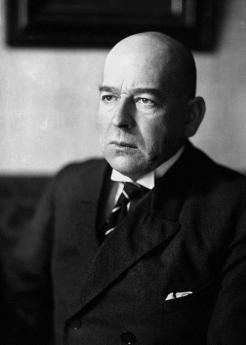
Spengler

Oswald Spengler

Oswald Spengler’s The Decline of the West as well as McGilchrist characterize the West as awash in phenomena associated with an extreme LH emphasis. Spengler argues that Western civilization was originally much more RH (to use McGilchrist’s categories) and that all its most significant artistic (in the broadest sense) achievements were triumphs of RH accentuation.

The RH is where novel experiences and the anomalous are processed and where mathematical, and other, problems are solved. The RH is involved with the natural, the unfamiliar, the unique, emotions, the embodied, music, humor, understanding intonation and emotional nuance of speech, the metaphorical, nuance, and social relations. It has very little speech, but the RH is necessary for processing all the nonlinguistic aspects of speaking, including body language. Understanding what someone means by vocal inflection and facial expressions is an intuitive RH process rather than explicit.

Though communication exists between the two hemispheres, there is a fairly high degree of independence and needs to be. Awareness of context or extraneous background sounds can interfere with focus. Getting lost in specifics can harm a sense of the big picture. Making RH intuitive processes explicit can actually harm, slow them down or even destroy them. A joke explained is no longer funny. A metaphor spelled out can no longer function. The gestural aspect of speech (RH) if made conscious is merely distracting. Self-consciousness (LH) interferes with “flow” and public speaking. Processes like going to sleep involve letting go. We fall asleep, but wake up, having control over, rising above your feelings. Having a name on the tip of your tongue is more likely to be recalled if you stop focusing on it. Shortly before executing a jump in figure skating, breaking a board in karate, shooting at a target, thinking must cease. Happiness is best achieved indirectly not explicitly.

RH is very much the center of lived experience; of the life world with all its depth and richness. The RH is “the master” from the title of McGilchrist’s book. The LH ought to be no more than the emissary; the valued servant of the RH. However, in the last few centuries, the LH, which has tyrannical tendencies, has tried to become the master. The LH is where the ego is predominantly located. In split brain patients where the LH and the RH are surgically divided (this is done sometimes in the case of epileptic patients) one hand will sometimes fight with the other. In one man’s case, one hand would reach out to hug his wife while the other pushed her away. One hand reached for one shirt, the other another shirt. Or a patient will be driving a car and one hand will try to turn the steering wheel in the opposite direction. In these cases, the “naughty” hand is usually the left hand (RH), while the patient tends to identify herself with the right hand governed by the LH. The two hemispheres have quite different personalities.

The connection between LH and ego can also be seen in the fact that the LH is competitive, contentious, and agonistic. It wants to win. It is the part of you that hates to lose arguments.

Using the metaphor of Mystery and Order, the RH deals with Mystery – the unknown, the unfamiliar, the implicit, the emotional, the dark, danger, the chaotic. The LH is connected with Order – the known, the familiar, the rule-driven, the explicit, and light of day. Learning something means to take something unfamiliar and making it familiar. Since the RH deals with the novel, it is the problem-solving part. Once understood, the results are dealt with by the LH. When learning a new piece on the piano, the RH is involved. Once mastered, the result becomes a LH affair. The muscle memory developed by repetition is processed by the LH. If errors are made, the activity returns to the RH to figure out what went wrong; the activity is repeated until the correct muscle memory is developed in which case it becomes part of the familiar LH.

Science is an attempt to find Order. It would not be necessary if people lived in an entirely orderly, explicit, known world. The lived context of science implies Mystery. Theories are reductive and simplifying and help to pick out salient features of a phenomenon. They are always partial truths, though some are more partial than others. The alternative to a certain level of reductionism or partialness would be to simply reproduce the world which of course would be both impossible and unproductive. The test for whether a theory is sufficiently non-partial is whether it is fit for purpose and whether it contributes to human flourishing.

Eye and the world

The LH looks for and finds order in the flux of experience. In reality, every person is slightly different and every experience is unique. The 100th time something is done is different from the 99th. In order not to just get lost in Mystery, the LH uses categories and applies them across experience. While focusing on the repetitive aspects of experience can be useful, too much LH and Order is boring – resulting in the feeling “been there, done that.”

Analytic philosophers pride themselves on trying to do away with vagueness. To do so, they tend to jettison context which cannot be brought into fine focus. However, in order to understand things and discern their meaning, it is necessary to have the big picture, the overview, as well as the details. There is no point in having details if the subject does not know what they are details of. Such philosophers also tend to leave themselves out of the picture even when what they are thinking about has reflexive implications. John Locke, for instance, tried to banish the RH from reality. All phenomena having to do with subjective experience he deemed unreal and once remarked about metaphors, a RH phenomenon, that they are “perfect cheats.” Analytic philosophers tend to check the logic of the words on the page and not to think about what those words might say about them. The trick is for them to recognize that they and their theories, which exist in minds, are part of reality too.

The RH test for whether someone actually believes something can be found by examining his actions. If he finds that he must regard his own actions as free, and, in order to get along with other people, must also attribute free will to them and treat them as free agents, then he effectively believes in free will – no matter his LH theoretical commitments.

By trying to emulate the explicit formulations of science, analytic philosophy effectively excludes from its purview and thus from its conception of reality, all RH phenomena. By focusing only on what can be made explicit and what can be put into words using them literally, they distort reality. This happens even in their discussion of consciousness.

The philosopher Martin Heidegger tried to describe the human condition, how humans are in the world, in a more RH way. He invented the term “Dasein,” which is described as Being-in-the-world.[2] We have a dim apprehension of the situations or contexts in which activities are undertaken. We are building a house, meeting a friend, sick of our lives, bored, relaxed, anxious, etc.. Each RH feeling or purpose reveals the world in different ways, foregrounding some things out of the infinite complexity of background. The RH determines what the LH sees. One person experiences X as a friend, another as a son, another as a student, another as a mechanic. Each experience is legitimate and none is comprehensive.

Heidegger

Martin Heidegger

Heidegger described people as always, already in the world. The World is the largest conception one might have of context. It is pre-theoretical and implicit. We find ourselves in the world and then try to make sense of it. We are in the world and then proceed to have theories about it. We do not and cannot prove the external world exists as a theoretical matter.

Most of our interaction with the world is precognitive. When we learn a skill (anomalous at the time it is learned) we have to learn it consciously (RH). Once acquired, the skill becomes LH – the known, the familiar, the routine. Colin Wilson calls this “the robot.” By that he means all activities that can be undertaken without the necessity of conscious thought, such as driving a car in non-difficult conditions. Driving a car is not entirely unconscious, but neither is it very conscious.

We demonstrate that we know what a hammer is, what it means, by stretching out a hand and hammering with it. Only if it breaks do we look at it and think about it. The hammer is “ready-at-hand,” and then “present-at-hand” if it breaks.

From a RH perspective, to understand a hammer is to understand what it means; its function. Since meaning is a matter of connections to context, the thing to be studied must be carefully placed in its appropriate context rather than being studied in isolation. Just analyzing the wood and metal used to construct the hammer, which would be a LH approach, is not to understand its meaning. The exact materials, so long as they are fit for purpose, do not really matter.

To understand the hammer it is necessary to look at in relation to the tool users who employ it, then to recognize that it points to nails and boards and then to the items constructed out of them. These matters of context are understood dimly via the RH and not at all by the LH. The ultimate meaning might be to build a house; to provide shelter for people.

Dasein is in the world concernfully. How the world is going for it, matters to Dasein. Dasein is not an object to be fully seen and understood. It reaches into the past and imagines alternative futures. It is a clearing in the forest where things get revealed. It is also “Being-toward-death.”

For Aristotle, passive nous (mind) is the great sweep of perceptions cascading over us. Active nous (LH) involves focusing on some elements and not others, partly to avoid confusion and partly to avoid sensory overload. We do not want to be constantly thinking about persistent but unimportant sensations like the feel of the shirt on our backs, etc..

Attempting to understand consciousness by focusing only on the LH will omit everything connected to the RH. All such accounts tend to say nothing about music, humor, intuition, context, the metaphorical, emotion, emotional nuance of language, the unique and individual, social connection, and meaning.

Having a stroke in the RH means having to make do with the LH. Without the ability to deal with gestalts, the LH is forced to identify a person by single attributes, like a nose, or mouth, or haircut. Normal people recognize someone using the RH which has a broader focus and can see wholes. RH also deals with the unique – which is necessary to tell one person from another. RH perception takes multiple factors into account, including how a person moves. It provides fewer details, but it can see the forest for the trees.

LH accounts of consciousness tend only to include what can be seen by the LH. Unless a person is autistic, these accounts will therefore not correspond very well to our actual experience of consciousness. They will be exceedingly partial and incomplete, focusing only on what is explicit and can be articulated clearly.

A lot of moving through the world is non-linguistic. Animals reason and problem-solve non-linguistically and we do too, much of the time.

It is possible in experiments to cause each hemisphere in turn to cease to function using magnetism – brains are electro-magnetic at some level and this can be manipulated. In one experiment, subjects were given the following syllogism:

All monkeys climb trees.
Porcupines are monkeys.
Therefore, porcupines climb trees.[3]

When the RH is functioning subjects reject the argument as unsound since the second premise is false. The argument is recognized as technically valid – the premises if true would guarantee the truth of the conclusion – but that is all.

When only the LH was working, subjects accepted the argument as legitimate. When asked – but what about the second premise?, subjects acknowledged that it was false, but accepted it anyway saying “but it says here…”

The LH tends to accept a coherence theory of truth and knowledge – do beliefs create a self-consistent system? The RH embraces a correspondence theory of truth and knowledge – do beliefs actually match reality? (lived experience). Since we tend to move in social circles that are not simply random cross-sections of society generalizations based in RH experience sometimes need to be corrected by LH empirically gathered data. On the other hand, LH theory can be heavily ideologically driven, such as ideas about men and women, that are contradicted by actual experience. That’s when the coherence theory of truth is so dangerous because it is immune to correction.

The trouble with system-creation is that intellectual systems try to provide an answer for everything. This is a power-grab by the LH – making theory primary and comprehensive. It effectively claims omniscience via self-referential abstractions. Reality, however, includes a high degree of flux and process. Heraclitus’ aphorisms capture this well. “It is not possible to step into the same river twice,” he wrote. This is because man is in a constant state of change and with its flowing water, so is the river. There is a Logos that provides order to things so that things are not merely chaotic, but that order is better captured by the metaphor of the organic and the organic is wet, flexible, goal-directed, growing and changing. And it is the RH that deals with living things.

Heraclitus

Heraclitus

In the past, the universe and the world were thought of as alive and ensouled. The word “cosmos” refers to a harmonious well-ordered whole which has pleasant home-like connotations. The tendency since the scientific revolution has been to substitute the organic metaphor for the mechanical and metaphors tend to determine what is perceived.[4]

A LH mode of thought concerning free will or the existence of telepathy might be to reject them both on the grounds that – “I don’t see how that is possible,” i.e., they might seem to contradict the thinker’s materialistic metaphysics. The RH response is to focus on the actual evidence and let the data determine the theory. The appropriate modus operandi is to start with RH perception, perhaps modify those perceptions after pondering them (LH), and then return to RH experience.

For instance, someone is looking into the distance. Another person comments that the lights are beautiful. The first person alters his attention and focus slightly and he notices the beauty of the lights. Beauty is perceived but perception can be modified by thought. Likewise little children and even some animals perceive injustice (RH) at least when it concerns themselves. This perception can be modified by thought and theory (LH) – not always for the better. The result can be a permanent alteration in perception. However, attempts to generate morality through moral theories like utilitarianism do not work. The LH is analytic, not generative.

We do not know the origin of life. We do not know how or even if consciousness can emerge from matter. We do not know the nature of 96% of the matter of the universe. Clearly all these things exist. They can provide the subject matter of theories but they continue to exist as theorizing ceases or theories change. Not knowing how something is possible is irrelevant to its actual existence. An inability to explain something is ultimately neither here nor there.

If thought begins and ends with the LH, then thinking has no content – content being provided by experience (RH), and skepticism and nihilism ensue. The LH spins its wheels self-referentially, never referring back to experience. Theory assumes such primacy that it will simply outlaw experiences and data inconsistent with it; a profoundly wrong-headed approach.

Zamyatin, Gödel, Turing and Keats

Gödel’s Theorem proves that not everything true can be proven to be true. This means there is an ineradicable role for faith, hope and intuition in every moderately complex human intellectual endeavor. There is no one set of consistent axioms from which all other truths can be derived.

Godel and Einstein

Gödel and Einstein

Alan Turing’s proof of the halting problem proves that there is no effective procedure for finding effective procedures. Without a mechanical decision procedure, (LH), when it comes to moderately complex matters, intuition and insight will be required. (RH)

Axioms must retain a tentative, provisional, hypothetical nature ready to be discarded if they are contradicted by further evidence.

What is very significant about Gödel and Turing is that they provide certainty about the irreducible nature of uncertainty. In other words, they provide definitive proof once and for all of the limitations of LH thinking. They demonstrate to what should be to the satisfaction of even the most die-hard LH rationalistic reductionist and skeptic that the RH cannot be dispensed with. It is simply not possible have everything in the clear light of day; dry, proven, known, and nailed down. Thinking is not merely computation.

Intuition, the context of lived experience, being always already in the world, emotion, metaphor, humor, irony, and all the other things associated with the right hemisphere of the human brain are here to stay. The left hemisphere’s love of logic, mechanism, clarity and certainty must be tempered by the right hemisphere’s tolerance for ambiguity, uncertainty, and the organic. The fantasy of an omniscient science should be extinct.

A liberating character in Yevgeny Zamyatin’s dystopian novel We, chastising the benighted LH dominated mathematician in a horrible LH culture, says “Oh come on – knowledge! This knowledge of yours is utter cowardice. Yes, that’s it – really. You just want to build a little wall around infinity – and you’re afraid to look behind it.”[5] The One State tames a wild zigzag into a straight line – “a great, divine, precise, wise, straight line – the wisest of lines.” The result of “integrating the grand equation of the universe.”[6] The main character, D-503, writes: “I personally do not see anything beautiful in flowers and the same goes for everything that belongs to the wild world…Only the rational and the useful are beautiful: machines, boots, formulas, food, etc..”[7] Zamyatin demonstrates an exact understanding of the LH attitude and its limitations.

The LH has a tendency to turn the known world; the comprehensible, into the world; outlawing the transcendent and infinite – that, as D-503 writes, which is incapable of being encompassed by an equation.

John Keats

John Keats

The Romantic poet John Keats became frustrated by fellow poet Samuel Coleridge’s desire for definitive answers and wrote in a letter to his brothers, George and Thomas;

Several things dovetailed in my mind, and at once it struck me, what quality went to form a Man of Achievement especially in Literature and which Shakespeare possessed so enormously — I mean Negative Capability, that is when man is capable of being in uncertainties, Mysteries, doubts, without any irritable reaching after fact & reason — Coleridge, for instance, would let go by a fine isolated verisimilitude caught from the Penetralium of mystery, from being incapable of remaining content with half knowledge. This pursued through Volumes would perhaps take us no further than this, that with a great poet the sense of Beauty overcomes every other consideration, or rather obliterates all consideration.

Facts are in a sense dead. Facts exist in the clear light of day. They are in the realm of Order which represents the familiar, the known, the robotic, and thus, the boring.

The point of intensest life and interest occurs at the dividing line between Mystery and Order. Creativity and discovery, philosophical, scientific and artistic, emerge from a state of wonder; neither being overwhelmed by infinity and the darkness of Mystery which would be fatal, nor insisting on the certainty of facts already known of Order. Scientific discoveries tend to come by accident. A scientist asks a question and in the process of trying to answer it, answers another question. Since practitioners do and theoreticians write, the role of theory and reason gets exaggerated in histories of discovery. Most scientific advances come through chance, and trial and error. Trial and error involve Keats’ description of negative capability. The experimenter can have tentative hypotheses or intuitions but if he imagines that he already knows the outcome or insists on particular and foreordained results his research ceases.

Creativity has a tentative quality with no guaranteed outcome. There is an understandable desire to find the formula for creativity – rote instructions for writing the perfect novel might seem nice – but formulas and rote instructions are the opposite of creativity. Certainty and creativity are simply incompatible. There can be no creation machine. Creativity is more aligned with the organic, living, and “wet.” It is permeated by mystery and the dark.

Data from Star Trek

“Data” from Star Trek Next Generation

It is hard not to fantasize about a Star Trek Next Generation future where all drugs, for instance, will be designer drugs and scientific discovery loses its haphazard guesswork and tentativeness.[8] Just one or two designer drugs, AZT being the prime example, have ever been created. The metaphor of Mystery and Order demonstrates why this will never change. Such “directed” research rests too heavily on what is already known or thought to be known; leaving no room for what is not already understood.

Jet engines, for instance, were developed by tinkering. The theory of how they work came later.


How to kill a research program

The following indicative story is from chapter four of John Gall’s The Systems Bible.[9] The story is fictional, but the scenario is all too familiar. It demonstrates how LH desires for clarity and explicitness in the name of accountability and efficiency, and the creation of complex systems can actually neutralize and ruin research programs.

Gall imagines Lionel Trillium, a shy young man whose questions about human reproduction went unanswered as a child and who developed instead an interest in the reproductive cycle of plants. He has been a moderately successful junior professor of biology with ongoing research programs.

His head of department, Baneberry, on the other hand, has been unproductive for years. He picks up a book about management and is struck with excitement. He will reorganize his department in a way calculated to boost productivity and efficiency. The administration greets this idea with enthusiasm. The plan is to get the other members of the department to write down their research objectives for the year. Their success or failure will then be judged according to the criteria that the faculty members themselves have provided. Baneberry will be able to hold them to account for any difference between what they said they were going to do and what they actually did.

A side effect of this approach is that any research that does not match the stated research objectives will be counted as a failure and the professor will get no credit for it.

The news of this new policy horrifies Lionel and has a depressing effect. If Lionel were going to write anything down about his Goals and Objectives it would be “I love botany. Let me keep studying it.” However, this is clearly unacceptable.

John Gall

John Gall

The results of science might be nicely clear, logical and explicit but the method of reaching these results necessarily involves delving into the unknown and mysterious. Generating hypotheses to be tested is a matter of imagination, intuition informed by experience and creativity. One is reaching into the realm of Mystery – what is currently unknown – and trying to find a hitherto undiscovered Order. To do that, inspiration and insight are required.

Inspiration and insight are likely to be the product of enthusiasm and interest. In fact, many seemingly intractable problems in various fields are solved by someone with no vested interest in the field; just a passing, but genuine curiosity.

Productive creativity in any area is likely to be a combination of expertise, skills, prior knowledge and crucially, a temporary enthusiasm. By definition, temporary enthusiasms do not last. So it is important that a thinker pursues the interest while it exists and is at its keenest. Enthusiasm provides the needed grit not to stop as soon as things get difficult, promotes a joyful attitude and bolsters effort. Boredom and frustration are unlikely to help, whereas a certain relaxed playfulness might well assist.

There are inevitably some boring aspects to mastering something. The goal-driven nature of temporary enthusiasms means that these elements are likely to be better tolerated; simply subsumed within the larger sense of purpose.

It is the very nature of research that it is not possible to list Goals and Objectives in advance. Or rather, one might have Goals and Objectives but they must be provisional and change as research progresses. If the outcome of research were known in advance no research would be necessary. By definition, what one will discover is a mystery.

Since temporary enthusiasms are not predictable or possible to artificially generate, nor to know in advance what one will find, it is not possible to know what direction research will go in. There is simply no point in forcing someone to think about a problem that he has no interest in; not if the goal is to be creative.

We

Inspiration, creativity and temporary enthusiasms are killed by trying to systematize them. A system is akin to bureaucracy and in this case it is supposed to promote productivity and efficiency. Ironically, such a system is guaranteed to do the opposite and this is the case with nearly all systems. Systems are LH affairs.

A system is akin to an algorithm – a set procedure for producing predictable results. Systems arise in response to problems. There are several problems with this. One is that the problem the system is designed to remedy may not be the problem at hand. Another issue is that any problem the system cannot “see” is typically deemed not to exist. And finally complex systems produce unpredictable new problems of their own – often in exact opposition to the stated goal of the system.

If authors and musicians were forced to follow systems the results would be predictably awful, and it is the same for scientists.

This is not the same as setting certain times of day aside for attempts at productive effort. There is nothing wrong with being organized – in fact, that will be very helpful. Writing music or novels in the morning hours, for instance, might be a very good idea. But no algorithm exists to guarantee the result. Algorithms are also known as “mechanical decision procedures” and they are literally a mechanical, rule-governed step-by-step method for achieving specific results. E.g., long division. They are tools, but they are no more creative than the chisel of a sculptor, although the chisel in this case is a crucial instrument for the creative process.

The National Institute of Health (NIH) takes nearly every productive scientist interested in cancer research and inserts them into a giant bureaucracy crammed filled with rules and regulations, research grant applications, Goals and Objectives, and effectively neutralizes these scientists by killing any spontaneity, such as temporary enthusiasms and unpredictable results. Research projects will have to be approved by committees and then funding for that goal and only that goal will be provided. Famously, the NIH tested 40,000 substances to see if they had any cancer fighting properties. None did. Zero. The amount of time and money wasted on this enterprise was stupefying. A machine-like uninspired mindless approach simply failed.

One reason that research in the private sphere is much more productive than government funded R & D is that companies are interested in making money. They are less filled with layers and layers of bureaucracy each one being accountable to the next. Viagra was discovered during research into blood pressure medicine. Erections were an unexpected side effect and initially treated as a problem. By remaining flexible and open-minded and not locked into stated Goals and Objectives, the company decided this side-effect could actually be the new product and Viagra was born. This kind of happy accident is actually the norm.

Lionel Trillium is in the impossible situation of trying to guess what he will be interested in in the future. He desperately does not want to write anything down. By getting Lionel to write down his Goals and Objectives, Baneberry is actually neutralizing Lionel and ensuring that only a pitiful trickle of probably uninspired research will result.

If the rather timorous Lionel dares try to complain to Baneberry or Baneberry’s superiors, Baneberry can respond that he, Baneberry, did not decide on the Goals and Objectives. It was Lionel himself who proposed them so Lionel has no right to complain. Lionel is not being forced to do anything that he did not want to do. Except this is a lie. Lionel was compelled to predict a future that is unpredictable and then compelled again to abide by what he wrote.

The European Union provides money for research and development. Scientists are supposed to outline research programs projected two years into the future. An engineer friend of mine told me that he would be asked to apply for such grants and then had to try to retrofit what he actually discovered or invented to what he said he was going to do. He now refuses to apply. Government funded R & D is immensely counterproductive for this reason; particularly because it tends to target previously successful scientists – the ones that had been doing just fine without government grants – and shut them down.

None of this contradicts the notion that innovation is 99% perspiration, 1% inspiration. Enthusiasm means someone is self-motivated and likely to work harder than could reasonably be expected by a supervisor. Supervision is expensive – supervisors are usually paid more than the people of whom they are in charge. A self-reliant employee is a cheaper and more productive one. A lot of hard work mastering aspects of a field of study is usually going to be required for any breakthrough of insight. However, when it comes to creativity, mere effort is insufficient. Scientists must come up with hypotheses to test and there is no algorithm for that.

Dan Ariely

Dan Ariely

Dan Ariely, who is particularly good at asking questions and then devising experimental methods for answering them, proved this in a series of experiments outlined in The Upside of Irrationality. He found that offering incentives such as paying someone more for an activity works best when the work being done is mechanical and involves sheer physical effort. If someone is asked to do as many jumping jacks as he can in one minute, paying him a hundred dollars might mean he squeezes out a couple more. If, however, someone is asked to paint a beautiful picture for one thousand dollars and then after it is completed, two thousand dollars is offered for a more beautiful picture, the chances are the artist will be unable to comply. Or, imagine a particular form of surgery has a 4% chance of complications – will paying the surgeon five million dollars above his usual fee for a successful outcome lower that percentage? Might his hands begin to shake, his forehead perspire and similarly unproductive things result? Would he not already being doing his best? Will asking someone to solve a puzzle faster by paying him more be likely to work? Unlike physical effort, these things are not directly in someone’s control. That is why paying a child to read a book makes more sense than paying him to get an “A” on an assignment, although such payments might have other unintended negative consequences.

[1] Oswald Spengler makes a connection between visual depth of field; space, and the spiritual and transcendent. Mystical experience is RH, as is experience in general. LH analysis can help make sense of the experience or parse its meaning, but there is a reason that excessive rationalism and the atheistic tend to go together.

[2] Calling Dasein “the human,” is misleading because it reduces what it is to be to biological terms. A human being is just one very limited way of referring to Dasein.

[3] The Russians who did this experiment did not know that some kinds of porcupines really do climb trees, so it is necessary to ignore this inconvenient fact!

[4] Interestingly, women scientists tend to gravitate to the living and organic; inclined to major in biology and veterinary science rather than physics.

[5] Zamyatin, Yevgeny, We, Modern Library, 2006, p. 37.

[6] Zamyatin, Yevgeny, We, Modern Library, 2006, p. 4.

[7] Ibid, p. 44.

[8]Although STNG contains elements of Order, the Enterprises’ mission is explicitly exploratory. The drama of the stories exists only through encountering the unknown and unexpected with the constant threat of annihilation. The figure of the android “Data” also centers around the mystery of what it is to be human.

[9] General Semantics Press, 2002.

20 thoughts on “Mystery and Order; the right and left hemispheres”

  1. Pingback: Chaos and Order; the right and left hemispheres | @the_arv
  2. Pingback: Chaos and Order; the right and left hemispheres | Reaction Times
  3. How familiar are you with the original research behind the claims of LH/RH brain activity emphasis and personality differences?

    It’s my understanding that they’re based on shoddy data and execrable methodology and have never managed to be replicated, but I admit freely it’s not my field.

    • Re: Rhetocrates: My understanding is that is not true. There was at one point some fluffy New Agey garbage on the topic, I think. But that situation has been rectified. Regardless of the biology, the different approaches to thinking and attitudes to life I am painfully aware of having multiple degrees in philosophy – one BA, two MAs and a PhD. I can confirm that what is being referred to as “LH” is a very real phenomenon, whether it turns out to be LH or not – unfortunately! My preference would be that it would be only the result of a fevered imagination! If you read the novel “We” you can get an idea of the flavor of autistic style thinking if you are lucky enough to be unfamiliar with it. Lucky you if you are.

  4. Odd that I’m left-handed but also seem to be one of the most “left hemisphere” of the Orthosphere writers. When I was a kid, I heard that left-handers were supposed to be creative but bad at math. (As you point out in your article, mathematics is itself a very creative enterprise, but this was not widely appreciated. Presumably they meant that lefties are bad at calculating.) I absolutely love math but admit that I’m not especially good at it; I’m still waiting for my creativity to manifest itself. I suppose it’s possible that the hemisphere that dominates in cognitive areas may not be the one that dominates in motor areas.

    Let’s take a poll. Any other lefties here?

    • Hi, Bonald: There is a good chance that your brain is organized the same as us righties or that it is just inverted (sideways, not upside down!). From “The Master and His Emissary:

      In the 11 per cent, who are broadly left-handed, there will be
      variable conformations, which logically must follow one of three patterns:
      the standard pattern, a simple inversion of the standard pattern, or some
      rearrangement. The majority (about 75 per cent) of this 11 per cent still
      have their speech centres in the left hemisphere, and would appear to
      follow broadly the standard pattern. It is, therefore, only about 5 per cent
      of the population overall who are known not to lateralise for speech in the
      left hemisphere. Of these some might have a simple inversion of the
      hemispheres, with everything that normally happens in the right
      hemisphere happening in the left, and vice versa; there is little significance
      in this, from the point of view of this book, except that throughout one would
      have to read ‘right’ for ‘left’, and ‘left’ for ‘right’. It is only the third group who,
      it has been posited, may be truly different in their cerebral organisation: a
      subset of left-handers, as well as some people with other conditions,
      irrespective of handedness, such as, probably, schizophrenia and
      dyslexia, and possibly conditions such as schizotypy, some forms of
      autism, Asperger’s syndrome and some ‘savant’ conditions, who may have
      a partial inversion of the standard pattern, leading to brain functions being
      lateralised in unconventional combinations. For them the normal
      partitioning of functions breaks down.

    • I’m not a lefty, but I’ve noticed that among the best engineers I’ve been acquainted with, a disproportionate number are lefties.

  5. Richard: Concerning your invocation of Oswald Spengler…

    In The Decline, Vol. II in the chapter on “Peoples, Races, and Tongues” (which I happen currently to be re-reading for the nth time), Spengler, as elsewhere, distinguishes between the “cosmic-plantlike side of life,” the “destiny [of which] is determined by… the bodily succession of parents and children, the bond of the blood,” and the “tendency to take root in a landscape,” from “waking -consciousness,” which expresses itself in language, such that there are “currents of being and linkages of waking-being.” The first, the “cosmic-plantlike side of life,” resembles Edmund Husserl’s Lebenswelt and Heidegger’s Dasein. It is the pre-given, the background-environment, against which, and only against which, the subject becomes aware of itself as, precisely, a thematic self-consciousness. The second, the “waking-consciousness,” would correspond to Heidegger’s “thrownness,” and it expresses itself, Spengler writes, through propositional language. From the parent-child succession and from living for generations in a particular place, arises “Race,” which is nearly synonymous with Lebenswelt or Dasein in Spengler’s usage. Spengler writes: “Race is something cosmic and psychic (Seelenhaft), periodic in some obscure way, and in its inner nature partly conditioned by major astronomical relations.” But “waking-consciousness,” on the other hand, expressing itself through the prescriptions of language, partakes in “causal forms,” that is, in syntax, grammar, and correct idiom. “To Race,” writes the Munich realist, “belong the deepest meanings of the words ‘time’ and ‘yearning’; to language those of the words ‘space’ and ‘fear.’”

    Spengler’s “cosmic-plantlike” seems to me to correspond with what your essay calls the Right Brain; his “waking-consciousness” with what your essay calls the Left Brain. Or at any rate the Right Brain is the organ — or faculty — that attunes the subject cosmically, and the Left Brain is the organ — or — faculty that puts the ego in rational communication with other egos.

    I could easily find other passages in The Decline apposite to your topic, especially in Vol. I, in the first three chapters, but the items that I quote above give the flavor of Spengler’s anticipation of the Right-Brain/Left-Brain idea.

  6. Pingback: Sam Harris: The Unconverted | S y d n e y T r a d s
  7. Profoundly interesting read. This idea of how the brain has evolved its two hemispheres to cope with the reality (or meta-reality) of chaos and order in the world is a fascinating concept.

    • Thanks, Nicolas Helssen. I should give credit, of course, to Iain McGilchrist and a bit to Jordan Peterson. But McGilchrist’s work, I find articulates some of the issues I had with my degrees in philosophy. I always had a sympathy and intuitive understanding of the RH that was simply rejected by my professors. To read such a good defense of the vague and hard to articulate aspects of human existence I found really rewarding.

  8. Pingback: AI and the Dehumanization of Man – The Orthosphere
  9. Pingback: Tit for Tat – The Orthosphere
  10. Thank you for your interesting article. It left me with a question. In process of left and right are we losing sight of the integrating the two parts, corpus callosum? Based on understanding we take action and that, I imagine, comes only after integration, or else we ponder and funnel! for ever seems to me.

    • Sorry forgot the click the notification email. I am curious as to your thoughts, please on the corpus callosum? Where it all happens, Thanks much for enlightening us.

    • Hi, Nader: Our consciousness will always be a fusion of the two hemispheres – unless there is some organic thing wrong involving surgery or a stroke, etc. I guess I’m less interested and not really knowledgeable about the physiological mechanics of how it is accomplished. More about the interplay between the two modes of relating the world and integrated they need to be. Sorry I can’t be more helpful.

  11. Pingback: Sam Harris: The Unconverted – Sydney Trads

Comment

This site uses Akismet to reduce spam. Learn how your comment data is processed.

Be Serious

Taken from https://meetingthemasters.blogspot.com/2021/04/be-serious.html

The modern world is fundamentally superficial. I am not simply talking about the childish obsession of many adults with an ever more degraded popular culture, and nor do I just refer to the ordinary person though I include him. I am talking about present day thinkers, the intellectual class, the movers and shakers in all areas of life. Hardly any of these people are really serious. They are just playing games, more concerned with power, fame, money and influence than truth.

A serious person thinks about life and death and grapples with what those might mean because the meaning of death is directly related to the meaning of life. If you say that death has no meaning, it’s just the end, curtains, goodbye, then you have washed your hands of spiritual responsibility. You have trivialised life because you have denied death, and, yes, you have denied it because you have reduced it to nothing and you can only do that by rejecting what it is to be human. For a human being is like an iceberg though with this important difference. It’s an upside down iceberg with the perceived part the lowest part and the hidden part, which nevertheless supports the whole, stretching up above and beyond what is seen and known. The boundary between the two can be melted occasionally in life but is only fully crossed at death.

Human beings come into this world because, unlike in the spiritual domain from whence we derive, we do not know God directly here. We have to find him. We have to choose him. Everything in nature obeys God’s laws automatically except man. We have a natural part which does obey as it must but a human being is also a person so there is necessity but there is also freedom. God has renounced his supreme power to give us some power and he has done so because of love in which there can be no compulsion.

There are fewer and fewer serious people these days, people really willing to think for themselves and look life squarely in the face. We are too distracted by phenomena and the shiny trinkets of modern technology to try to understand what a human being really is. Some people do seek a spiritual answer but the fact is not all forms of spirituality are equally valid. There are some forms that seek to reduce human beings purely to a kind of naked spirit, void of form and individuality. But this is a return to our origins without having learnt the lessons of creation and the material world, and if God had wanted this for us he would never have bothered sending us out into this world, separated from him in order to find him again and know him consciously for who and what he is. There is a higher form of spirituality which includes the spiritual and the individual and the fruits of this are love and creativity, something that pure spirit does not know. For the love that advocates of the pure spirit path talk of is not really this spiritual love at all. They have borrowed the concept from theistic religion while rejecting what makes it possible. Their love is impersonal but impersonal love is a contradiction in terms. God’s love is not impersonal and directed equally to everything. He loves more what opens itself more fully to his love and reflects it back.

As the world progresses further and further into what is effectively chaos it is critical that people become serious. Don’t accept what you are told by authority without submitting it to a thorough intuitive assessment. Even if everyone you know goes along with the agenda that is no reason for you to follow. Hold up everything you are told to the truth of Christ and see whether it stands or falls in that light. The time is coming when Christ will be the only serious thing left.
